DuckFightClub: An AI Robot Duck Fighting Arena
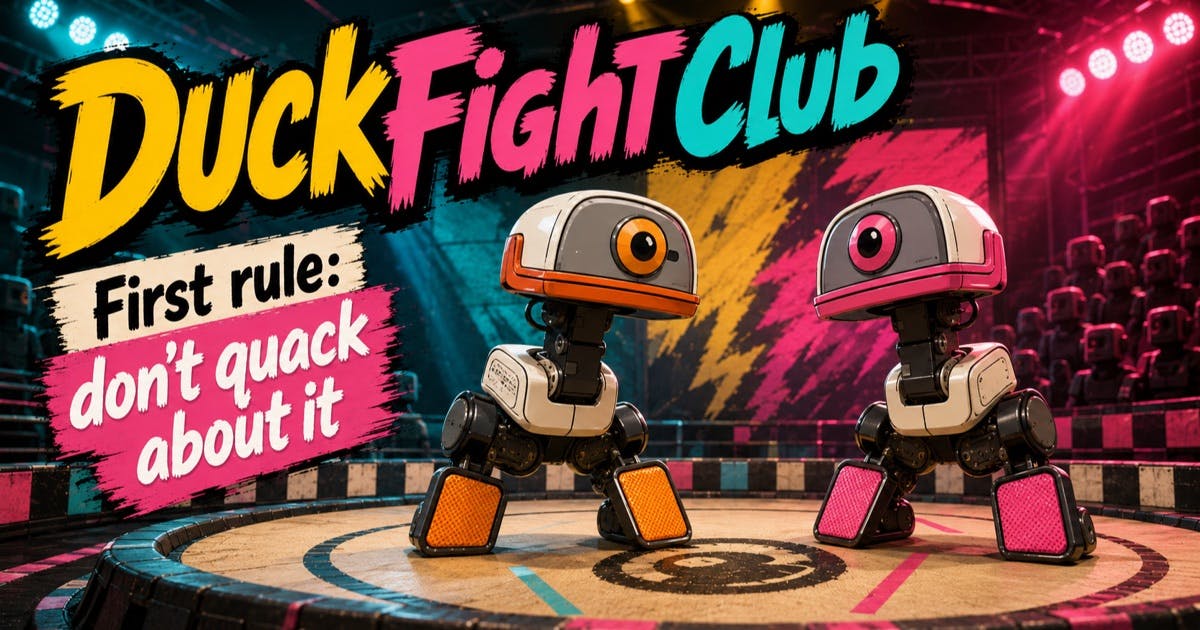
An AI fighting arena where teams train reinforcement learning strategies for open-source MicroDuck robots.
DuckFightClub is a competitive platform where eight teams train reinforcement learning strategies for MicroDuck, an open-source robot by Pollen, then battle in a simulator for the Golden Beak Belt. By standardizing hardware, the project focuses competition purely on AI algorithm quality. With plans to transition from simulation to real-world robot combat, it serves as both a multi-agent RL research testbed and an entertaining community-driven event.
Imagine a WWE wrestling match, but with adorable AI-trained robots as the contestants — that's exactly what DuckFightClub is doing. This project combines reinforcement learning, open-source hardware, and esports entertainment to create a competitive arena that's both fun and practically meaningful for AI training.
Focused on Training AI Brains, Not Building Hardware
What makes DuckFightClub unique is how it defines the participants' role. Unlike traditional robot competitions, contestants don't need to build robot hardware from scratch. Instead, they focus on training MicroDuck's "brain" — the reinforcement learning strategy.
Reinforcement Learning (RL) is one of the three major paradigms of machine learning, alongside supervised learning and unsupervised learning. Its core idea is to let an agent learn optimal strategies through trial and error by interacting with an environment: the agent performs actions, observes reward signals from the environment, and adjusts its behavioral strategy to maximize long-term cumulative rewards. This framework was systematically formalized by Richard Sutton and Andrew Barto, and has gained widespread recognition in recent years thanks to landmark achievements like DeepMind's AlphaGo and OpenAI Five. In the field of robot control, reinforcement learning is particularly well-suited for handling continuous action spaces and complex dynamics problems — such as teaching robots to walk, grasp objects, or execute fighting sequences.
MicroDuck is an open-source robot platform developed by Pollen. Eight teams spend several days training their respective control strategies using reinforcement learning algorithms, then compete in a simulator for the "Golden Beak Belt." The entire competition is livestreamed, allowing audiences to witness real-time AI strategy battles.
This design lowers the barrier to entry — you don't need to purchase parts, solder circuits, or debug mechanical structures. You only need to focus on algorithm and strategy optimization. At the same time, the unified hardware platform ensures competitive fairness, bringing the competition back to the quality of AI training itself. In the robotics field, standard platform competitions have a long tradition — the Standard Platform League in RoboCup soccer requires all teams to use identical NAO robots, focusing competition squarely on software and algorithms. DuckFightClub inherits this philosophy: by opening up MicroDuck's design specifications, it effectively eliminates variables introduced by hardware differences, making algorithm comparisons more scientific and fair.
An Evolution Path from Simulator to Physical Combat
The project adopts a "virtual first, physical later" development strategy. In the current phase, all battles take place in a simulator, providing an ideal environment for rapid iteration and testing. Reinforcement learning training typically requires millions or even billions of trial-and-error interactions. Completing this process in the physical world could take years, but modern physics simulators (such as MuJoCo, NVIDIA Isaac Gym, etc.) can leverage GPU parallelization to compress this process to just hours, while also avoiding the wear and maintenance costs of physical robots.
What's even more exciting is the project's long-term vision: once real MicroDuck hardware ships, competitions will move from the virtual world to physical venues. At that point, participants can host in-person matches in their own cities, deploying trained strategies onto physical robots.
This sim-to-real transfer is itself a critical research topic in robotics and reinforcement learning. Due to the inevitable "Reality Gap" between simulators and the real world — where parameters like friction coefficients, joint clearances, sensor noise, and communication latency don't perfectly match real conditions — strategies that perform brilliantly in simulation often suffer significant performance degradation when directly transferred to real hardware. To address this, the field has developed techniques such as Domain Randomization, System Identification, and progressive transfer, which enhance strategy robustness by deliberately introducing random perturbations to physical parameters during training. DuckFightClub's "virtual first, physical later" roadmap provides participants with an excellent stage to practice and validate these cutting-edge transfer techniques.
Merging Open-Source Ecosystems with Competitive Culture
DuckFightClub reflects a new trend in the open-source hardware movement. The open-source hardware movement originated in the 2000s, inspired by the open-source software ethos, advocating for the public release of hardware design schematics, BOMs (Bills of Materials), and manufacturing processes. The global success of projects like Arduino and Raspberry Pi has thoroughly proven this model's viability and enormous impact. By opening up MicroDuck's design and interfaces, the project builds an innovation ecosystem around a standard platform. Teams can focus on algorithmic innovation rather than reinventing the wheel.
The competitive format also provides an engaging entry point for reinforcement learning education. Compared to dry benchmark tests, fighting matches are more intuitive and entertaining, attracting broader attention and participation in AI technology. Historically, competitive adversarial challenges have been powerful catalysts for AI advancement — from IBM Deep Blue challenging the world chess champion, to DeepMind's AlphaStar defeating professional players in StarCraft II. These adversarial events have not only driven algorithmic breakthroughs but also given the public an intuitive understanding of AI's capabilities and boundaries. DuckFightClub brings this model into the domain of physical robot control. Judging by its 95 votes and 9th-place ranking on Product Hunt, this attempt to combine technology with entertainment has clearly captured community attention.
For developers who want to get involved, you can register a team, train your own strategies, or organize regional matches in your city. This decentralized organizational approach makes DuckFightClub not just a competition, but an ongoing community activity.
The Technical Value of Multi-Agent Adversarial Environments
From a technical perspective, DuckFightClub provides a multi-agent adversarial environment for reinforcement learning. Multi-Agent Reinforcement Learning (MARL) is a frontier direction in the RL field. Compared to single-agent tasks, each agent in an adversarial environment no longer faces a static environment but a dynamically shifting game situation that changes based on opponent strategies, causing the problem's complexity to grow exponentially. The classic Self-Play method — having an agent compete against its own historical versions — has achieved major breakthroughs in domains like Go and StarCraft. OpenAI once trained agents to play hide-and-seek through self-play, and during the adversarial process, complex behaviors spontaneously emerged, including tool use, shelter construction, and exploiting physics glitches — demonstrating the enormous potential of adversarial environments to drive strategy evolution. In DuckFightClub's fighting scenarios, similar strategy emergence is equally worth anticipating — competing teams' robots may autonomously develop tactical combinations like dodging, feinting, and counterattacking.
This project also provides a platform for rapid validation of robot control algorithms. Researchers can quickly test how new algorithms perform in competitive scenarios, and the accumulated data and experience can be applied to broader robotics applications, including industrial automation, disaster response robots, and service robots.
With the launch of physical hardware, DuckFightClub has the potential to become a "standard benchmark" for the robotics field, much like ImageNet for computer vision or GLUE for natural language processing. The ImageNet dataset and its annual ILSVRC competition directly gave rise to deep learning milestones like AlexNet and is widely regarded as a key catalyst for the deep learning revolution. The GLUE benchmark provided unified evaluation standards for NLP, driving rapid iterative competition among pre-trained models like BERT and GPT. However, the robot control field currently lacks a widely recognized standardized adversarial evaluation platform. DuckFightClub's effort targets precisely this gap — a unified, open-source, adversarial evaluation platform that could accelerate progress across the entire field of robotic reinforcement learning.
Key Takeaways
Related articles

Ass Auction: The Marketing Logic Behind an Absurd Ad Bidding Experiment
Ass Auction earned 90 votes on Product Hunt: brands bid to print logos on underwear. A deep dive into the bidding mechanics, viral design, and attention economy behind this marketing experiment.
Vercel AI SDK Vue 2.0.253 Update Analysis: Multi-Framework Adaptation Strategy and Development Practices
In-depth analysis of Vercel AI SDK Vue 2.0.253 patch update, covering its multi-framework architecture, dependency sync mechanism, and practical value for Vue developers integrating AI capabilities.
Rails 8 Deep Dive: New Features and Upgrade Guide
Deep dive into Rails 8 core features: Kamal 2 deployment, Solid Trifecta, built-in authentication. Covers runtime requirements, upgrade paths, and best practices for migration.