AT&T's AI Sales Agent: Google Reveals an Enterprise-Grade Deployment Blueprint

Google and AT&T showcase a production AI sales Agent with persistent memory enabling cross-channel hyper-personalization.
Google partnered with AT&T to reveal an AI sales Agent system already in production, shifting from stateless interactions to persistent memory-driven experiences. Built on ADK and Gemini, the system maintains cross-session, cross-channel context enabling seamless user journeys across web, voice, and retail touchpoints. It achieves line-level hyper-personalization within family accounts and employs enterprise-grade security including DLP, red teaming, and MCP tool filtering.
From "Guessing" to "Remembering": A Paradigm Shift in AI Sales Agents
In a recent technical presentation, Google partnered with American telecom giant AT&T to reveal an AI sales agent system already running in production. This is no longer a lab-based concept demo—it's a real feature that ordinary AT&T users can experience today in the company's flagship app. The presenter summed up the system's core value in one sentence: "Our system has shifted from guessing to remembering—because we're calling upon verified facts that users have explicitly stated."
Behind this statement lies the most critical mindset shift in enterprise AI Agent deployment. Traditional customer service and sales systems are fundamentally "stateless": every interaction starts from scratch, forcing users to repeatedly explain their needs. This "stateless" nature stems from the design philosophy of HTTP itself—each request exists independently, and the server retains no information from previous interactions. While Session and Cookie mechanisms partially address this limitation, they typically only maintain state within a single session, with information lost once the session ends. AT&T's approach elevates state persistence to the "customer lifecycle" level, using persistent long-term context to ensure the Agent "always starts with information, never from zero." Technically, this requires building cross-session, cross-channel unified identity recognition and state management infrastructure—far more complex than traditional session management.
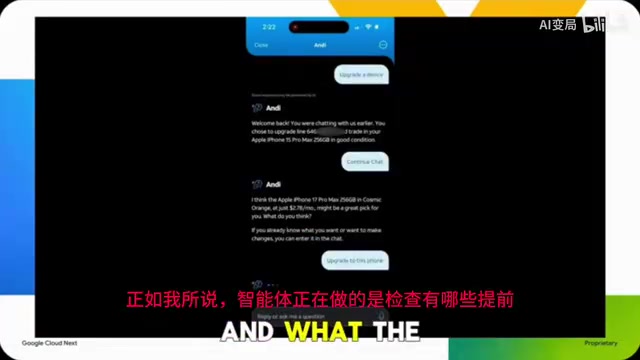
Cross-Channel Continuous Experience: A Real User Journey
The presentation included a highly compelling user journey case study worth referencing for any team building enterprise Agents.
Imagine a user visits AT&T via the web channel on "Day 1," expressing interest in trading in for an iPhone 16, but then drops off mid-journey—"life happens." On "Day 3," the same user connects again through a completely different channel (say, the IVR voice channel). IVR (Interactive Voice Response) is one of the most traditional customer service entry points in the telecom industry, where users dial a service number and interact with an automated system via keypad or voice commands. Traditional IVR systems are built around tree-structured menus, delivering rigid experiences with siloed information. Integrating an AI Agent into the IVR channel requires additional ASR (Automatic Speech Recognition) and TTS (Text-to-Speech) capabilities, while also handling the latency sensitivity unique to voice—users' tolerance for wait times on the phone is far lower than in text chat. In a traditional system, this customer would have to repeat every step from the beginning because the system has zero context.
But under the new architecture, thanks to long-term persistent context, the system can skip straight to the recommendation stage. The presenter specifically highlighted a real-world pain point in telecom retail: many users drop off again after receiving a quote—"We walk into Costco to get an AT&T quote, then go to an AT&T retail store for another quote, discuss with friends and family, and only then make a decision."
When the user finally decides to purchase on "Day 7"—even through yet another channel—the system has already asynchronously created a shopping cart in the background. The user needs just "one click" to complete the purchase, while always being welcome to make modifications.

This cross-channel continuous experience is the concrete manifestation of "cross channel synergy." It connects previously fragmented touchpoints—web, voice, in-store—into a unified customer journey.
Architecture Deep Dive: Decoupling Logic and Presentation Layers
From a technical architecture perspective, this system features several design decisions worth examining closely.
Separating Logic Layer from Display Layer
A key architectural decision the team made was splitting the logical layer from the display layer. The "sales master" handles the core logic of the conversation, while the "formatter" adapts the output to the specific channel—whether web or any other endpoint.
The direct benefit of this decoupling: regardless of which channel the user interacts through, the system maintains a single, unified context. This is precisely the technical foundation enabling the cross-channel continuous experience described earlier. This design pattern is analogous to the classic MVC architecture philosophy extended into the AI Agent domain—strictly separating business logic (Model) from rendering (View), allowing the same reasoning capabilities to adapt to new channels at zero cost without rebuilding Agent logic for each touchpoint.
Context Management and Cost Balancing
The presenter repeatedly emphasized the importance of "context" while also pointing out a practical constraint: "We don't want tokens to inflate forever." To address this, the team carefully curates context for different Agents and adjusts the "thinking budget" and "thought tokens," constantly seeking balance between accuracy and latency.
"Thinking budget" is a tunable parameter for models like Gemini that support Chain-of-Thought reasoning. When a model is allowed more "thinking tokens," it can perform deeper reasoning and consider more edge cases, improving accuracy—but at the cost of higher API expenses (billed per token) and longer response latency. In sales conversation scenarios, users are extremely sensitive to wait times—research shows that response latency exceeding 3 seconds significantly reduces user retention. Therefore, the AT&T team needs to allocate different thinking budgets for different types of Agent tasks: simple information queries may require minimal reasoning, while complex plan recommendations demand deeper analysis.
This is an engineering challenge that all production-grade LLM applications face: longer context and more reasoning typically mean higher costs and slower responses. AT&T's approach offers a pragmatic answer—fine-grained context governance rather than indiscriminate accumulation.
Memory System
In terms of concrete implementation, the team uses Vertex AI's Session Service and Memory Bank, handling short-term and long-term memory respectively. Session Service manages conversation-level short-term memory—the context window within a single interaction session, including message history, tool call results, and intermediate reasoning states. Memory Bank provides cross-session long-term memory capabilities, persistently storing preferences and facts expressed by users across different times and channels, retrieving and injecting them into subsequent sessions as needed. Their collaborative working pattern resembles human working memory and long-term memory: Session Service handles "what's being discussed right now," while Memory Bank answers "what has this user expressed historically." This memory infrastructure is precisely what supports the "never starting from zero" experience described earlier.
Tech Stack: ADK, Gemini, and MCP
The entire architecture is built on the ADK framework, powered by Gemini-series LLM models. ADK (Agent Development Kit) is an open-source Agent development framework released by Google in 2025, designed to simplify the construction and orchestration of multi-Agent systems. ADK provides core capabilities including Agent lifecycle management, tool call orchestration, and session state management. Developers can define Agent behavior logic in Python and achieve multi-Agent collaboration and delegation through declarative configuration. ADK deeply integrates with Google Cloud's Vertex AI platform, supporting managed services like Session Service and Memory Bank, freeing developers from building memory and state management infrastructure from scratch.
On the security front, the team employs multiple layers of protection:
- DLP (Data Loss Prevention): Used to encrypt any private data—encrypting before sending to the LLM and decrypting after the LLM returns, ensuring sensitive information isn't leaked. DLP faces entirely new challenges in LLM scenarios—since large language models' reasoning processes can "remember" input data, sensitive information entering the model in plaintext risks being leaked through subsequent conversations. AT&T's "encrypt before model input, decrypt after model output" strategy essentially replaces sensitive fields with placeholders at the prompt level. The model only processes desensitized text, and the application layer restores real information in the final output, architecturally eliminating the possibility of data leakage.
- Red Teaming: Proactively attacking the framework to discover vulnerabilities. Red teaming originates from military adversarial exercise concepts. In the AI security context, it specifically refers to systematically discovering Agent security weaknesses through simulated malicious user tactics—prompt injection, jailbreak attacks, data theft attempts—and patching them before going live.
- MCP Tool Filtering: The Agent connects to external capabilities through MCP (Model Context Protocol) tools, but the team deliberately filters available tools, "not wanting data to be overexposed." MCP is a standardized protocol proposed and open-sourced by Anthropic in late 2024, designed to provide LLMs with a unified way to access external tools and data sources. Before MCP, every AI application needed custom integration code for each external service, creating N×M complexity. MCP reduces this to N+M through a standardized client-server communication protocol. AT&T adds a tool filtering layer on top, meaning even if an MCP server exposes multiple tool capabilities, the Agent can only invoke a security-audited subset—embodying the principle of least privilege in enterprise deployments.
This security combination reflects the essential difference between enterprise-grade Agents and consumer-facing demos—in real business environments, data compliance and privacy protection are often more decisive than model capabilities themselves.
Hyper-Personalization: From Account-Level to "Line-Level"
The most impressive aspect of this system is how it redefines the granularity of "personalization."
The presenter noted that while the telecom industry appears to have only two major product lines—wireless and broadband—the permutations of user decisions are enormous. To address this, the Agent proactively checks: what early upgrade options are available, what device protection plans exist, what accessories are available—all precise down to a specific line number within an account.
"We're not personalizing at the account level—we're hyper-personalizing at the individual line number level." This means every line within a family account receives independent recommendations tailored to its specific usage profile. In the telecom industry, a family account typically contains 4-6 lines belonging to different family members, whose device preferences (iOS vs Android), usage patterns (heavy gaming vs light communication), spending capacity, and upgrade cycles may differ dramatically. Traditional CRM systems can only build a single profile at the account level, while line-level personalization means maintaining independent preference models and recommendation strategies for each line.
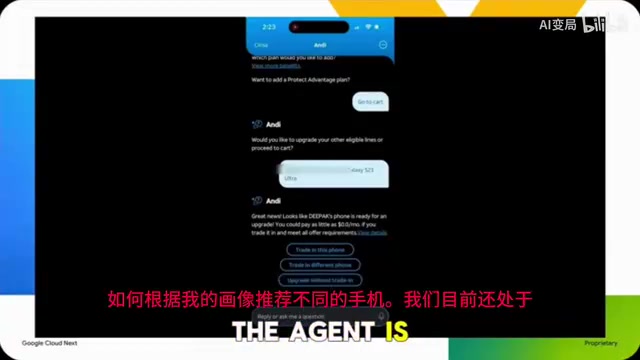
In the demo, when a user had previously selected the iPhone 16, the Agent intelligently recommended the iPhone 17 Pro Max. When upgrading a second line, the system recommended a Samsung device based on a different user profile—intuitively demonstrating the recommendation engine's profile-aware capabilities.

Additionally, when a user initiates a device upgrade, the Agent intelligently recognizes past conversation history, proactively offers a "summary of the previous conversation," and provides both "continue" and "start over" options—this memory-aware interaction design dramatically reduces the cost of repeated communication for users.
Current Status and Outlook
A notable detail: AT&T maintains a quite measured attitude toward this system's rollout. The presenter candidly admitted they're still in early stages—"We've only rolled out for a single channel, single use case." But the roadmap includes many exciting directions, including predictive home screens and the cross-channel synergy discussed earlier.
The predictive home screen concept means the app's homepage is no longer a static list of feature entry points, but dynamically generates the most relevant action suggestions based on signals like the user's current status, historical behavior, and soon-to-expire contracts. For example, when the system detects that a user's device warranty is about to expire, or that a new upgrade offer matches their usage profile, the home screen prioritizes displaying corresponding personalized cards—shifting from "users finding features" to "features finding users."
From "generic barista-style service" to "truly intelligent sales Agents," AT&T's practice provides a reference blueprint for enterprise AI deployment: it doesn't chase flashy tech, but focuses on solving real business problems around continuity, personalization, and security compliance. For practitioners focused on AI Agent commercialization, this system already running in production carries more insight than any concept demo ever could.
Key Takeaways
Related articles

Cursor AI Programming in Practice: Build a Student Management System from Scratch in 30 Minutes
A Bilibili creator demonstrates Cursor AI programming: generating a student management system in 30 minutes with natural language. Details on Agent mode, Claude selection, prompt techniques, and thresholds.

Top 20 AI Coding Tools Ranking: From Rock-Solid to Lackluster, a Scored Matrix
Bilibili creator releases top 20 AI coding tools ranking, tiered T0–T4 from rock-solid to lackluster, with Claude Code and Codex tied at T0. This article details the scoring dimensions (capability, reliability, robustness, durability, cost, domestic availability) and tool performances to help developers choose the right AI coding assistant.

Vibe Coding Systematic Tutorial: Master AI-Assisted Programming from Zero
A three-month Vibe Coding tutorial from a Bilibili creator covering Codex, ClaudeCode, and Cursor, from core logic to commercial project practice for beginners.