ATI: A Federated Trust Architecture for Cross-Organizational AI Agents

ATI uses PKI, zero trust, and remote attestation to provide a pre-execution trust verification layer for cross-organizational Agent collaboration.
Existing AI Agent frameworks lack common mechanisms for identity verification, execution integrity, and authorization during cross-organizational collaboration. The paper's Agent Trust Infrastructure (ATI) builds federated trust with peer AgentCAs instead of a shared root authority, and performs certificate validation, model/tool/prompt configuration attestation, and three-fold policy checks before execution. ATI integrates with existing frameworks as an external security layer and uses IETF WIMSE tokens and Entity Attestation Tokens. In an evaluation across 8 organizations and 6 frameworks, enabling all mechanisms raised attack containment from 43% to 84%, with only about 174 microseconds of overhead per request. The evaluation relies on judge models, and the peer CA structure adds some operational complexity.
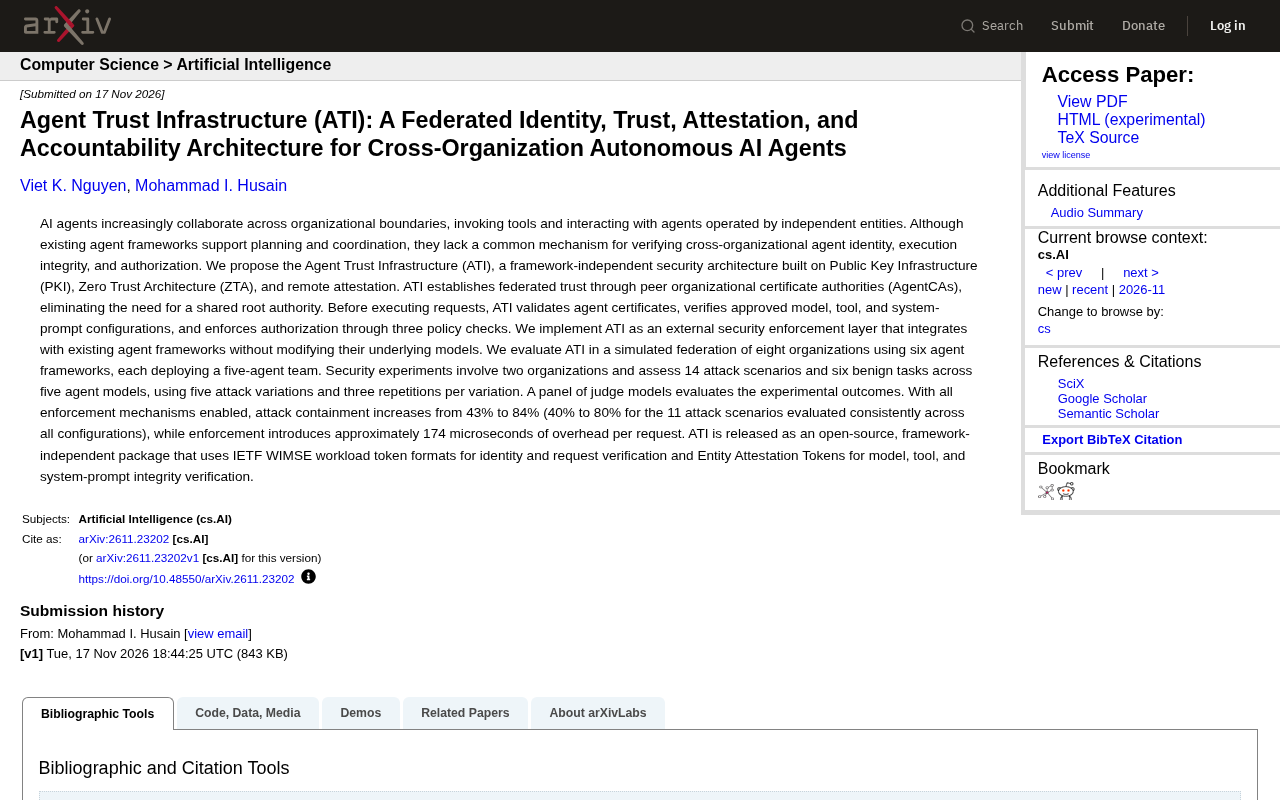
AI Agents are increasingly collaborating across organizational boundaries—calling external tools and interacting with Agents operated by other entities. But existing Agent frameworks generally lack a common mechanism for verifying Agent identity, execution integrity, and authorization status in cross-organizational scenarios. A new paper proposes Agent Trust Infrastructure (ATI), which attempts to fill this gap using PKI, Zero Trust Architecture (ZTA), and remote attestation.
The Problem: Agent Collaboration Is Outpacing Trust Mechanisms
Existing Agent frameworks are already quite mature in planning and coordination, and multi-Agent teams can decompose tasks and divide execution. However, when collaborators come from different organizations, the trust problem immediately emerges: how do you confirm that the Agent on the other side really belongs to the organization it claims to represent? Have the model it runs, the tools it calls, and the system prompts it uses been approved? Is its request authorized?
These questions have long had mature answers in traditional distributed systems—identity certificates, remote attestation, and policy engines. But most Agent frameworks leave this security layer for developers to assemble themselves, lacking a unified standard. ATI's positioning is precisely to provide a framework-agnostic security layer that packages these capabilities into reusable infrastructure.
Remote Attestation is a technique that allows one party (the verifier) to confirm the integrity of another party's (the prover's) runtime environment. The prover uses a Trusted Platform Module (TPM) or a similar hardware root of trust to generate signed evidence containing software measurements (hashes), based on which the verifier can determine whether the loaded model, tools, and system prompts have been tampered with. In the AI Agent context, this corresponds to "configuration attestation"—ensuring that the other Agent's inference stack is in an approved state. Remote attestation solves the problem of "how can I trust the runtime of a system I cannot physically access," and is a key support for device and workload identity in Zero Trust Architecture.
Architecture Design: Federated Trust Without a Shared Root Certificate
ATI's core design choice is not to rely on a single shared root authority. Each participating organization runs its own Agent Certificate Authority (AgentCA), and organizations establish federated trust through peer relationships. This structure reduces the political and security risks of "who controls the root certificate" and is closer to the shape of real inter-enterprise collaboration.
Before a request is executed, ATI completes three verifications: validating the Agent certificate; checking whether the model, tool, and system prompt configuration belongs to an approved combination; and enforcing authorization through a three-fold policy check. Together, these three layers form "pre-execution gating" rather than post-hoc auditing.
Zero Trust Architecture (ZTA) is built on the core principle of "never trust, always verify": trust is not automatically granted based on network location or organizational affiliation, and every access request must undergo identity authentication and authorization. ATI's three-fold check of Agent certificates, configuration, and policy before execution is exactly the implementation of ZTA principles in Agent collaboration. PKI (Public Key Infrastructure) provides the mechanisms for certificate issuance, distribution, and revocation, enabling Agents to hold verifiable identity credentials. By replacing a single root CA with peer AgentCAs, ATI effectively distributes PKI's trust anchors across organizations while retaining certificate chain verification—a variant of federated identity management in the Agent ecosystem.
Implementation: An External Security Layer
ATI is implemented as an external security enforcement layer that can be integrated directly with existing Agent frameworks without modifying the framework's underlying model or runtime. This is critical for adoption—enterprises do not need to rewrite existing Agent applications in order to introduce security mechanisms.
At the protocol level, ATI uses the IETF's WIMSE workload token format to handle identity and request verification, and uses Entity Attestation Tokens to complete integrity checks of models, tools, and system prompts. Both are standardized formats, meaning ATI's trust credentials have a foundation for interoperability with other infrastructure. The project is released as an open-source, framework-agnostic package.
WIMSE (Workload Identity in Multi-System Environments) is a workload identity standard being advanced by the IETF, aimed at providing interoperable identity token formats for services and workloads across systems and cloud environments. Its tokens can carry workload attributes, issuer information, and attestation results, making them suitable for dynamic, short-lived entities such as Agents. Entity Attestation Token (EAT) is an attestation carrier format defined by the IETF RATS working group, used to encapsulate measurements and assertions produced by remote attestation and to bind them to a specific entity. ATI's adoption of these two standards means its trust credentials do not depend on proprietary protocols and can later interface with infrastructure such as service meshes and confidential computing, reducing the cost of cross-organizational interoperability.
Experimental Evaluation: A Clear Increase in Attack Containment
The paper evaluates ATI in a simulated federated environment of 8 organizations, covering 6 Agent frameworks, with a 5-Agent team deployed for each framework. The security experiments involved 2 organizations, testing 14 attack scenarios and 6 benign tasks across 5 Agent models, with 5 variants used for each attack variant and 3 repetitions, and the experimental results ultimately judged by a set of judge models.
The results show that with all enforcement mechanisms enabled, the attack containment rate rose from 43% to 84%; among the 11 attack scenarios consistently evaluated across all configurations, the containment rate rose from 40% to 80%. In terms of performance cost, each request incurs about 174 microseconds of additional overhead—a magnitude that is almost negligible for the vast majority of Agent workloads.
Trade-offs Worth Noting
ATI's evaluation methodology deserves a closer look. The experiments use judge models to determine whether attacks were contained rather than relying entirely on human labeling, which is a pragmatic choice for large-scale security experiments but also introduces the risk of bias in the judge models' own judgments. The paper reports two sets of numbers: all 14 scenarios and the 11 consistently evaluated scenarios. The latter excludes comparability issues caused by configuration differences and is the more cautious metric.
Another point worth considering is the operational complexity of federated trust. A peer CA structure avoids a shared root authority, but each organization still needs to maintain its own certificate infrastructure and policy configuration, which remains a considerable burden for small and medium-sized teams. Fortunately, standardized token formats and open-source release lower the barrier to entry and leave room for future integration with other security infrastructure.
Conclusion
The idea proposed by ATI is not novel—PKI, zero trust, and remote attestation are all mature technologies—but it combines them into a complete solution for cross-organizational Agent collaboration and quantifies the security benefits and performance costs through experiments. At a time when Agents are beginning to truly execute tasks across enterprise boundaries, the importance of this kind of trust infrastructure will only increase. Its open-source release and adoption of standard formats give it the potential to become public infrastructure.
One-line Summary
ATI uses PKI, zero trust, and remote attestation to provide a pre-execution trust verification layer for cross-organizational Agent collaboration.
Paragraph Summary
Existing AI Agent frameworks lack common mechanisms for identity verification, execution integrity, and authorization during cross-organizational collaboration. The paper's Agent Trust Infrastructure (ATI) builds federated trust with peer AgentCAs, without relying on a shared root authority, and completes certificate validation, model/tool/prompt configuration attestation, and three-fold policy checks before request execution. ATI integrates with existing frameworks as an external security layer and adopts the IETF WIMSE token and Entity Attestation Token standard formats. In an evaluation across a simulated federation of 8 organizations and 6 frameworks, enabling all mechanisms raised the attack containment rate from 43% to 84%, with only about 174 microseconds of overhead per request. The evaluation relies on judge models to determine results, and the peer CA structure also introduces some operational complexity.
Related articles

ChatGPT Plus Subscription Pitfall Guide: Go/Plus/Pro Tier Comparison and Quick Activation
A complete ChatGPT Plus subscription guide based on a Bilibili tutorial: from registering an account, comparing Go/Plus/Pro tiers, to the practical steps for quickly completing your subscription.

GPT-6.2 Sol/Astra Released! A Step-by-Step ChatGPT Plus Subscription Guide and Tier Comparison
GPT-6.2 Sol/Astra is out—here's a ChatGPT Plus subscription guide: register an account, compare Go/Plus/Pro tiers, and subscribe in a minute.

Comparing Three Channels for Subscribing to GPT Plus in China: Is Website Top-Up the Easiest?
How to subscribe to GPT Plus in China? This article compares website top-up, credit card, and mobile top-up channels—process, cost, and risk—with steps and tips to help you choose wisely.