Auditing Machine Unlearning in Diffusion Language Models: A New Attempt with Sparse Autoencoders
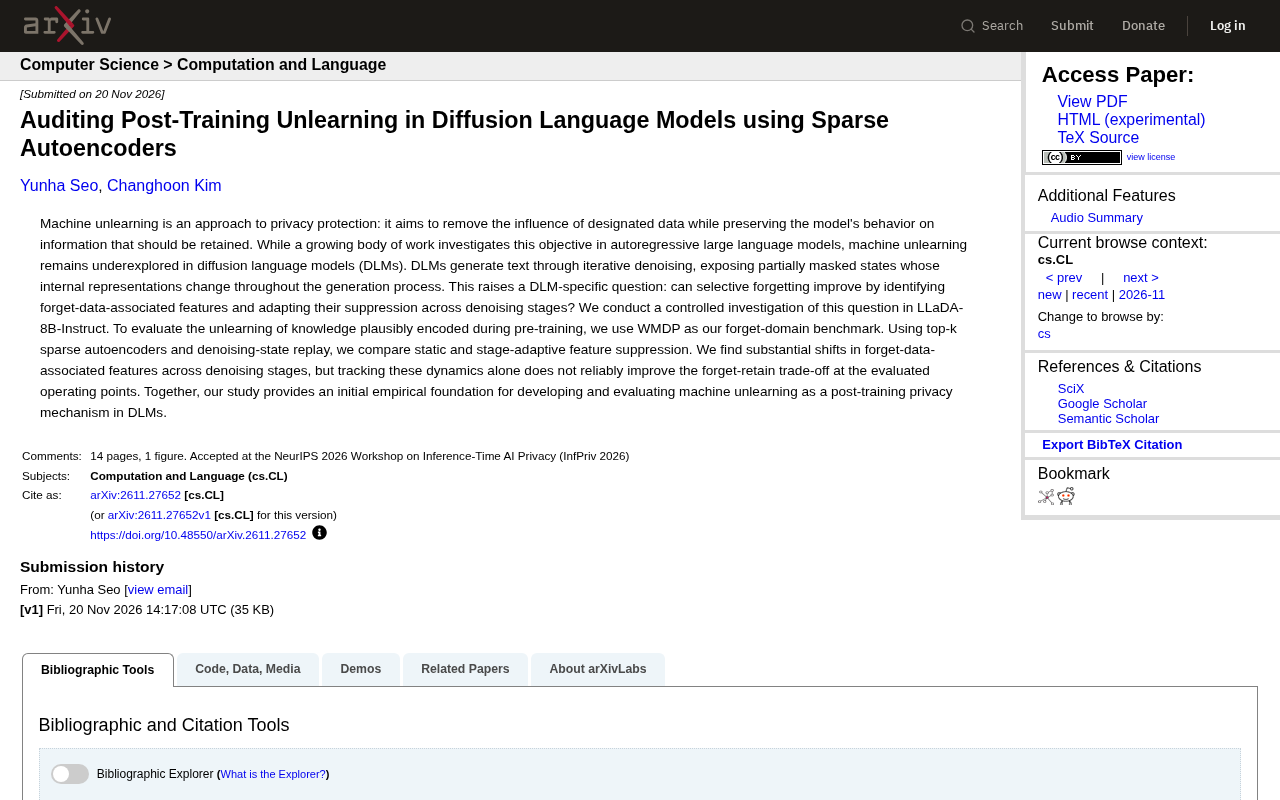
The first SAE-based audit of unlearning in diffusion language models finds that tracking feature drift fails to improve the forget-retain trade-off.
Targeting the gap in machine unlearning for diffusion language models (DLMs), this study audits LLaDA-8B-Instruct using top-k sparse autoencoders and denoising-state replay, comparing static and stage-adaptive feature suppression on the WMDP benchmark. It finds that although unlearning-related features drift significantly across denoising stages, tracking this drift does not reliably improve the forget-retain trade-off, indicating that DLM unlearning needs dedicated strategies rather than direct reuse of autoregressive methods.
Machine unlearning, as a privacy-preserving technique, aims to remove the influence of specified data while preserving the model's behavior on other information. This direction has been extensively explored in autoregressive large language models, but remains a blank spot in Diffusion Language Models (DLMs). A recent study targets LLaDA-8B-Instruct and uses Sparse Autoencoders (SAEs) to conduct a controlled audit of unlearning in DLMs, providing an initial empirical foundation for this emerging field.

Why Is Unlearning in DLMs More Complicated?
DLMs generate text through iterative denoising, exposing partially masked states during the process, and their internal representations continuously change throughout generation. This is fundamentally different from the token-by-token generation of autoregressive models. The researchers raise a DLM-specific question: can selective unlearning be improved by identifying features associated with the forget data and adaptively suppressing them across different denoising stages?
This question touches on the core difficulty of unlearning in DLMs—unlearning is not static but must be aligned with the dynamic generation process. If unlearning-related features drift significantly across denoising stages, then static suppression strategies may not work.
Diffusion Language Models (DLMs) are a class of models that draw on the ideas of diffusion models to generate text. Unlike autoregressive models that generate word by word from left to right, DLMs typically start from a fully masked or noisy sequence and recover the text through multi-step iterative denoising. At each step, the model predicts a portion of the masked tokens and retains some masked states for subsequent steps. This "iterative refinement" mechanism makes the generation process non-causal, and the model's internal representations are recomputed at each step based on the current masking pattern, so the same input may correspond to vastly different activation patterns at different denoising stages. LLaDA-8B-Instruct is one representative of such models, trained on large-scale instruction data and capable of dialogue and generation tasks. Understanding the iterative denoising characteristics of DLMs is a prerequisite for analyzing why their unlearning is more complicated.
Experimental Design: SAEs and Denoising-State Replay
The study employs top-k sparse autoencoders to decompose the model's internal activations, combined with a denoising-state replay technique. Specifically, they compare two strategies: static feature suppression and stage-adaptive feature suppression. The former uses a fixed suppression pattern throughout the denoising process, while the latter adjusts dynamically according to the denoising stage.
The WMDP benchmark is chosen as the unlearning-domain benchmark; this dataset is designed to evaluate unlearning of dangerous knowledge that may be encoded during pretraining. The model chosen is LLaDA-8B-Instruct, a representative diffusion language model.
Sparse Autoencoders (SAEs) are an unsupervised method for decomposing neural network activations. Through an overcomplete hidden layer, they map high-dimensional activations into sparse codes, forcing each code dimension to respond to only a few input patterns, thereby extracting interpretable "features." In mechanistic interpretability research, SAEs are often used to identify directions in the model associated with specific concepts (such as dangerous knowledge or bias). Top-k SAE is a variant that keeps only the k dimensions with the largest activation values during encoding and sets the rest to zero, thereby ensuring sparsity and improving training stability. Denoising-state replay refers to re-running the model's intermediate states at specific denoising steps during the unlearning audit, so that feature suppression can be applied at these states and its effects observed. Together, the two allow researchers to locate and intervene on features associated with the forget data at different denoising stages.
Key Finding: Feature Drift Does Not Equal a Better Trade-off
The experiments reveal an important phenomenon: features associated with the forget data do indeed change significantly across different denoising stages. However, merely tracking these dynamic changes does not reliably improve the forget-retain trade-off at the evaluated operating point. In other words, although stage-adaptive suppression captures feature drift, it does not translate into actually better unlearning performance.
This result suggests that unlearning in DLMs may be more challenging than expected. Identifying dynamic features is only the first step; how to effectively translate changes in these features into suppression signals still requires further exploration.
The forget-retain trade-off is a core metric in machine unlearning evaluation: ideally, the model should forget the target data (e.g., dangerous knowledge) while maintaining performance on non-target data. In practice, over-suppressing unlearning-related features harms the model's general capabilities, while under-suppression leads to incomplete unlearning. Evaluation typically requires measuring performance separately on the forget set and the retain set, and examining how both change with intervention strength. The study points out that even though the stage-adaptive strategy can track feature drift, at the chosen operating point (i.e., suppression strength or threshold), the decline in forget-set performance is not accompanied by a simultaneous preservation of retain-set performance, so the trade-off curve is not reliably improved. This indicates that feature dynamism alone is insufficient to guarantee better unlearning performance; the choice of operating point and the mechanism for translating suppression signals are equally critical.
Implications for Privacy-Preserving Practice
Although the stage-adaptive strategy did not meet expectations, the significance of this study lies in being the first to systematically audit unlearning in DLMs. It provides a reusable experimental framework—SAE feature identification plus denoising-state replay—and points out the non-trivial relationship between feature dynamism and unlearning performance. For practitioners concerned with privacy protection, this means that directly applying unlearning methods from autoregressive models to DLMs may be insufficient, and dedicated strategies must be designed for the diffusion process.
The research team also acknowledges that this is only an initial empirical foundation and still far from practical deployment. Possible future directions include finer stage partitioning, integration with other interpretability tools, and exploration of generalization across different DLM architectures.
One-line Summary
This study is the first to use SAEs to audit machine unlearning in diffusion language models, finding that tracking feature drift does not improve the forget-retain trade-off.
Paragraph Summary
Addressing the gap in machine unlearning for diffusion language models (DLMs), this study targets LLaDA-8B-Instruct and conducts a controlled audit using top-k sparse autoencoders (SAEs) and denoising-state replay. It compares static feature suppression and stage-adaptive feature suppression, evaluating them on the WMDP unlearning benchmark. The key finding is that features associated with the forget data do drift significantly across denoising stages, but tracking these dynamic changes does not reliably improve the forget-retain trade-off at the evaluated operating point. This suggests that unlearning in DLMs is more challenging than expected, and simply applying unlearning methods from autoregressive models may be insufficient; dedicated strategies must be designed for the diffusion process. The study provides a reusable experimental framework and points to future directions including finer stage partitioning and cross-architecture generalization.
Related articles

Pure-Code Video Generation Tested: Which AI Model Actually Follows Instructions?
A Bilibili creator tested three AI models' pure-code video generation with unified prompts and three revisions each: Xiaonaomao has a high ceiling but lacks stability, GPT 6.2 Extra models well but only follows half the instructions, and OPAS 5.5 remains the benchmark.

GPT-6 Six-Tier Hands-On Test: Astra Ultra Dominates but Bills Double
GPT-6 six-tier test: Astra Ultra sweeps 3:0 in 3D tasks thanks to sub-agents and runs 14% faster, but hidden backend bills make its real cost 2.6x single-threaded.

GPT-6.2 Astra vs Fable 5.2: Huge Cost-Efficiency Gap Across 12 Real-World Tests
Bilibili creator tests GPT-6.2 Astra vs Fable 5.2 across 12 real tasks: Fable wins 7-5 but costs 7.2x more and takes nearly 5x longer. Token efficiency emerges as the key selection metric.