AutoOntologyBench: A Task Benchmark for Agents to Autonomously Build Ontologies
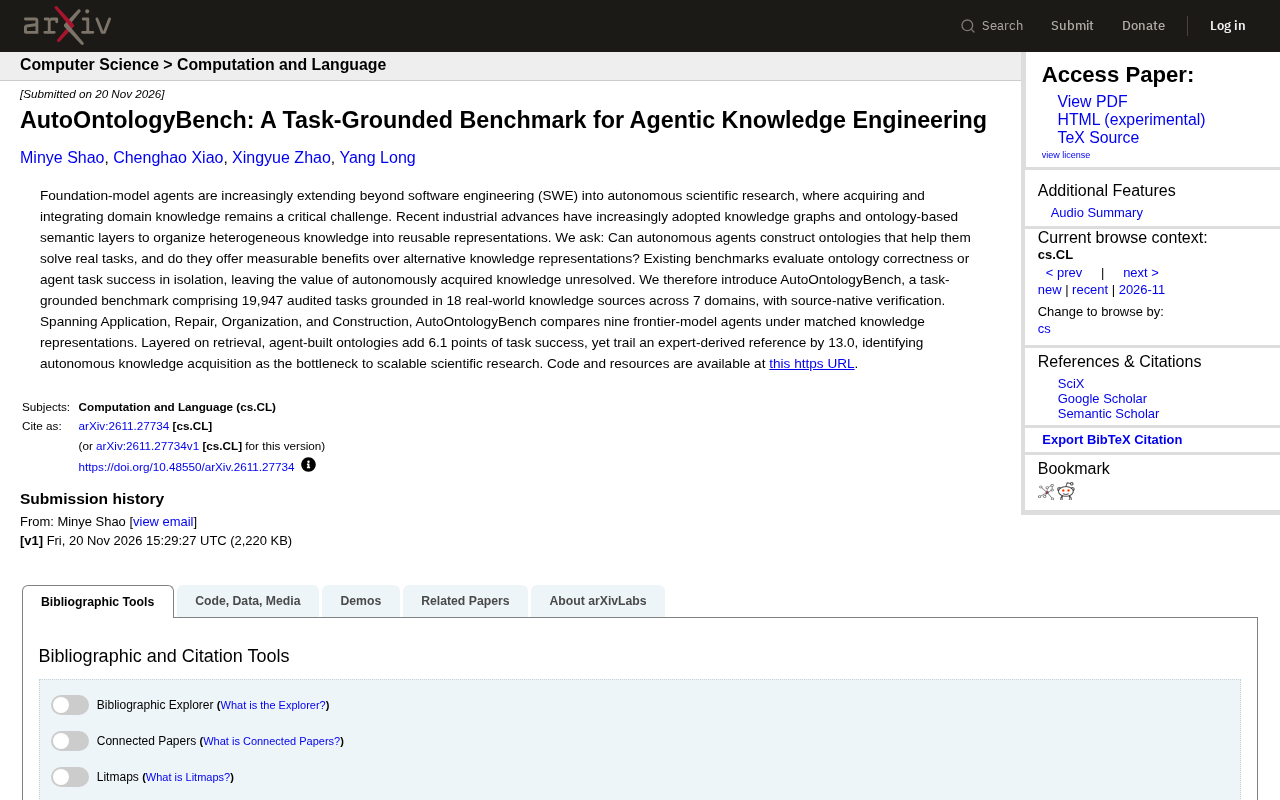
AutoOntologyBench links ontology evaluation with task success, showing agent-built ontologies gain 6.1 points but lag experts by 13.
AutoOntologyBench is a task-driven benchmark with 19,947 audited tasks across 7 domains and 18 real-world knowledge sources, using source-native verification to align evaluation with native knowledge structures. It covers application, repair, organization, and construction tasks and compares nine frontier model agents under matched knowledge representations. Agent-built ontologies improve task success by 6.1 percentage points over retrieval augmentation but still lag expert reference ontologies by 13.0 points, showing autonomous knowledge acquisition is the bottleneck for scaled scientific research.
Frontier model agents are extending from software engineering into autonomous scientific research, and their core challenge lies in acquiring and integrating domain knowledge. Industry has begun adopting knowledge graphs and ontology semantic layers to organize heterogeneous knowledge into reusable representations. But a key question remains unanswered: can autonomous agents build ontologies to solve real tasks? And compared with other knowledge representations, do ontologies deliver measurable gains?
Existing benchmarks either evaluate ontology correctness in isolation or measure agent task success rates separately, and thus cannot answer the value of autonomous knowledge acquisition. To address this, researchers introduce AutoOntologyBench—a task-grounded benchmark containing 19,947 audited tasks covering 18 real-world knowledge sources across 7 domains, using source-native verification. The benchmark spans four task types—application, repair, organization, and construction—and compares nine frontier model agents under matched knowledge representations.
Benchmark Design: Task-Grounded and Source-Native Verification
The core design philosophy of AutoOntologyBench is "task-grounded," meaning it evaluates whether the ontology an agent builds genuinely helps complete downstream tasks, rather than only checking the logical consistency of the ontology itself.
Tasks and Knowledge Sources
The benchmark contains 19,947 audited tasks based on 18 real-world knowledge sources spanning 7 domains. Each task is equipped with source-native verification, ensuring evaluation results align with the native structure of the knowledge source and reducing human bias.
Source-native verification means that evaluation uses the knowledge source's own native structure (such as the schema of the original database, the section hierarchy of a document, or an existing taxonomy) as the reference standard, rather than having annotators separately design scoring rules. The benefit is reduced human bias and evaluation results that can be automatically reproduced as the knowledge source updates. Compared with traditional approaches relying on human-annotated gold standards, source-native verification is closer to the "task-grounded" philosophy: whether the knowledge representation an agent produces aligns with the true organization of the knowledge source directly determines whether it can be effectively used in downstream tasks.
Four Task Scenarios
The benchmark covers four task types: Application, Repair, Organization, and Construction. These scenarios simulate different stages of knowledge engineering in scientific research, from leveraging existing ontologies to repairing errors, organizing heterogeneous information, and building ontologies from scratch.
Ontology in knowledge engineering refers to a formal, shared conceptualization specification, typically comprising classes (concepts), properties, relations, and constraint rules. It differs from an ordinary knowledge graph: a knowledge graph focuses on instance-level fact triples, whereas an ontology provides schema-level semantic constraints that enable machines to perform reasoning and consistency checking. Adding an "ontology semantic layer" on top of this means mapping heterogeneous data sources into a unified conceptual system, thereby supporting cross-source queries and semantic interoperability. This is also why the article emphasizes that ontologies can form "reusable representations"—the same ontology can be shared by multiple downstream tasks without having to repeat data understanding for each task.
Experimental Setup and Core Findings
The study compares nine frontier model agents under matched knowledge representations to ensure fairness. All agents run under the same knowledge representation to isolate the effect of ontology-building capability.
Gains from Ontologies
On top of retrieval augmentation, the ontologies built by agents bring a 6.1 percentage point improvement in task success rate. This shows that autonomously acquired knowledge representations do help agents solve tasks better, validating the value of ontologies as a semantic layer.
Retrieval-Augmented Generation (RAG) is a technique that lets a model retrieve relevant snippets from an external knowledge base and inject them into context before generation, mitigating issues of timeliness and insufficient coverage in parametric knowledge. But pure retrieval augmentation typically operates on flat text chunks, lacking explicit relations between concepts and making it hard to support multi-hop reasoning and cross-source integration. As a semantic layer, an ontology can provide structured navigation paths and type constraints for retrieval, thereby bringing additional gains on top of retrieval augmentation. The 6.1 percentage point improvement in the article is measured against this baseline, indicating that structured knowledge representations and flat retrieval are complementary rather than substitutes.
Gap with Expert Ontologies
Despite the gains, agent-built ontologies still lag expert-derived reference ontologies by 13.0 percentage points. This gap clearly identifies autonomous knowledge acquisition as the bottleneck for scaled scientific research. Agents cannot yet fully replace experts in building high-quality ontologies, but they have demonstrated measurable assistive value.
Expert-derived reference ontologies are typically hand-built by domain experts according to recognized standards (such as GO and the OBO series in biomedicine), undergoing long-term iteration and community review, and possess good coverage, granularity control, and logical consistency. Agent-built ontologies often fall short in naming standardization of concepts, hierarchy depth, and completeness of relations—the main sources of the 13.0 percentage point gap. Understanding this gap helps identify directions for improvement: not simply adding more construction rounds, but introducing expert priors, ontology design patterns, or automated consistency checking to improve quality.
Significance and Outlook
AutoOntologyBench is the first to directly link ontology evaluation with task success, providing a reproducible metric for autonomous knowledge engineering. Its open-source code and resources have been released on GitHub for further community research.
Future work can focus on closing the gap between agent and expert ontologies, for example through more efficient exploration strategies, human-AI collaboration, or continual learning mechanisms. The benchmark also provides a unified framework for evaluating other knowledge representations (such as plain text retrieval or structured databases).
In summary, AutoOntologyBench reveals both the potential and the limitations of autonomous agents in knowledge engineering, laying the foundation for scalable automation of scientific research.
One-line Summary
AutoOntologyBench is the first to link ontology evaluation with task success, revealing that agent-built ontologies improve performance by 6.1 percentage points but still lag experts by 13 points.
Paragraph Summary
AutoOntologyBench is a new task-grounded benchmark containing 19,947 audited tasks across 7 domains and 18 real-world knowledge sources, using source-native verification to ensure evaluation aligns with the knowledge sources' native structures. The benchmark covers four task types—application, repair, organization, and construction—and compares nine frontier model agents under matched knowledge representations. The core finding: on top of retrieval augmentation, ontologies autonomously built by agents bring a 6.1 percentage point improvement in task success rate, validating the measurable value of ontologies as a semantic layer; however, agent ontologies still lag expert reference ontologies by 13.0 percentage points, indicating that autonomous knowledge acquisition is the bottleneck for scaled scientific research. The benchmark is the first to directly link ontology quality with downstream task success, providing a reproducible metric for autonomous knowledge engineering, with code and resources open-sourced.
Related articles
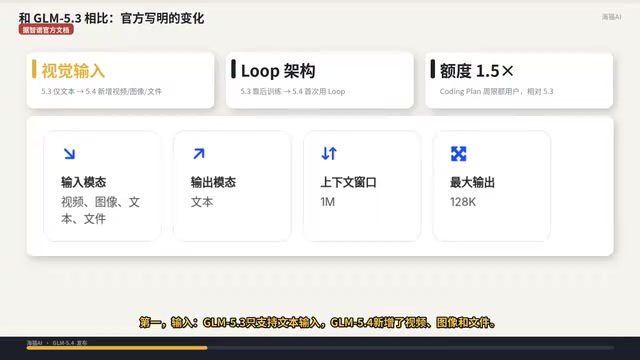
Zhipu GLM-5.4 Released: Loop Transformer Runs 28 Layers Twice
Zhipu releases GLM-5.4, the first Loop Transformer flagship: 28 layers run twice for 2-3T-equivalent intelligence, plus video and image input. API and open weights not yet released.

GLM-5.4 Coding Test 4.6x Slower? Unpacking the Loop Transformer Architecture
GLM-5.4 coding test took 431 minutes vs. competitor's 109, 4.6x more steps. We analyze its Loop Transformer architecture, KingBench4 score of 55.3, Max tier's 1.04M token cost, and tier selection advice.

Zhipu GLM-5.4 Quietly Released: A Debut for Loop Transformer Architecture
Zhipu GLM-5.4 quietly lands in coding plans: first Loop Transformer flagship with 750B params, 1M token context, AIM math up from 19.2 to 30.4, and native vision for coding from screenshots.