Zhipu GLM-5.4 Quietly Released: A Debut for Loop Transformer Architecture

Zhipu GLM-5.4's Loop Transformer with 750B params claims to match 2-3T models, plus vision and subscriber perks
Zhipu quietly released GLM-5.4 in its coding subscription plan without a launch event. The flagship model uses Loop Transformer architecture with 750B parameters, looping 28 weight-shared layers twice to achieve deeper computation paths, and claims intelligence comparable to 2-3T parameter models. Equal-parameter experiments show only ~10% training compute, 1M token context window, and AIM math scores rising from 19.2 to 30.4. New native vision capabilities generate code from screenshots and design mockups across programming, video, gaming, and 3D scenes. Subscribers receive ~50% more weekly quota with output up to 200 token/s. The article cautions that single benchmark gains don't guarantee comprehensive capability, and loop-related error accumulation and training stability remain unverified engineering challenges.
Zhipu didn't hold a launch event for GLM-5.4—it simply listed this flagship model in its coding subscription plan. According to a Bilibili creator, this is their first flagship model built on a Loop Transformer architecture, with 750 billion parameters and claims that its intelligence level is comparable to models with 2-3 trillion parameters.
Loop Architecture: Don't Stack Parameters, Run the Layers Twice
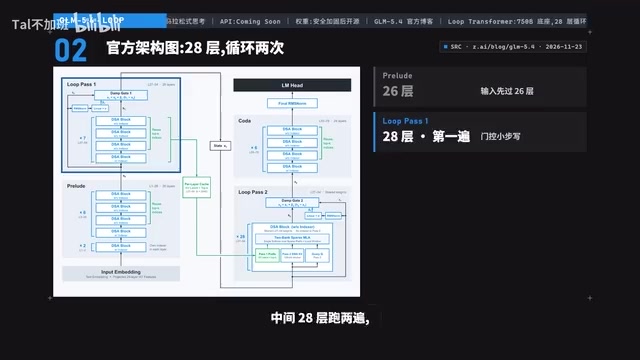
The core change in GLM-5.4 isn't parameter scale but computation method. According to the creator, the model loops through its 28 layers once—the first pass lays out context, the second pass refines output. The principle relies on weight sharing and depth looping, carrying deeper computation paths with fewer parameters.

This approach isn't unfamiliar in the industry: Universal Transformer and deep loop networks have both explored the possibility of "reusing the same set of weights repeatedly." GLM-5.4's highlight is making it a flagship product rather than a lab prototype. The company ran equal-parameter control experiments on thirty compute nodes, consuming only about one-tenth of training compute—meaning the cost-effectiveness advantage of loop architecture has empirical data backing, not just theoretical speculation.
Universal Transformer is a model structure proposed by Google in 2018, which can be seen as a hybrid of Transformer and recurrent neural networks: instead of fixedly stacking N different layers, it lets the same set of layers (shared weights) execute repeatedly for several steps as needed, with each step receiving the previous step's output. This gives the model deeper computation paths and stronger compositional reasoning capabilities without changing parameters, and can dynamically decide how many loops each token needs through the Adaptive Computation Time (ACT) mechanism.
Deep loop networks follow a similar approach: repeatedly calling a limited set of layers, trading weight sharing for effective depth. The core assumption is that many reasoning tasks are inherently iterative—first rough understanding, then gradual refinement—and fixed-depth feedforward networks struggle to explicitly express this iteration. The cost of loop architecture is longer backpropagation paths during training, prone to gradient instability and error accumulation, making gating, normalization, and loop count scheduling critical in engineering implementation.
1 Million Token Context, Math Ability Jumps Significantly
The context window reaches 1 million tokens, placing it in the current top tier. More noteworthy are the capability metrics: AIM math scores rose from 19.2 to 30.4—a significant improvement.

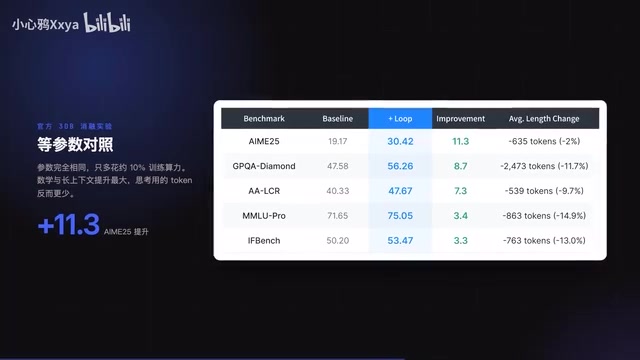
Achieving such gains while using only about one-tenth of training compute suggests that loop depth may yield higher returns for reasoning tasks than simply expanding parameters. Of course, a jump in a single benchmark doesn't equate to comprehensive capability improvement—actual coding and long-context performance still require more independent evaluation.
Token is the basic unit of text processed by models, roughly equivalent to a word or part of a word. Context window refers to the total number of tokens the model can simultaneously "see" in one inference, determining how long a document, codebase, or multi-turn conversation it can handle. 1 million tokens roughly corresponds to hundreds of thousands of Chinese characters or thousands of lines of code, placing it in the current top tier.
Larger windows aren't just a capacity issue: attention mechanism computation grows rapidly with sequence length, and long contexts are prone to "middle forgetting" (key information in the middle of long text being ignored) and degraded positional extrapolation. Therefore, long contexts often require engineering techniques like improved positional encoding, attention sparsification, or chunked retrieval, with actual effective length typically below the nominal limit.
Native Vision Launch: Write Code from Screenshots and Design Mockups
GLM-5.4 adds native vision capabilities, generating code directly from screenshots and design mockups, extending from programming to video, gaming, and 3D scenes. For developers, this means the "design-to-code" workflow can skip an intermediate description step—feed the image to the model and get runnable code directly.
The practical value of such capabilities depends on fidelity and maintainability. If native vision merely identifies element positions, output still requires extensive rework; if it truly understands design intent and component structure, it's a substantial efficiency boost for frontend and game prototype development. Currently released information leans toward capability claims, lacking public comparison samples.
Native vision means the model aligns images and text during training, rather than attaching a separate visual encoder for concatenation. This allows the model to understand images as part of the input sequence directly, typically with more complete grasp of layout structure, control hierarchy, and design semantics.
In "design-to-code" scenarios, the challenge isn't just recognizing elements but reproducing layout constraints (spacing, alignment, responsive rules) and component reuse relationships. Evaluating such capabilities typically examines three aspects: visual fidelity, whether generated code runs directly, and subsequent maintainability. The industry's common approach is having models output structured intermediate representations (like HTML/JSX component trees) for human or toolchain validation, with pure end-to-end generation still in an assistive stage.
Subscription Benefits Enhanced: 50% More Weekly Quota, 200 token/s Output
For subscribers, Zhipu increased weekly quota by about half, showing output speeds up to 200 tokens per second. For developers frequently using coding plans, quota and speed often affect daily experience more directly than benchmark scores—long-context sessions and batch code generation are major quota consumers.
Zhipu states this is just the first step in loop architecture. The implication: future models will continue iterating along this path, and parameter scale may no longer be the primary competitive dimension.
Measured Perspective: Opportunities and Questions of Loop Architecture
Loop Transformer's appeal lies in trading weight sharing for depth, theoretically approaching larger model effects with lower training and inference costs. But looping also brings new problems: error accumulation across multiple loops, training stability, and dynamic scheduling of loop counts under long contexts—all engineering challenges.
GLM-5.4 choosing no launch event and direct listing in coding plans is itself a stance—letting developers test in real tasks rather than debating on leaderboards. Whether it truly matches 2-3 trillion parameter models' comprehensive intelligence still requires community cross-validation across code, math, and vision tasks.
Weight sharing is the economic source of loop architecture: since all loop steps reuse the same parameter set, total parameter count doesn't grow with effective depth, and memory footprint and inference costs are correspondingly lower. But this also means each loop transforms within the same representation space—the model needs gating or residual connections to distinguish "which step" state, otherwise multiple iterations may converge to the same result and lose gains.
Equal-parameter control experiments are key methods for evaluating such architectures: comparing loop models with standard deep models under identical total parameters and data volume is necessary to attribute performance differences to architecture rather than scale. The "only about one-tenth training compute" mentioned in the article comes from such controls, but single-lab results still require third-party reproduction, especially observing whether gains diminish as loop counts increase.
One-line Summary
Zhipu GLM-5.4 uses Loop Transformer to achieve 750B parameters matching 2-3T, plus enhanced vision and subscription benefits
Paragraph Summary
Zhipu skipped a launch event, directly listing flagship GLM-5.4 in coding plans. Using Loop Transformer architecture with 750B parameters, it loops 28 shared-weight layers twice for deeper computation paths, claiming intelligence comparable to 2-3T parameter models. Equal-parameter experiments show only ~10% training compute, 1M token context, AIM math from 19.2 to 30.4. New native vision generates code from screenshots and mockups, covering programming, video, gaming, and 3D. Subscribers get ~50% more weekly quota and up to 200 token/s output. The article notes single benchmark jumps don't equal comprehensive capability—loop error accumulation and training stability remain engineering challenges to verify.
Related articles

GLM-5.4 Coding Test 4.6x Slower? Unpacking the Loop Transformer Architecture
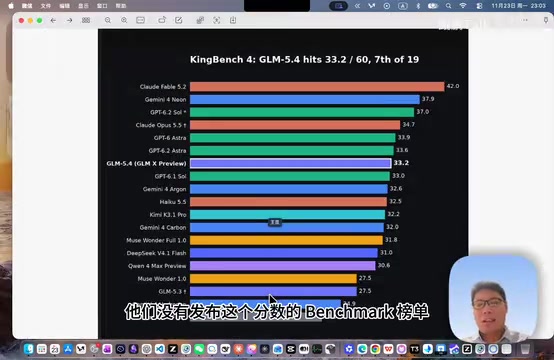
GLM-5.4 coding test took 431 minutes vs. competitor's 109, 4.6x more steps. We analyze its Loop Transformer architecture, KingBench4 score of 55.3, Max tier's 1.04M token cost, and tier selection advice.
GLM-5.4 Releases 750B Model: Recurrent Transformer Architecture and the 30B Benchmark Controversy
GLM-5.4 releases a 750B model with a recurrent Transformer architecture that runs the same layers twice, claimed to match 2T–3T scale. But the benchmark table tests a 30B small model, not the main model. We break down the architecture changes, benchmark data, four demos, and open-source timeline.
GLM-5.4 Released: Loop Transformer Architecture Boosts Intelligence Without Extra Parameters — So Why Is It So Slow in Practice?
Zhipu GLM-5.4 debuts with Loop Transformer architecture that boosts capability without extra parameters. Third-party benchmarks look strong, but real-world speed is slow and queuing is severe.