GLM-5.4 Coding Test 4.6x Slower? Unpacking the Loop Transformer Architecture
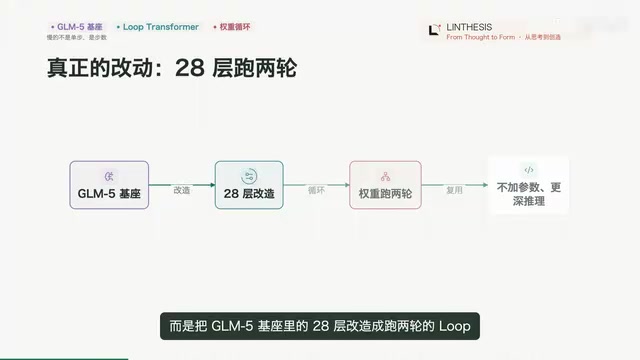
GLM-5.4 trades more steps for deeper reasoning via Loop Transformer, but time and token costs surge.
GLM-5.4 took 431 minutes on a coding test vs. 109 for its competitor; per-step it's faster, but it used 1,128 steps—4.6x more. Officially, 28 layers of the GLM-5 base were converted into a two-round Loop Transformer, trading no extra parameters for deeper reasoning, with ~750B parameters reaching 2T–3T intelligence. Third-party KingBench4 scored 55.3 (7th, highest open-source), but it's a creator-built, non-vendor benchmark. Subscription quotas increased, but Max tier consumes ~1.04M tokens (~15x competitor) and long thinking triggers 180s timeouts. For code review and complex planning, choose Hi; avoid the highest tier for everyday completion. Switching costs nothing.
GLM-5.4 took 431 minutes on a coding test, while its competitor finished in just 109 minutes. Per-step, it's actually faster — 22.9 seconds per step versus the competitor's 26.7 seconds. The real gap lies in the number of steps: it took 1,128 steps, 4.6 times that of its competitor. This data, from a hands-on test by a Bilibili creator, reveals a counterintuitive performance profile for GLM-5.4.
Slowness Isn't a Compute Issue — It's a Different Architectural Approach
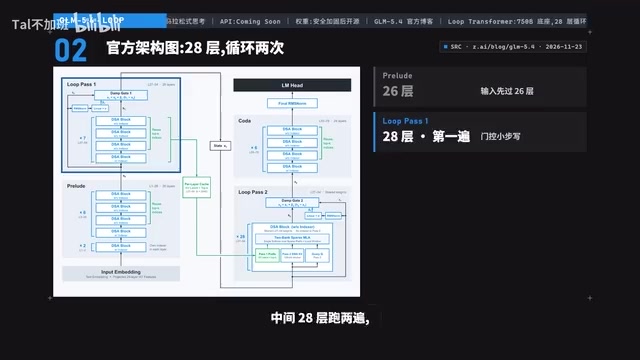
Officially, GLM-5.4 was not pretrained from scratch. Instead, 28 layers of the GLM-5 base model were converted into a loop transformer that runs two rounds, reusing the same set of weights cyclically without adding parameters in exchange for deeper reasoning. The model has roughly 750B parameters, and the company claims it achieves 2T–3T-level intelligence.
This design directly explains the step inflation: the loop structure makes the model repeatedly pass through the same layers during inference. Per-step efficiency doesn't drop — it actually rises — but the total number of steps needed to complete the same task is pushed up. The company also acknowledges that this architecture is prone to getting stuck in "marathon-style long thinking." In other words, GLM-5.4 trades a longer reasoning chain for deeper reasoning depth, rather than brute-forcing compute.
Loop Transformer is an architecture design that lets a model pass through the same set of Transformer layers multiple times during inference. Unlike a standard Transformer, which computes each layer once, the loop structure feeds the output of intermediate layers (such as the 28 layers mentioned here) back into the input of that same group of layers for a second or more rounds of forward computation, thereby simulating a deeper network without increasing parameter count. This design stems from explorations into decoupling computational depth from parameters, with notable examples including the Universal Transformer. Its advantage is high parameter efficiency, but the cost is more inference steps, higher latency, and a tendency to fall into lengthy iterative thinking. GLM-5.4 converts 28 layers of its base model to run two rounds, precisely leveraging this mechanism to trade loop depth for reasoning capability.
Third-Party Testing: 55.3 Points, Highest Among Open-Source Models but Limited Sample
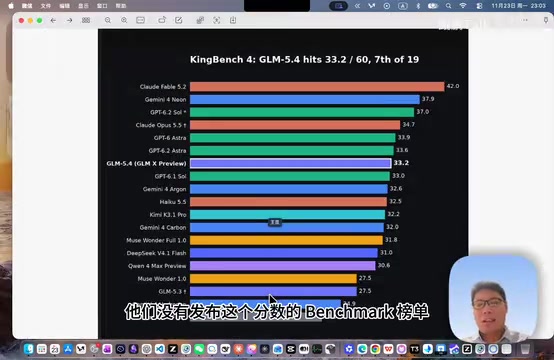
According to the Bilibili creator's self-built KingBench4 test, GLM-5.4 scored 55.3, ranking 7th among 19 models and the highest among open-source models. The test also showed it could catch bugs that other models missed.
But this needs to be taken with a grain of salt: it's a self-built benchmark of 6 projects, scored by the creator himself, not a vendor benchmark. The company has yet to release a benchmark table. The value of the 55.3 score and the "7th place" ranking depends on how well those 6 projects match your actual use cases. Information from multiple sources diverges here — the creator's hands-on test provides a specific ranking, but the absence of an official benchmark means this ranking lacks cross-validation.
KingBench4 is a coding capability evaluation set built by a Bilibili creator, not an industry-recognized standard benchmark (such as HumanEval, SWE-bench, etc.). It consists of 6 real projects covering tasks like bug discovery and code review, with scoring done by the creator himself, so it has subjectivity and limited sample size issues. The advantage of such self-built benchmarks is that they are close to real-world use cases and can reflect a model's performance in specific workflows; the disadvantage is the lack of cross-evaluator consistency validation, meaning rankings and scores cannot be directly compared with vendor benchmarks or academic leaderboards. The 55.3 score and "7th place" for GLM-5.4 mentioned in this article are only valid within this test set, and their reference value depends on how well the test projects match readers' actual needs.
Subscription Quotas and Hidden Costs
The changes at the subscription level are more tangible. Selecting GLM-5.4 in the coding plan adds visual input and increases the weekly quota by 50%. The official WeChat account mentions that VR V3 and the team edition have 1.5x quotas.
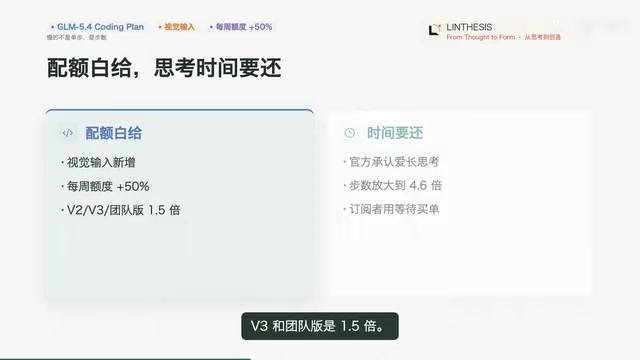
But these are the visible concessions. The creator's warning hits the mark: quotas are free, but thinking time is what you pay back. The cost is all concentrated in the Max tier — a full run consumes about 1.04 million tokens, nearly 15 times that of the competitor.
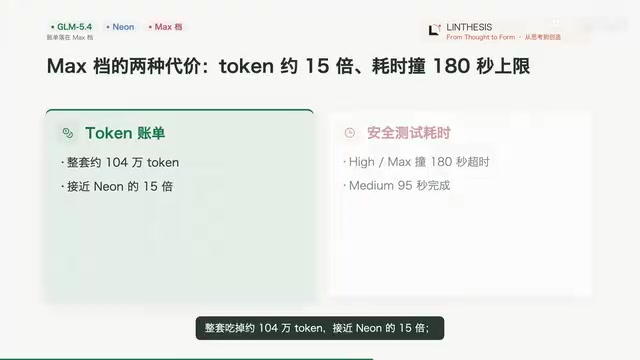
Safety testing also exposed the side effects of long thinking: the Hi and Max tiers, because they think too long, hit the 180-second timeout, while the Medium tier finished in 95 seconds. If you default to the highest tier for everyday completion tasks, what you get may not be better code but a timeout interruption.
Token consumption is a core metric for measuring the cost of using large models, referring to the total number of input and output text units processed by the model during inference. For models that use long reasoning chains (such as loop transformers with repeated iteration), the number of tokens needed to complete the same task will be significantly higher than traditional models. In this article, a full run at the Max tier consumes about 1.04 million tokens, nearly 15 times that of the competitor, meaning that even if subscription quotas appear to increase, the actual number of usable runs will be quickly diluted by high consumption. In addition, long thinking can also trigger inference timeouts (e.g., 180 seconds), causing task interruption and further affecting the experience. Understanding the relationship between token consumption and quotas helps users choose tiers reasonably based on task complexity and avoid hidden costs.
How to Choose a Tier: Hi Is the Sweet Spot
Those immediately affected are people who set Max as the default or use it for everyday completion. If you only write small functions and fix error messages, there's no need to worry. The creator's method is very specific: hand code review and complex engineering planning to GLM-5.4 and choose the Hi tier — that's the one with a better balance of capability and speed. Don't turn on the highest tier for everyday completion.
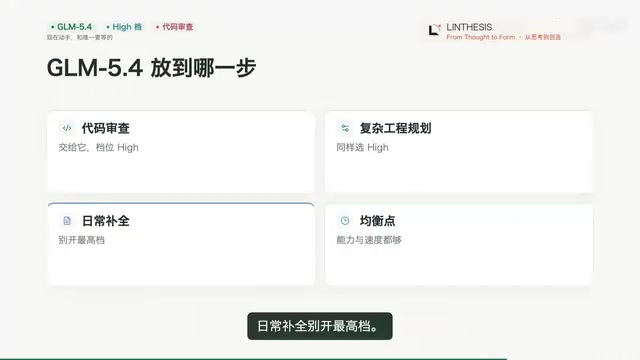
What you can do right now: switch over, take a real legacy project and have it review once, and see whether the issues it picks out are worth the wait. Switching itself costs nothing; what costs is the thinking time you give it.
Don't rush to calculate the long-term bill. Vendor benchmarks, API pricing, and open-source weights are all not out yet. Pricing and weights will only be released after the safety evaluation — wait for them to land before deciding whether to run the Max tier long-term. For now, there's only one more pragmatic criterion: let it prove its review value on your real codebase, rather than making decisions based on a benchmark table the vendor hasn't published.
Related articles

Zhipu GLM-5.4 Quietly Released: A Debut for Loop Transformer Architecture
Zhipu GLM-5.4 quietly lands in coding plans: first Loop Transformer flagship with 750B params, 1M token context, AIM math up from 19.2 to 30.4, and native vision for coding from screenshots.
GLM-5.4 Releases 750B Model: Recurrent Transformer Architecture and the 30B Benchmark Controversy
GLM-5.4 releases a 750B model with a recurrent Transformer architecture that runs the same layers twice, claimed to match 2T–3T scale. But the benchmark table tests a 30B small model, not the main model. We break down the architecture changes, benchmark data, four demos, and open-source timeline.
GLM-5.4 Released: Loop Transformer Architecture Boosts Intelligence Without Extra Parameters — So Why Is It So Slow in Practice?
Zhipu GLM-5.4 debuts with Loop Transformer architecture that boosts capability without extra parameters. Third-party benchmarks look strong, but real-world speed is slow and queuing is severe.