AWS Officially Launches Local Cloud Emulator, Marking a New Shift in Cloud Development
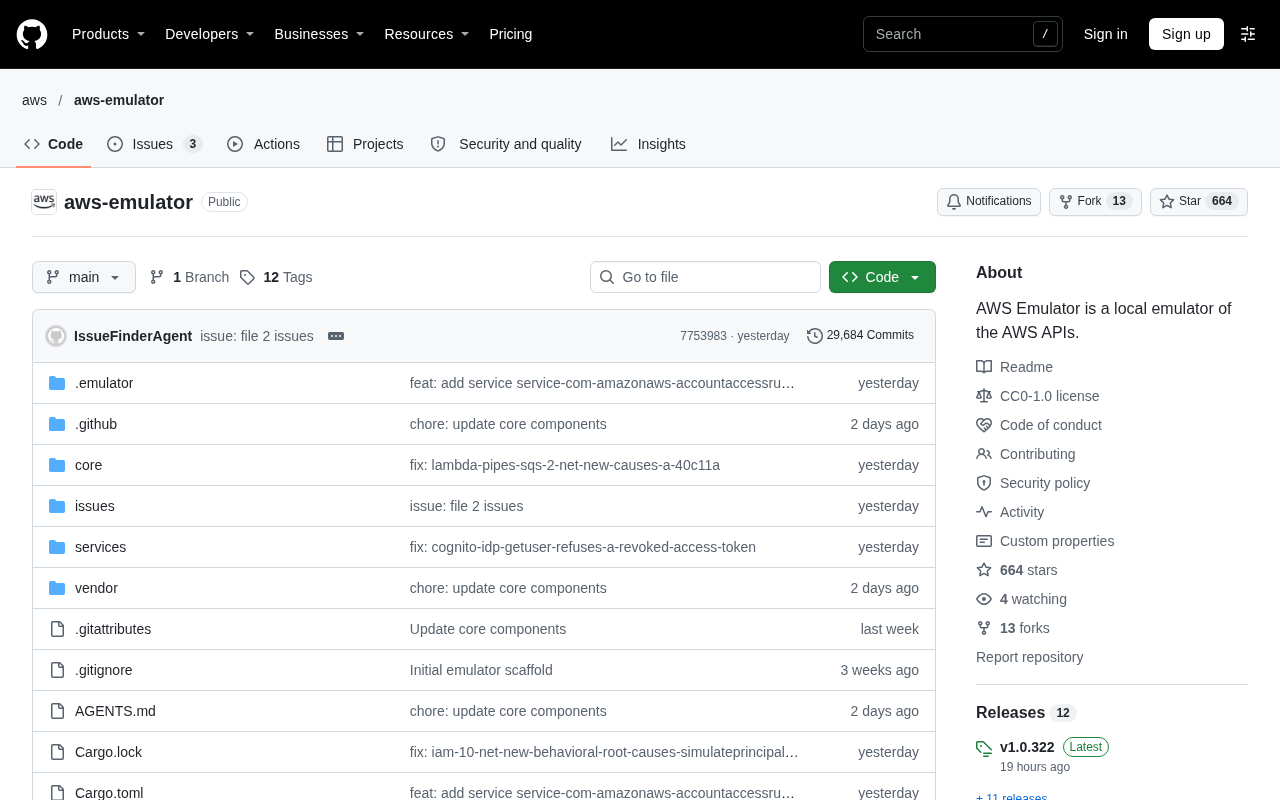
AWS officially releases AWS Emulator, filling the gap in local cloud emulators and disrupting the third-party tool ecosystem.
AWS has released its official AWS Emulator project on GitHub, sparking nearly three hundred points of discussion on Hacker News. Developers have long relied on third-party tools like LocalStack and Moto to emulate services such as S3, DynamoDB, and SQS locally, but behavioral discrepancies with real services often only surface after deployment, becoming a debugging nightmare. The official entry is seen as capable of improving consistency through a deep understanding of API edge cases and error code semantics, reducing the friction of "it runs locally but errors online." At the same time, the community worries the official tool will squeeze the survival space of open-source emulators. The project is still early-stage, with service coverage, update cadence, and product positioning all unclear, so the author advises teams to hold off on migration, first observing the coverage list and update frequency and running small-scale validation on non-critical paths.
In the cloud computing world, local cloud service emulation has long occupied an awkward position: third-party tools keep emerging, yet the official vendor has always been absent. Recently, AWS released its own AWS Emulator project on GitHub, sparking heated discussion in the technical community, with the Hacker News thread quickly accumulating nearly three hundred points and dozens of comments.
The Predicament of Third-Party Emulators and the Official Fill-In
For a long time, developers wanting to reproduce an AWS environment locally have typically relied on community projects like LocalStack and Moto. These tools simulate the API behavior of services such as S3, DynamoDB, and SQS, allowing developers to complete development and testing without real cloud resources. But behavioral discrepancies between emulators and real services often only surface after deployment to the cloud, becoming a debugging nightmare.
AWS stepping in to build an emulator itself means the official vendor is starting to take this need seriously. The potential advantage of an official emulator lies in its depth of understanding of service behavior—it knows the API's edge cases and error code semantics better than any third party. However, judging from the project address and community discussion, this is still an early-stage project, and its coverage and maturity remain to be seen.
LocalStack is currently the most mainstream local cloud service emulation solution. Written in Python and distributed as a Docker container, it works by intercepting requests sent to AWS endpoints and routing them to local implementations. Its community edition is free and open source, covering dozens of services including S3, Lambda, DynamoDB, and SQS, while the professional edition offers more services and more complete behavior emulation. Moto is a lighter-weight Python library, typically used in unit tests to temporarily replace the boto3 client via decorators or context managers. It suits fine-grained testing scenarios rather than building a complete local environment.
What an Official Emulator Means
For everyday development workflows, the value of a local emulator manifests on several levels: reducing cloud costs during development, speeding up feedback loops, and supporting offline development. If the official version can maintain higher consistency with real services, it will significantly reduce the friction of "it runs locally but errors online."
The deeper impact lies in the ecosystem niche. Third-party emulator projects have filled the official gap for years, and now that AWS has launched its own solution, the community can't help but worry whether this will squeeze the survival space of open-source tools. In the Hacker News discussion, there is both anticipation for the official tool and questions about the future direction of projects like LocalStack.
CI testing (continuous integration testing) refers to the build and test process executed by automated pipelines before code is merged into the main branch. In cloud-native projects, tests often need to access S3 to upload files, deliver messages to SQS, or read from and write to DynamoDB tables. If real AWS resources were called on every run, it would incur costs, introduce network latency, and make the pipeline depend on external credentials. Therefore, teams commonly start emulator containers in CI and point test code at local endpoints. This is precisely why emulator behavioral consistency is so critical: once the emulator deviates from real services in error codes, pagination behavior, or consistency semantics, a green CI build does not guarantee production readiness.
Community Reaction and Open Questions
Judging by the level of discussion, developers have a natural trust in "official releases," but they also raise practical questions: How many services does the emulator cover? Will it keep pace with real service updates? Could it just be a marketing vanity project? These questions are hard to answer fully in the project's early days.
Another noteworthy point is positioning. If AWS Emulator only covers a handful of core services, it is more likely a development aid than a LocalStack replacement; if its coverage is broad enough, the landscape of the cloud development toolchain could be rewritten. For teams that rely on emulators for CI testing, the official tool's consistency advantage is worth tracking and evaluating.
Practical Advice for Developers
In the short term, teams need not rush to migrate. It is worth watching the project's service coverage list and update frequency, and running small-scale validation on non-critical paths. For workflows heavily dependent on LocalStack, migration costs need to be taken into account—whether the official emulator's gains in behavioral consistency are enough to offset switching costs remains an open question.
The very fact that AWS is building its own emulator sends a signal: the local cloud development experience is becoming an extended battleground for cloud vendor competition.
Related articles
Gemini 4 Neon Released: Tops Coding Benchmarks, Gemini 4 World Model Opens Up
Google releases Gemini 4 Neon, topping the coding agent index with million-token context; Gemini 4 world model opens Project Genie; DeepSeek web search goes free; Microsoft unveils an on-device Windows small model; the White House discusses requiring US companies to disclose whether they use Chinese open-source models.
Google Gemini 4 Neon Released: Just $3 per Million Tokens as the AI Price War Escalates
Google releases Gemini 4 Neon at just $3 per million input tokens; Tencent open-sources Hy4 Flash; DeepSeek scraps search-crawling fees; Microsoft unveils new image and voice models; NVIDIA halts H200 shipments to China; Citi says no reimbursement for AI-agent fraud losses. Today's hardcore AI news in one read.
DeepSeek Quota Wall Pre-embedded in Code: The 48 Hours of Open-Source Migration Tools and Chat Restrictions
DeepSeek pre-embedded quota limits in frontend code two days early; old chats expire after 72 hours of inactivity on Nov 15, while APIs and client code go open-source the same week. This analysis examines the VRAM pressure and three-way resource contention behind rapid quota depletion, and the user dilemma of "not unwilling to pay, but unable to find where to pay."