AWS Principal Applied Scientist Reveals: The AI Research Journey Behind Bedrock and Lex

AWS Principal Applied Scientist James Gung shares insights on building Bedrock, Lex, and advancing agent evaluation research.
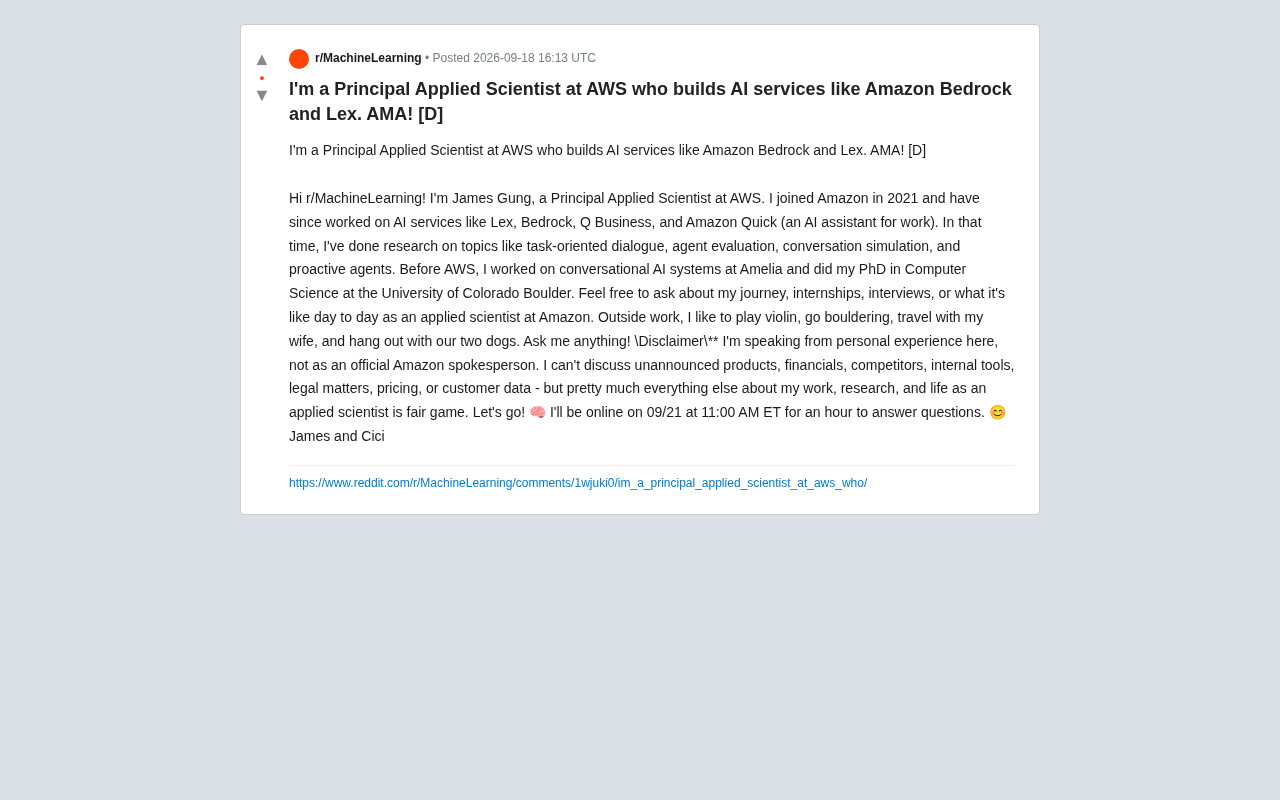
AWS Principal Applied Scientist James Gung hosted a Reddit AMA sharing his career journey from a conversational AI startup and a University of Colorado Boulder PhD to frontline scientist at Amazon. He has been deeply involved in building Amazon Lex, Bedrock, and Q Business, with research focused on task-oriented dialogue, agent evaluation, conversation simulation, and proactive agents. James spoke candidly as an individual about daily life as an applied scientist and career development details, offering rare first-hand guidance for researchers entering industry AI. He also highlighted that agent evaluation and reliability remain the core bottleneck in moving generative AI from demos to production.
AWS Principal Applied Scientist James Gung hosted an AMA (Ask Me Anything) session on Reddit's r/MachineLearning community, sharing his experience building AI services at Amazon and his career journey from PhD research to becoming a frontline industrial scientist. The conversation offers a rare first-hand perspective for practitioners looking to enter the applied science field.
From Academic Research to AWS
James Gung joined Amazon in 2021, having previously worked at conversational AI company Amelia and earned a PhD in Computer Science from the University of Colorado Boulder. This trajectory — from a conversational AI startup to a doctoral degree to a tech giant — is fairly typical in the applied science world.
The Applied Scientist role sits between pure research and engineering. It demands the ability to produce academically valuable work while also shipping that work as scalable products and services. James's experience perfectly embodies this duality: he both publishes research and directly contributes to building large-scale commercial services like Amazon Bedrock and Lex.
Four AI Services at the Core of His Work
Since joining Amazon, James has been involved in developing several key AI products, spanning the full spectrum from conversational bots to generative AI platforms:
Amazon Lex and Conversational AI
Lex is Amazon's service for building conversational interfaces and one of the underlying technologies powering Alexa. James's work here closely aligns with his research focus — task-oriented dialogue, which involves enabling AI systems to understand user intent and complete specific tasks rather than just making small talk.
Amazon Bedrock and Generative AI
Bedrock is AWS's enterprise generative AI platform, offering unified access to a variety of foundation models. As the large language model wave took hold, Bedrock became AWS's central strategic play in the generative AI race.
Bedrock's core value lies in its "model-agnostic" design philosophy: enterprises aren't locked into a single model vendor and can access foundation models from Anthropic (Claude series), Meta (Llama series), Mistral, Stability AI, and others through a unified API. On top of that, they can perform fine-tuning, retrieval-augmented generation (RAG), and agentic orchestration. This architecture lowers migration costs for enterprises and allows AWS to remain neutral at the model layer while focusing on compute infrastructure and security compliance. For applied scientists, Bedrock means designing universal evaluation and orchestration frameworks across a highly diverse set of model capabilities — which directly overlaps with James's research direction.
Q Business and Amazon Quick
James has also contributed to Q Business and Amazon Quick (a workplace-oriented AI assistant). These products represent the enterprise AI assistant frontier, requiring solutions to reliability and practicality challenges in real-world business environments.
Research Focus: Making AI Agents More Reliable
James's research centers on several critical pain points in deploying AI agents in production:
- Agent evaluation: How to scientifically measure an AI agent's performance — widely recognized as one of the hardest problems in the field.
- Conversation simulation: Using simulated conversations to train and test systems, reducing dependence on real user data.
- Proactive agents: Moving beyond purely reactive AI to systems that can anticipate user needs and take initiative.
These directions cut to the core bottleneck preventing generative AI from moving from demos to production deployments. Evaluation and reliability are exactly what enterprises care most about when deploying AI agents.
Agent evaluation is widely considered a hard problem because an AI agent's action space is far more complex than single-turn question answering: an agent may need to call external tools across multiple steps, maintain conversation state, and make decisions under uncertainty — making it difficult to measure outcomes with any single metric. Traditional NLP tasks (such as classification or translation) typically have clear ground-truth answers, whereas agent tasks may have multiple valid paths to success, and even a correct final result may involve unsafe intermediate steps. Conversation simulation attempts to address this by using LLMs to play virtual users and automatically generate test scenarios at scale without relying on real user data — but the distributional gap between simulated and real users introduces new evaluation biases, creating a circular challenge.
Career Insights from the AMA
The value of this AMA goes beyond product information. James was willing to openly discuss many details of career development — including internships, interviews, and what daily life actually looks like as an applied scientist at Amazon. For students and engineers hoping to enter the field, these first-hand accounts from frontline scientists are often far more useful than the job descriptions on a careers page.
Notably, James clearly defined the boundaries of the discussion: he emphasized that he was speaking as an individual, not as an official Amazon spokesperson, and could not address topics such as unreleased products, financials, competitors, internal tooling, legal matters, pricing, or customer data. This caution reflects the compliance constraints that scientists at large tech companies must navigate in public communications.
Conclusion
James Gung's AMA opens a window into the inner workings of AWS's AI research and development. From Lex's conversational technology to Bedrock's generative AI platform to cutting-edge research questions like agent evaluation, his work paints a complete picture of what applied science looks like in industry. For readers following AI career paths, this candid Q&A provides a genuine case study of the transition from academia to the industrial frontier.
Related articles

Build an AI Super Employee System at Zero Cost: A Full Breakdown of Automated Agent Workflows
A deep breakdown of the AI super employee system demoed on Bilibili: agent orchestration, digital human voiceovers, map and enterprise lead generation, 24/7 customer service, and legal modules. We analyze the business logic and compliance risks behind zero-cost signup to help entrepreneurs judge the real ROI of this AI digital employee system.

The Essential Difference Between Chatbots and AI Agents: Crossing from Conversation to Execution
What's the difference between a chatbot and an AI agent? Based on the MCP series on the Learn Tech channel, this article uses examples like booking flights and summarizing notes to explain: a chatbot only gives answers, while an agent actually completes tasks through a think-act-observe loop. It breaks down the four core components—model, tools, memory, and goal—as well as MCP's role as a bridge, and discusses agents' applicable boundaries and permission risks.

Free GitHub Repo: 342 Hours of AI Courses, from Math to MCP Servers
A free GitHub repo offers 342 hours of AI courses: 523 lessons across 20 phases, from math fundamentals to agent building and MCP servers. Nearly 100,000 learners have started.