Axari: Let Your AI Twin Take Over the Mundane Work of Security Operations
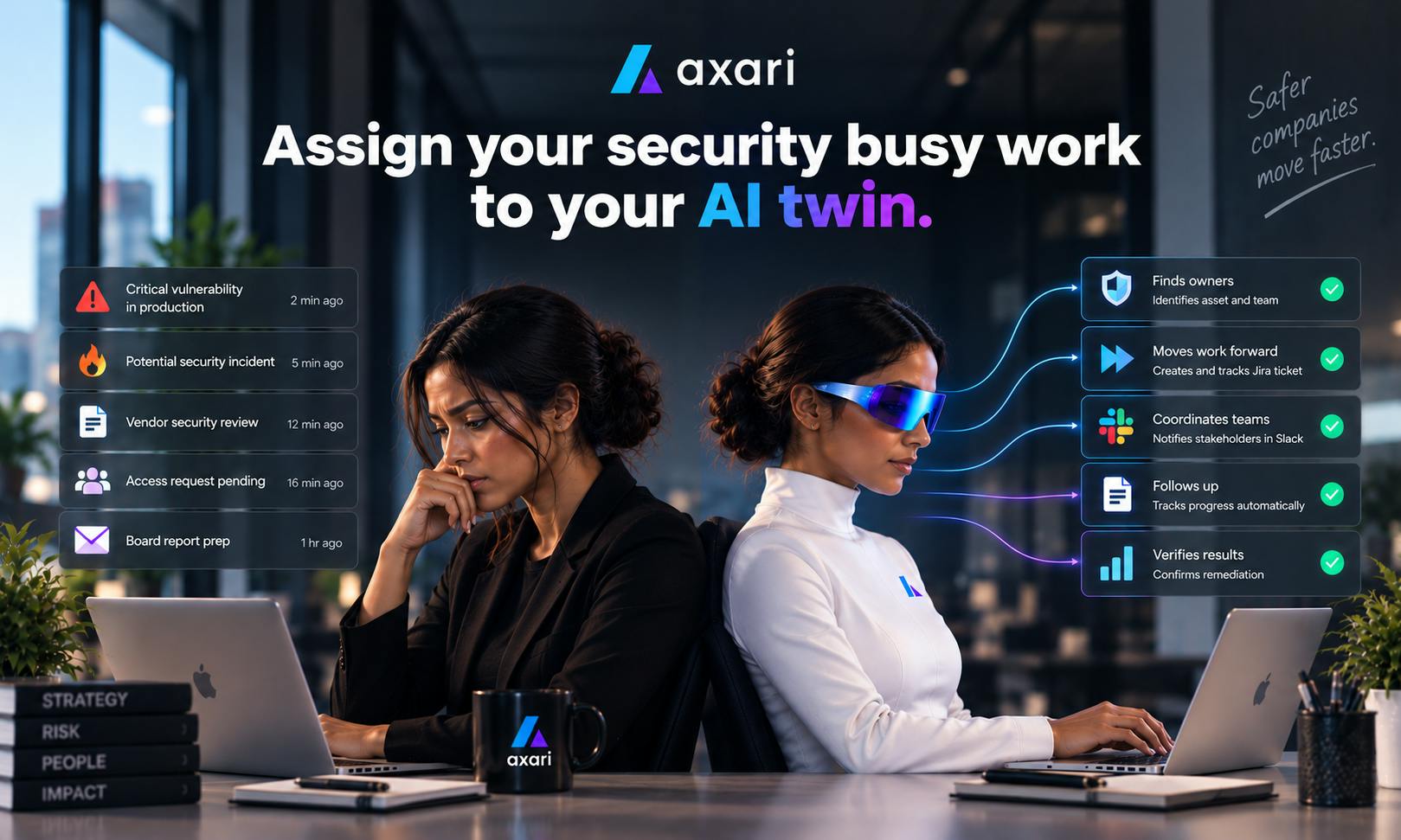
Axari deploys an AI twin inside Slack/Teams to autonomously take over repetitive security operations work.
Axari is an AI agent product for security operations (SecOps) teams, offering an "AI twin" that handles alert triage, compliance audits, and other repetitive tasks on behalf of security engineers. It supports three modes — assigning goals, proactive issue detection, and recurring responsibilities — all operable directly within Slack or Microsoft Teams. Its narrative is grounded in the reality that attackers already use AI extensively, and defenders shouldn't fall behind. Unlike rules-driven SOAR platforms, Axari emphasizes autonomous, closed-loop task execution. It ranked fifth on Product Hunt on launch day (108 upvotes), but its permission boundaries, integration depth, and real-world SOC effectiveness still await independent validation.
When Security Teams Are Drowning in Busywork
Security operations (SecOps) teams deal with a flood of alerts, tickets, compliance checks, and cross-tool coordination every single day. High-value decisions that genuinely require human judgment get buried under mountains of repetitive, low-value busywork. Attackers have long been leveraging AI to launch attacks at scale, while defenders are still fighting back with manual effort — an asymmetry that a growing number of security professionals see as a core pain point.
Axari, a new product that recently launched on Product Hunt and climbed to fifth place on the daily leaderboard (108 upvotes, 6 comments), is targeting exactly this problem. Its core proposition is straightforward: hand off your security busywork to an AI twin that understands your business.
What Exactly Is Axari
According to its official description, Axari provides an "AI twin" that understands your security environment, collaborates across tools and teams, and keeps work moving until it's actually done.
This product logic breaks down into three usage modes:
- Assign a goal: Give the AI twin a clear objective, and it autonomously breaks it down and executes.
- Work proactively: Let it independently surface and address issues without requiring step-by-step instructions.
- Recurring responsibilities: Permanently delegate periodic security tasks — such as routine checks and compliance audits — to the AI twin.
The choice of interaction channel is worth noting: all of these operations can be performed directly within Slack or Microsoft Teams. Security engineers don't have to keep switching to yet another standalone dashboard — instead, human-AI collaboration happens right inside the collaboration tools teams already use heavily. This "embed into existing workflows" design philosophy has become a clear trend in enterprise AI products in recent years.
The Clever Framing Behind "AI Twin"
Axari didn't position itself as another "security alert analysis tool" or "SOAR platform." Instead, it chose the more anthropomorphic framing of an "AI twin."
There's deliberate thinking behind this choice of words. Traditional security automation tools are typically passive and rules-driven — you write a playbook, and it follows the script. "Twin," by contrast, emphasizes understanding your context and continuously pushing things forward on your behalf — closer to a colleague who can act autonomously than a script. The product copy's phrase "keeps work moving until it is actually done" is specifically highlighting agent-style closed-loop execution, rather than simply offering recommendations and tossing all decisions back to a human.
From a categorization standpoint, Axari is listed under Artificial Intelligence, Bots, and Security — confirming its ambition to be an "autonomous security agent" rather than a pure analytics or chat assistant.
"AI Agent" and "AI twin" overlap significantly in technical meaning but differ in emphasis. AI Agent is a broad term for AI systems that can perceive their environment, plan autonomously, and execute multi-step tasks — it highlights the capability framework of "autonomous action." The "AI twin" narrative, on the other hand, emphasizes the anthropomorphic quality of "representing a specific individual or role" — not just a general-purpose agent, but a digital stand-in that understands your work context, habits, and organizational environment. The concept has precedent in industry: "Digital Twin" has long been used to describe virtual replicas of physical devices. Axari transposes it to the level of "a person's role," implying the product's goal isn't just task completion, but handling problems in a way that approximates the judgment of the person it represents. This narrative is highly appealing to enterprise buyers — but it also sets an extremely high expectations bar.
The Industry Logic of "Fighting AI with AI"
Axari's marketing copy includes a particularly charged line: "Attackers aren't going to use less AI, neither should you. You + your AI twin = indefatigable."
This speaks to a reality that's been widely discussed in the security industry: AI is simultaneously arming both sides of the offense-defense divide. Attackers use AI to generate phishing content, automate vulnerability scanning, and launch attacks at scale. If defenders continue relying on limited human resources and passive rules, the efficiency gap between attackers and defenders will only keep widening.
Delegating repetitive labor to a tireless AI, while freeing human security experts to focus on tasks that genuinely require judgment and experience — that's the core story Axari wants to tell, and it's also the shared narrative underlying the entire "AI for Security" category. From this perspective, Axari sits squarely in the same movement as the wave of security agent products that have emerged in recent years.
What Deserves a Sober Look
As a product that just launched on Product Hunt, the publicly available information still largely reflects the official marketing narrative — independent third-party evaluations and real-world deployment data are notably absent. Several questions remain to be answered:
- Boundaries and safety of autonomous execution: In a security context, having an AI "keep work moving until it's done" means it may touch critical operations in production environments. How permissions are controlled, how accidental actions are rolled back, and how human approval checkpoints are designed are all make-or-break factors for products like this.
- Depth of cross-tool integration: Claiming to "work across your tools" is easy, but the real moat lies in how deeply the product actually integrates with the range of security tools that matter (SIEMs, EDRs, ticketing systems, etc.).
- Real-world effectiveness: 108 upvotes from the community signals that the concept is compelling — but whether it can genuinely reduce the burden on real SOC (Security Operations Center) teams without introducing new risks is something only time and actual deployments can answer.
Background on SOAR and traditional security automation: SOAR (Security Orchestration, Automation and Response) is the most mainstream automation platform type in today's SOC environments. It automates tasks like alert triage, ticket creation, and threat intelligence lookups through pre-written "Playbooks." However, SOAR's core limitation is that all automation logic must be written by humans in advance — when novel attack patterns emerge or unpredicted scenarios arise, the system simply stops and waits for human intervention. Industry research suggests SOC teams process thousands of alerts per day on average, with a large portion being false positives, and analysts spend the majority of their time on mechanical triage work. What Axari targets is precisely this structural weakness of SOAR's "rules-driven, reactive" model — replacing it with an AI agent capable of reasoning and autonomous decision-making, which theoretically can handle problems even without a pre-written playbook. But that also means its predictability and auditability are considerably harder to guarantee than traditional SOAR.
Takeaway
Axari represents a clear product direction in the security space: using autonomous AI agents embedded in collaboration tools to take repetitive security operations work off human hands, reserving limited expert capacity for high-value decisions. Its "AI twin" narrative and "fight AI with AI" positioning both hit real industry pain points.
For security teams that have long been overwhelmed by alerts and tickets, this kind of product vision is undeniably appealing. That said, security contexts demand far higher standards of reliability and controllability than typical productivity tools. How trustworthy and usable Axari's "autonomous execution" ultimately proves to be is a question that only real-world deployments can answer.
Related articles
A New DeepSeek Harness Experiment: Agent Supervising Agent for Self-Evolution
A developer built an "Agent supervising Agent" self-evolution system using DeepSeek Harness, with a ledger mechanism enabling near-unattended overnight software iteration.
DeepSeek + 3 Tools: Generate a Professional PPT in 5 Minutes
A step-by-step guide to generating a PPT outline with DeepSeek, then using Tongyi, Kimi, or Coze to create a professional presentation in under 5 minutes — all free.
DeepSeek Speaks Japanese: Observations on Natural Multilingual Interaction
A Bilibili demo shows DeepSeek conversing naturally in Japanese — with proper honorifics, emotional roleplay, and Chinese–Japanese switching. Here's what it means.