Azure Databricks on Azure Government Public Preview: Modern Data and AI for Mission-Critical Workloads
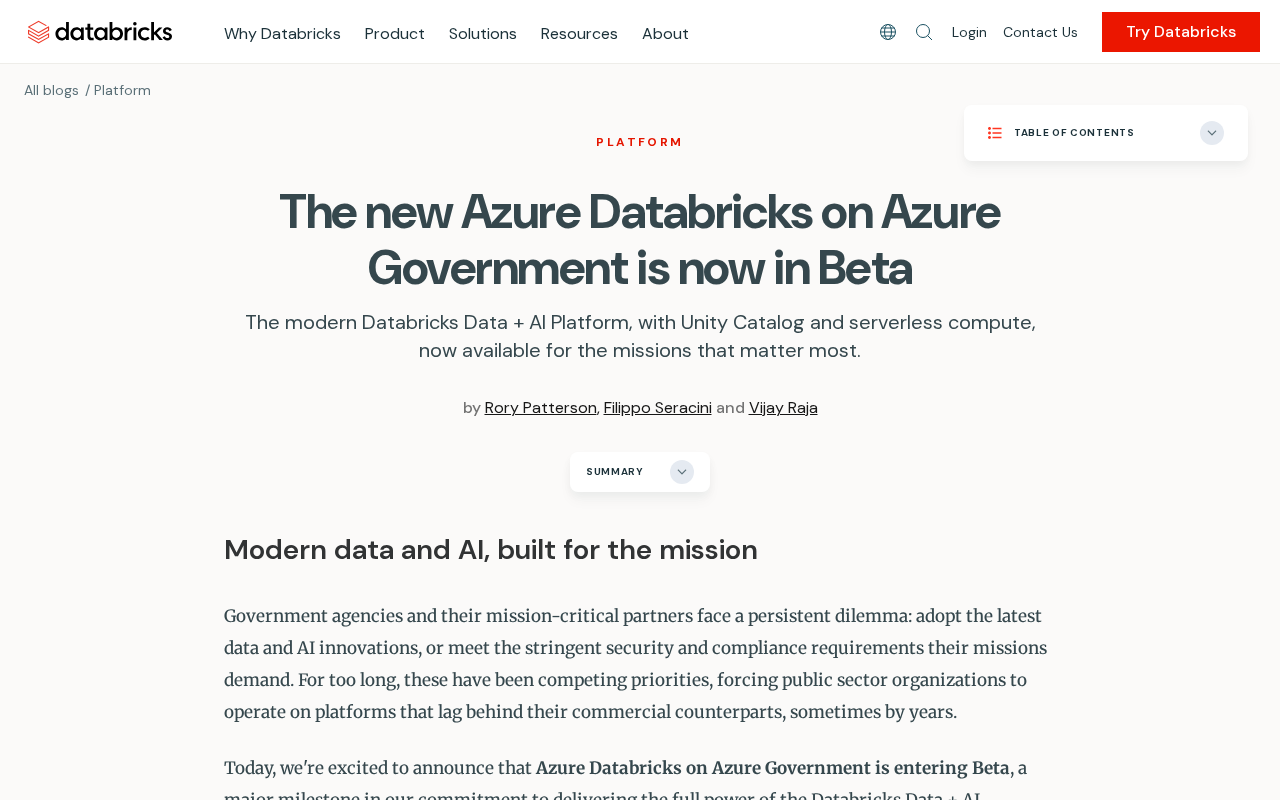
Azure Databricks enters public preview on Azure Government, signaling the migration of data and AI platforms to compliant government clouds.
Microsoft announced that Azure Databricks on Azure Government has entered public preview, offering managed lakehouse analytics and AI capabilities for government agencies' mission-critical scenarios. The article notes that government clouds have far stricter compliance, data sovereignty, and isolation requirements than commercial clouds, making general-purpose data platforms difficult to migrate directly; the significance of a dedicated environment is that government customers need not choose between compliance and capability. It also cautions that the Beta stage typically lacks a formal SLA and is suitable for evaluation, pilots, and architecture validation rather than production-grade workloads. Official details on regional coverage, feature trimming, and pricing have not yet been disclosed, and these will determine whether the service can move from pilot to production.
Microsoft has announced that Azure Databricks on Azure Government, aimed at government agencies, has entered public preview. On the surface, this is just a regional product expansion, but it points to a more noteworthy trend: data and AI platforms are migrating from commercial clouds to government cloud environments with the strictest compliance requirements.
Why Government Clouds Need Dedicated Data and AI Platforms
The original announcement positions this service as "modern data and AI built for mission," emphasizing that it targets government agencies and their mission-critical scenarios. This positioning is not vague—government workloads differ enormously from commercial workloads in compliance, data sovereignty, and isolation requirements, and general-purpose commercial cloud data platforms are often difficult to migrate directly.
Azure Government itself is a dedicated cloud environment for government agencies. By choosing to offer a managed service within this environment, Databricks means government customers can use unified lakehouse analytics and AI capabilities while complying with their compliance frameworks, without having to choose between compliance and capability.
FedRAMP and Government Cloud Compliance Frameworks
One of the core thresholds for U.S. federal government cloud procurement is FedRAMP (Federal Risk and Authorization Management Program), which provides civilian agencies with a unified cloud service security assessment and authorization mechanism. In parallel is the Department of Defense's Impact Level (IL2/IL4/IL5/IL6) classification, where higher levels impose stricter requirements on data isolation and encryption. When selecting platforms, government customers typically require that services have obtained the relevant authorization or are in the authorization process. This is also the fundamental reason why commercial cloud services are difficult to migrate directly: compliance authorization is not a natural extension of technical capability but a certification process that requires separate investment.
What the Beta Stage Means
The "Beta" status needs to be interpreted correctly. It usually indicates that core functionality is available, but service-level commitments and feature completeness may still change. For government customers, this means it is suitable for evaluation, pilots, and architecture validation, but not for directly hosting production-grade mission-critical workloads.
Interestingly, the original information is very concise and does not disclose specific regional coverage, feature trimming lists, or pricing details. These are precisely the parts government customers care most about during the evaluation stage, and official documentation should be the reference going forward.
The Relationship Between Preview Stages and SLAs
In the lifecycle of cloud services, Public Preview / Beta typically does not come with a formal Service Level Agreement (SLA). Microsoft makes no contractual commitments regarding availability, recovery time, or other metrics, and feature interfaces may change without notice. In contrast is the General Availability (GA) stage, when the service is incorporated into formal SLAs and support systems. For government customers, this means workloads during Beta do not have production-grade guarantees and are better suited for proof of concept (PoC), architecture adaptation, and security reviews rather than systems with high business continuity requirements.
Practical Impact on Government Data and AI Adoption
The value of this announcement lies in lowering the barrier for government agencies to adopt modern data stacks. In the past, if government customers wanted to use lakehouse architecture and machine learning capabilities, they often had to weigh compliance approval against platform selection repeatedly. With the managed service entering the government cloud, procurement and compliance paths are significantly simplified.
From an industry perspective, this is also a signal that cloud vendors and data platform vendors continue to increase their bets on the "regulated industries" track: whoever can first provide complete analytics and AI capabilities within compliant environments will be more likely to capture long-term infrastructure share.
Lakehouse Architecture
Lakehouse architecture is a data platform paradigm proposed by Databricks that attempts to combine the low-cost storage of data lakes with the transactional consistency and query performance of data warehouses. Its technical foundation includes open table formats (such as Delta Lake), a unified metadata management layer, and compute engines that simultaneously support BI analytics, stream processing, and machine learning on the same data. For government agencies, the value of the lakehouse lies in avoiding repeated data replication across multiple systems, thereby reducing data exposure surface and simplifying audit chains—which naturally aligns with government requirements for data governance and traceability.
Questions Still to Be Observed
Currently, public information is limited, and several key questions remain unanswered: the specific regional availability of the service within Azure Government, feature differences from the commercial version, and the scope of support for common government security and compliance certifications. These details will directly determine whether the service can move from pilot to production.
For teams focused on government digital transformation, it is recommended to prioritize architecture adaptation and compliance mapping validation during Beta rather than rushing to migrate production workloads.
(This article is based on limited information from the official announcement. For specific features and availability, please refer to official documentation.)
Related articles

Gemini 4 Neon Review: Benchmark Scores Rival Carbon, API Pricing and Quota Breakdown
Google Gemini 4 Neon is now live, benchmark scores closely tracking Carbon, API pricing 3/15 at twice Hydrogen's rate. This article compiles Bilibili creator testing: Neon can replace 90% of Carbon scenarios, AntiGravity quota consumption is only one-third of Carbon, plus subscription channel restrictions and 2API ban risks.

Gemini 4 Helium Coming Soon? Signals of Google Loosening Subscription Restrictions
Google team member hints releases will continue; community speculates Gemini 4 Helium (Flash Lite) may be next. Subscription ban controversy gets a response as product lead says "Soon," suggesting restrictions may be lifted. This article covers Gemini developments, OpenAI Coding Agent and risk management, Doubao real-time audio-video API, and compute business dynamics.

AI-Assisted React Development in Practice: Optimizing a Video App and Handling Errors
A 14-year veteran developer demonstrates AI-assisted React video app optimization: compressing video from 80MB to 5MB (~94%) via ImageKit, plus reliable error handling and retry mechanisms. Includes planning, code understanding, and verification methods for working with AI.