Backdoor: Reverse-Matching Startup Jobs from Your LinkedIn Profile

Backdoor reverse-matches startup jobs from LinkedIn profiles and provides founder email templates.
Backdoor is a job tool gaining attention on Product Hunt. After users paste their LinkedIn profile, it matches growing startups within about two minutes and suggests which founder to contact and how to write the email. Unlike traditional job search, it uses reverse matching to emphasize person-company connections, is free with no sign-up, and lowers the barrier for passive job seekers. The article analyzes its email template value, niche AI recruiting positioning, and long-term challenges around data real-time performance and matching accuracy under a free model.
In today's crowded landscape of job-hunting tools, a product called Backdoor has attracted considerable attention on Product Hunt. Its core logic is simple: paste your LinkedIn profile, and Backdoor reads your work experience, searches for growing startups, and surfaces opportunities that match your background. More importantly, it tells you which founder to email and how to write that email. The entire process is free, requires no sign-up, and takes about two minutes.
From "Sending Resumes" to "Reaching the Right Person"
Traditional job platforms often make users sift through massive job listings, but Backdoor tries to flip this process. Instead of actively searching for jobs, you let the tool discover suitable startups based on your profile. According to its Product Hunt page, Backdoor analyzes your LinkedIn profile and then identifies high-match options among growing startups.
This reverse-matching approach is unusual in the job-search space. Most platforms focus on job postings and resume submissions, while Backdoor emphasizes human connections — it directly provides founder contact information and email templates, attempting to shorten the path from discovering an opportunity to making contact.
A LinkedIn profile typically contains structured information such as work experience, education, skill certifications, and recommendations, and is a primary basis for recruiters and job seekers to understand each other. Backdoor reads users' public LinkedIn profiles, which means the completeness and accuracy of the profile directly affect matching results. Many users only list job titles and companies on LinkedIn, lacking project descriptions and skill tags, so AI may struggle to extract enough features during parsing to match startup needs. Therefore, before using such tools, improving the responsibility descriptions and achievement data in your profile is often more effective at boosting recommendation quality than relying solely on the matching algorithm.
Startup growth stages are usually divided by funding rounds — from seed, Series A, to Series B and beyond — and talent needs vary greatly across stages. Seed-stage companies may need more generalists and early core members, while post-Series A companies begin to establish clearer functional divisions. The "growing startups" emphasized by Backdoor generally refer to companies that have just completed financing and are expanding their teams but have not yet hired at scale. Such companies often lack enough brand awareness to attract proactive applications, so they rely more on founders' or early employees' personal networks to reach talent. This also explains why the tool directly provides founder contact information and email templates.
A Lightweight, Free, No-Sign-Up Experience
Backdoor emphasizes being free and requiring no registration, which lowers the barrier to use. Users only need to paste a LinkedIn link and wait about two minutes to receive a set of matching results. For passive job seekers who are keeping an eye on new opportunities, this low-commitment approach may be more appealing.
However, this also raises a question: how can a free tool sustain its operations? The product page currently does not disclose a business model, but it is reasonable to infer that it may monetize in the future through value-added services or enterprise-side fees.
Direct Access to Founders: The Value of Email Templates
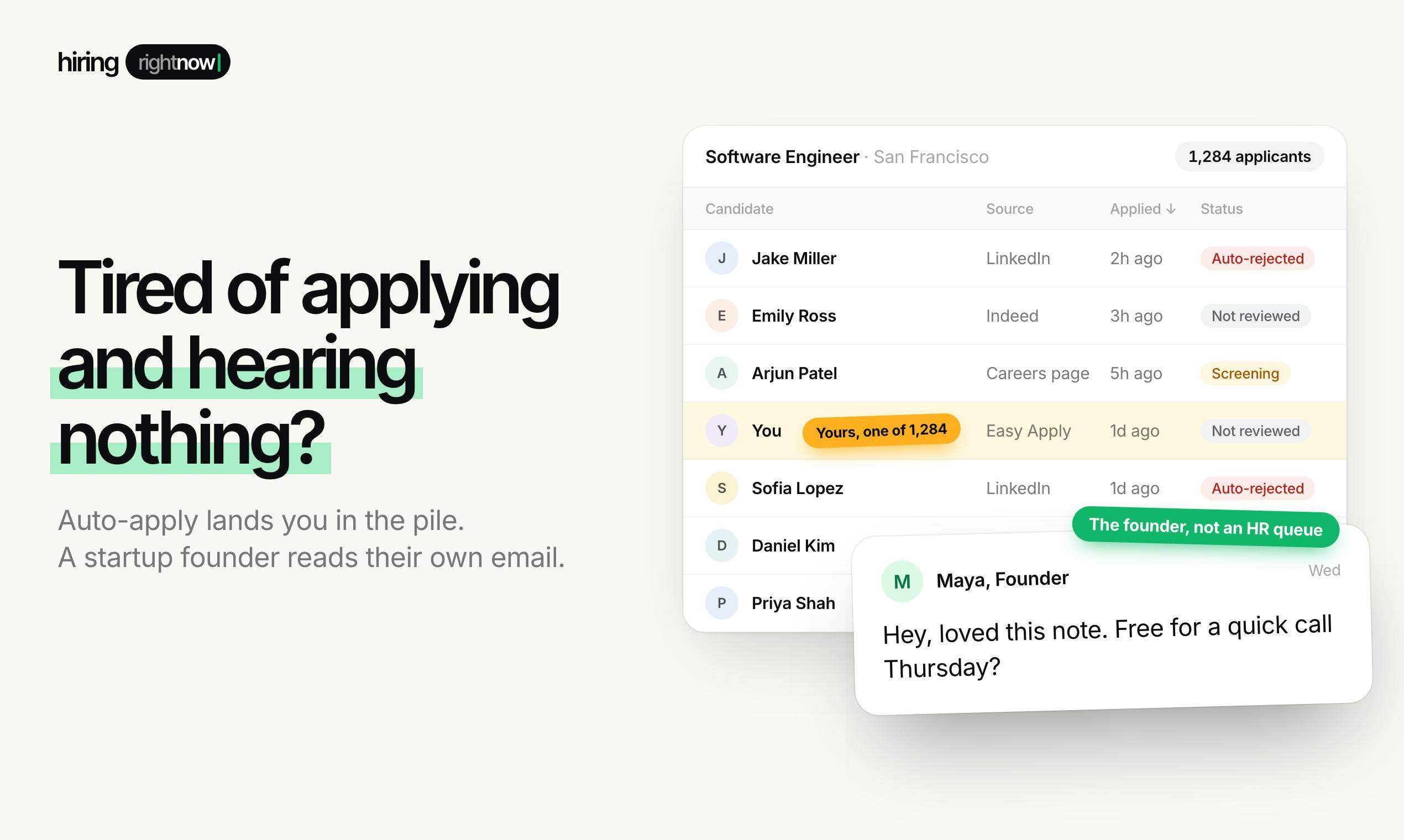
Another highlight of Backdoor is that it provides "which founder to email" and "what the email should say." When job-hunting at startups, contacting founders directly is often more effective than going through the regular recruitment process, but many people do not know how to start. Backdoor tries to solve this pain point by helping users take the first step with preset email templates.
This design also suggests Backdoor's understanding of the startup hiring ecosystem: early-stage companies value candidates' initiative and fit more than simple resume screening.
When job-hunting at startups, emailing founders directly is an informal but efficient way to reach out, especially when the company has not posted formal positions or its recruitment process is not transparent. An effective cold email usually needs several elements: a concise self-introduction, specific understanding of the company's business or product, what problems you can solve, and a clear call to action. The templates provided by Backdoor lower the psychological barrier to writing emails, but templates themselves are prone to homogenization. If a large number of users send similar content, founders' open and reply rates will decline. Therefore, templates are better used as structural references, and users still need to personalize them based on their own experience and the company's characteristics.
Market Positioning and Potential Challenges
Backdoor appears under the Hiring and Artificial Intelligence categories on Product Hunt, indicating that it targets both job search and AI-assisted tools. Currently, AI applications in recruiting are mostly concentrated in areas such as resume screening and interview scheduling, while Backdoor切入的是候选人端的匹配和触达,算是一个细分方向。
Challenges also exist. The quality of LinkedIn profiles directly affects matching results, and many users' profiles are incomplete. In addition, startup hiring needs change quickly, and the tool needs to keep its data real-time. Whether Backdoor can maintain data updates and matching accuracy under a free model will determine its long-term value.
Product Hunt is a community platform for launching and discovering new tech products, where users can upvote and comment on products, and top-ranked products usually gain attention from early seed users. Appearing under the Hiring and Artificial Intelligence categories shows that Backdoor is simultaneously classified under both the recruiting tool and AI application tag systems. For early-stage products, Product Hunt exposure is more of a cold-start tactic; what truly tests a product's value is subsequent user retention and paid conversion. A free, no-sign-up strategy is effective during customer acquisition, but it also means the product lacks a direct user account system, making it difficult to track long-term usage behavior and build user profiles. This will impose certain limitations on subsequent refined operations and monetization.
Who Is It For?
Backdoor is suitable for job seekers who are interested in startups but do not want to spend a lot of time searching for positions. It is especially suitable for passive job seekers, who may not be in a hurry to change jobs but are willing to see whether there are suitable opportunities on the market. The low-cost two-minute trial, plus direct-to-founder email templates, makes Backdoor a worthwhile starting point.
Of course, tools are only辅助,最终能否拿到面试,还要看候选人的实际能力和沟通质量。Backdoor 降低了信息门槛,但无法替代真实的职业竞争力。
One-line Summary
Backdoor reverse-matches startup jobs from LinkedIn profiles and directly provides founder email templates.
Paragraph Summary
Backdoor is a job-hunting tool that has attracted attention on Product Hunt. After users paste their LinkedIn profile, it matches growing startups within about two minutes and indicates which founder to contact and how to write the email. Unlike traditional job search and resume submission, Backdoor adopts a reverse-matching approach, emphasizing person-company connections and directly shortening the path from discovering an opportunity to making contact. The product is free and requires no registration, lowering the barrier for passive job seekers. The article analyzes the value of its email templates, its niche positioning in the AI recruiting track, and the long-term challenges of data real-time performance and matching accuracy under a free model, concluding that it is suitable for people interested in startups but unwilling to spend a lot of time searching for jobs.
Related articles

Pure-Code Video Generation Tested: Which AI Model Actually Follows Instructions?
A Bilibili creator tested three AI models' pure-code video generation with unified prompts and three revisions each: Xiaonaomao has a high ceiling but lacks stability, GPT 6.2 Extra models well but only follows half the instructions, and OPAS 5.5 remains the benchmark.

GPT-6 Six-Tier Hands-On Test: Astra Ultra Dominates but Bills Double
GPT-6 six-tier test: Astra Ultra sweeps 3:0 in 3D tasks thanks to sub-agents and runs 14% faster, but hidden backend bills make its real cost 2.6x single-threaded.

GPT-6.2 Astra vs Fable 5.2: Huge Cost-Efficiency Gap Across 12 Real-World Tests
Bilibili creator tests GPT-6.2 Astra vs Fable 5.2 across 12 real tasks: Fable wins 7-5 but costs 7.2x more and takes nearly 5x longer. Token efficiency emerges as the key selection metric.