Backend Developer Transition to AI/LLM: 4 Core Skills and a Practical Learning Roadmap

A practical guide for backend developers to transition into AI/LLM engineering with 4 core skills.
This guide helps backend developers transition into AI/LLM roles by focusing on four core skills: Python fundamentals, RAG (Retrieval-Augmented Generation), fine-tuning, and AI Agents. It explains why engineering talent is in high demand, provides a phased learning roadmap (2 weeks for Python/API basics, 2 months for RAG/fine-tuning/workflows), and emphasizes building real projects on GitHub over theoretical study.
Why Now Is the Critical Window for Backend Developers to Transition into AI/LLM
As large language model (LLM) technology accelerates its adoption in enterprises, more and more backend developers are considering a career transition. This isn't simply chasing hype—it's a genuine market signal: the demand for engineering-oriented talent who can integrate AI technology into real business applications is growing rapidly.
From an industry lifecycle perspective, AI/LLM is at a critical inflection point, moving from the "technology validation phase" into the "scaled application phase." It's similar to the mobile internet explosion around 2010—once the infrastructure (smartphones, 4G networks) matured, the real commercial value was created by a massive wave of application-layer developers, not chip designers. Today, the foundational capabilities of large models are already powerful enough. The industry bottleneck has shifted from "can the model do it" to "how do we use the model well and integrate it into business."
Interestingly, this transition path is fundamentally different from traditional AI research roles. A key insight: You don't need to be a math genius who can derive formulas from scratch to work in AI and LLMs. This punctures a common misconception about AI positions—many people abandon the idea of transitioning because they fear complex mathematical derivations. In reality, what enterprises truly lack is application-oriented, engineering-focused talent.

What Kind of AI/LLM Talent Do Enterprises Actually Need?
After analyzing over a thousand LLM-related job descriptions (JDs), a clear pattern emerges: what enterprises truly want is engineering talent who can integrate AI technology into actual business operations, not pure algorithm researchers.
This reflects the current stage of AI industry development. Foundational model capabilities are already provided by leading companies like OpenAI, Anthropic, and DeepSeek. The vast majority of enterprises don't need to train models from scratch—they need to perform business integration, fine-tuning, and productization on top of existing model capabilities. This paradigm is known in the industry as MaaS (Model as a Service)—enterprises call cloud-based LLM capabilities through APIs, just like using cloud computing services, without building their own compute infrastructure. Under this model, enterprises' core need becomes: how to deeply combine model capabilities with their own business data and workflows to create measurable commercial value. This is precisely what backend engineers excel at—system integration, API design, data flow management, and service reliability.
This means that for backend developers with engineering backgrounds, the barrier to transitioning into AI/LLM is far lower than imagined.
The key advice: don't blindly compete in areas where you lack natural aptitude (such as fundamental algorithm research). Instead, build on your existing skill tree and add a few critical new skill points.
Four Core Skills for Transitioning to an AI/LLM Engineer
Based on job requirement analysis, backend developers transitioning to AI/LLM engineering need to build these four key capabilities:
Python Fundamentals: The Universal Language of the AI Ecosystem
You don't need to be an expert, but you should at least be able to read and understand code. As the universal language of the AI ecosystem, Python is an essential tool for connecting to model APIs and writing data processing logic. For backend developers with programming experience, this step is relatively straightforward.
Python became the "official language" of AI due to its rich machine learning ecosystem—from data processing with NumPy and Pandas, to deep learning with PyTorch and TensorFlow, to LLM application development with LangChain and LlamaIndex. Nearly every AI toolchain uses Python as its primary language. For backend developers accustomed to Java or Go, Python's syntax is more concise and flexible. The core differences are dynamic typing and indentation-based syntax, which typically take about a week to get comfortable with.
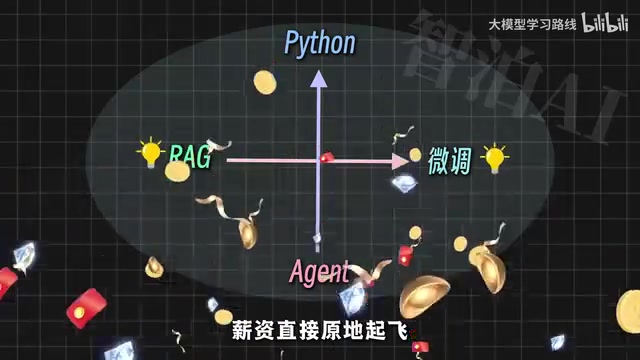
RAG (Retrieval-Augmented Generation): Solving LLM Hallucination Problems
RAG (Retrieval-Augmented Generation) specifically addresses the problem of models "confidently making things up" (hallucination). By combining enterprise private knowledge bases with the model, it enables the model to answer questions based on real data. This is currently a must-have technology for enterprise AI deployment.
To understand RAG's value, you first need to understand the root cause of LLM hallucinations: large models are fundamentally probabilistic prediction systems that generate the "most likely next token" based on statistical patterns in training data, rather than retrieving facts from a database. This means that when a model lacks training data in a certain domain, it will "fabricate" plausible-sounding but actually incorrect answers based on semantic similarity. RAG's approach is to retrieve relevant information fragments from an external knowledge base before the model generates its answer, then feed these fragments as context to the model. Its typical technical architecture contains three core components: Vector Database (such as Milvus or Pinecone, for storing semantic vector representations of documents), Retriever (responsible for matching the most relevant knowledge fragments to the user's question), and Generator (the LLM itself, generating the final answer based on retrieved context). For backend developers, building a RAG system is essentially creating a microservice architecture with semantic search—this shares remarkable similarities with traditional backend search services and caching layer design.
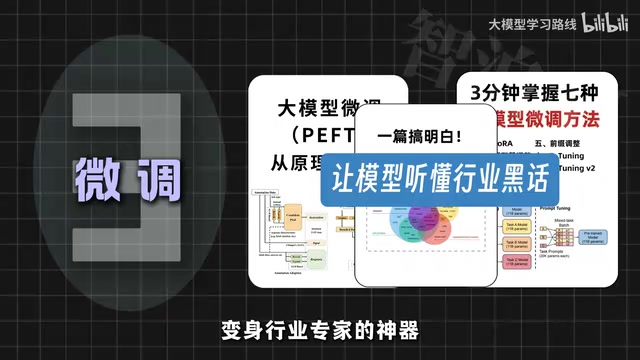
Fine-Tuning: Teaching the Model Industry Jargon
Fine-tuning adapts a general-purpose model to a specific domain, transforming it into an industry expert. This is a crucial method for adapting LLMs to vertical business scenarios and can significantly improve the model's output quality in specialized fields.
The core principle of fine-tuning is performing additional training on a pre-trained LLM using domain-specific datasets, enabling the model to learn professional terminology, expression patterns, and knowledge systems of that domain. What's particularly relevant for backend developers is that mainstream fine-tuning approaches no longer require dozens of GPUs for full-parameter fine-tuning. Instead, parameter-efficient fine-tuning techniques like LoRA (Low-Rank Adaptation) have become the standard. LoRA's core idea is to freeze the vast majority of the original model's parameters and insert a small number of trainable low-rank matrices into the model's attention layers—this reduces the compute requirements from hundreds of GB of VRAM down to what a single consumer-grade GPU can handle. Similar techniques include QLoRA (quantized LoRA) and Adapters. For engineers, the key to mastering fine-tuning isn't understanding every mathematical detail of the Transformer architecture, but rather: how to construct high-quality training datasets, how to select appropriate hyperparameters, and how to evaluate whether the fine-tuned model actually improves—these are all engineering-oriented challenges.
Agent: The Future Direction of AI Applications
Enabling models to think autonomously and execute tasks automatically is currently the hottest development trend in the entire industry. Agents upgrade LLMs from "Q&A tools" to "assistants that can get things done," representing the future direction of the application layer.
The fundamental difference between Agents and traditional Chatbots is that Chatbots operate in a passive "question-and-answer" mode, while Agents possess the ability to autonomously plan and execute complex tasks. A typical Agent architecture contains four core modules: Planning—decomposing complex tasks into executable sub-steps; Memory—including short-term memory (current conversation context) and long-term memory (historical interaction experience); Tool Use—the ability to call external APIs, databases, code executors, and other tools to complete specific operations; Reflection—self-evaluating execution results and iteratively optimizing. Here's a concrete scenario: when you tell an Agent "analyze last month's sales data and generate a report," it will automatically plan the steps (connect to database → write SQL queries → analyze data → generate visualizations → write report), execute them sequentially, and autonomously adjust strategy when encountering problems. For backend engineers, building Agent systems is essentially doing complex task orchestration and service scheduling—this shares natural similarities with workflow engines and message queue dispatching in microservice architectures.
A Replicable AI/LLM Learning Roadmap
The core principle of this learning roadmap is phased progression with emphasis on hands-on practice, suitable for backend developers with programming experience to directly follow:
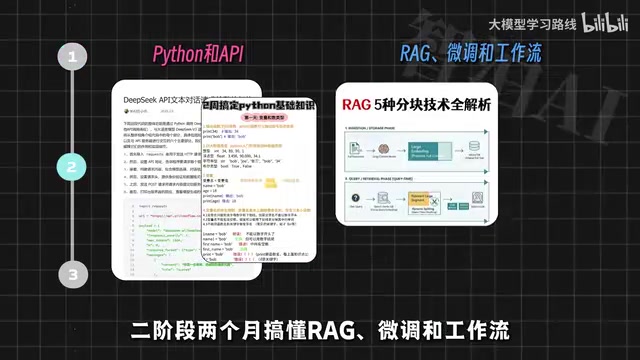
Phase 1: Two Weeks to Master Python and LLM API Calls
For developers with programming experience, two weeks is sufficient to grasp Python's basic syntax and learn how to call LLM APIs. The goal of this phase is to establish the fundamental channel of "driving models with code."
LLM API calls are essentially HTTP requests that send a Prompt to the model service and receive the model's text response. Several core concepts to understand include: Token—the smallest unit of text processing for LLMs; in Chinese, approximately 1.5-2 characters correspond to one Token, and API billing and context length limits are measured in Tokens; Prompt Engineering—guiding models to produce high-quality outputs through carefully designed input text format and content; this is a skill that doesn't require a math background but demands extensive practice; Streaming—similar to HTTP Server-Sent Events, allowing the model to return results token by token rather than waiting for complete generation. Major API providers include OpenAI (GPT series), Anthropic (Claude series), and domestic providers like Zhipu AI (GLM series), Baidu Wenxin, and Alibaba Tongyi. It's recommended to start with the OpenAI-compatible API format, since most domestic providers offer compatible interfaces—learn one format and apply it universally.
Phase 2: Two Months to Conquer RAG, Fine-Tuning, and Workflows
Over the next two months, focus on understanding the implementation principles and engineering practices of RAG, fine-tuning, and Workflows. This is the highest-value portion of the entire transition process.
Workflow here refers to chaining multiple AI capability nodes together according to specific logic to form automated business processes. For example: user input → intent recognition → knowledge retrieval → answer generation → format output → quality check, where each step may involve different model calls or tool invocations. Current mainstream development frameworks include: LangChain (the earliest and most popular LLM application development framework, offering out-of-the-box capabilities for chain calling, memory management, and tool integration), LlamaIndex (focused on data indexing and retrieval, particularly suited for building RAG systems), and Dify/FastGPT (visual workflow orchestration platforms that lower the development barrier). For backend developers, the design philosophy of these frameworks is highly similar to Spring Boot, Express, and other web frameworks—all reducing development complexity through abstraction and encapsulation. Mastering one or two of these frameworks and completing actual projects is the core objective of this phase.
It's particularly worth emphasizing that the key in this phase is not learning theory, but completing two hands-on projects and publishing them on GitHub. In AI talent recruitment, demonstrable project experience is often more convincing than certificates, directly proving your engineering ability to deliver technology into production.
A Realistic View on "Quick-Win" Promises in Career Transitions
While the market is full of marketing slogans like "from beginner to expert in seven days," given the objective rules of technical learning, readers should approach such quick-win promises with healthy skepticism.
The truly valuable information lies in the reasonableness of the skill framework and learning path: Python as the foundation, RAG to solve hallucination, fine-tuning for business adaptation, Agent for the future—this skill combination genuinely aligns with current enterprise needs. And the advice to "focus on practice, publish on GitHub" also aligns with engineering role hiring logic.
For backend developers, the biggest advantage in transitioning to AI/LLM is this: you already possess engineering thinking and programming ability. What you're missing is simply supplementary knowledge of the AI technology stack. Rather than anxiously trying to catch up, start by understanding API calls and gradually build your portfolio of AI projects.
Summary
In the current AI wave, the ability to deliver engineering-grade implementations will be the key differentiator for individual competitiveness. For backend developers, transitioning to AI/LLM doesn't require becoming a math genius—it requires building on your existing skills by adding Python, RAG, fine-tuning, and Agent capabilities, while accumulating engineering experience through real projects. Setting aside exaggerated marketing rhetoric, this skill framework itself is worth serious consideration by every developer hoping to enter the AI field.
Related articles

DynamicLake 2.0: Bringing Dynamic Island to Your Mac
DynamicLake 2.0 brings iPhone's Dynamic Island experience to Mac, with notifications, file staging, format conversion, AirDrop, timers, and a new plugin system.

Proofrr: One Workspace for Creative Feedback, Review, and Approval
Proofrr unifies client feedback, version comparison, review, and approval for design and video teams in one workspace — with no-login sharing and AI-assisted review.

FATHER: A Mac Operations Monitoring Dashboard Built for Vercel Teams
FATHER is a Mac-native ops dashboard for Vercel teams, aggregating traffic, deployments, uptime, PageSpeed, and Search Console SEO data with downtime alerts, SSL reminders, local token storage, and a one-time purchase model.