FATHER: A Mac Operations Monitoring Dashboard Built for Vercel Teams

FATHER is a Mac-native dashboard that unifies Vercel deployments, traffic, SEO, and alerts in one panel with a one-time purchase.
FATHER is a Mac-native desktop app by indie developer Richard Rogers, built for teams deeply invested in Vercel. It consolidates data from Vercel, Google Search Console, Bing, and performance tools — including traffic, deployment status, uptime, PageSpeed scores, keyword rankings, and indexing status — into a single dashboard, reducing the need to switch between multiple tools. Its core highlight is proactive alerting: the menu bar icon turns red on build failures, and SSL/domain renewal countdowns prevent costly oversights. With local token storage and a one-time purchase model, FATHER differentiates itself from mainstream SaaS tools, though it remains tightly coupled to the Vercel ecosystem.
For development teams deploying sites on Vercel, a Mac-native app called FATHER recently launched on Product Hunt, earning 81 upvotes and landing at #10 on the daily leaderboard. It consolidates scattered data — website traffic, deployment status, uptime, SEO performance, and more — into a single "mission-control" style desktop dashboard.
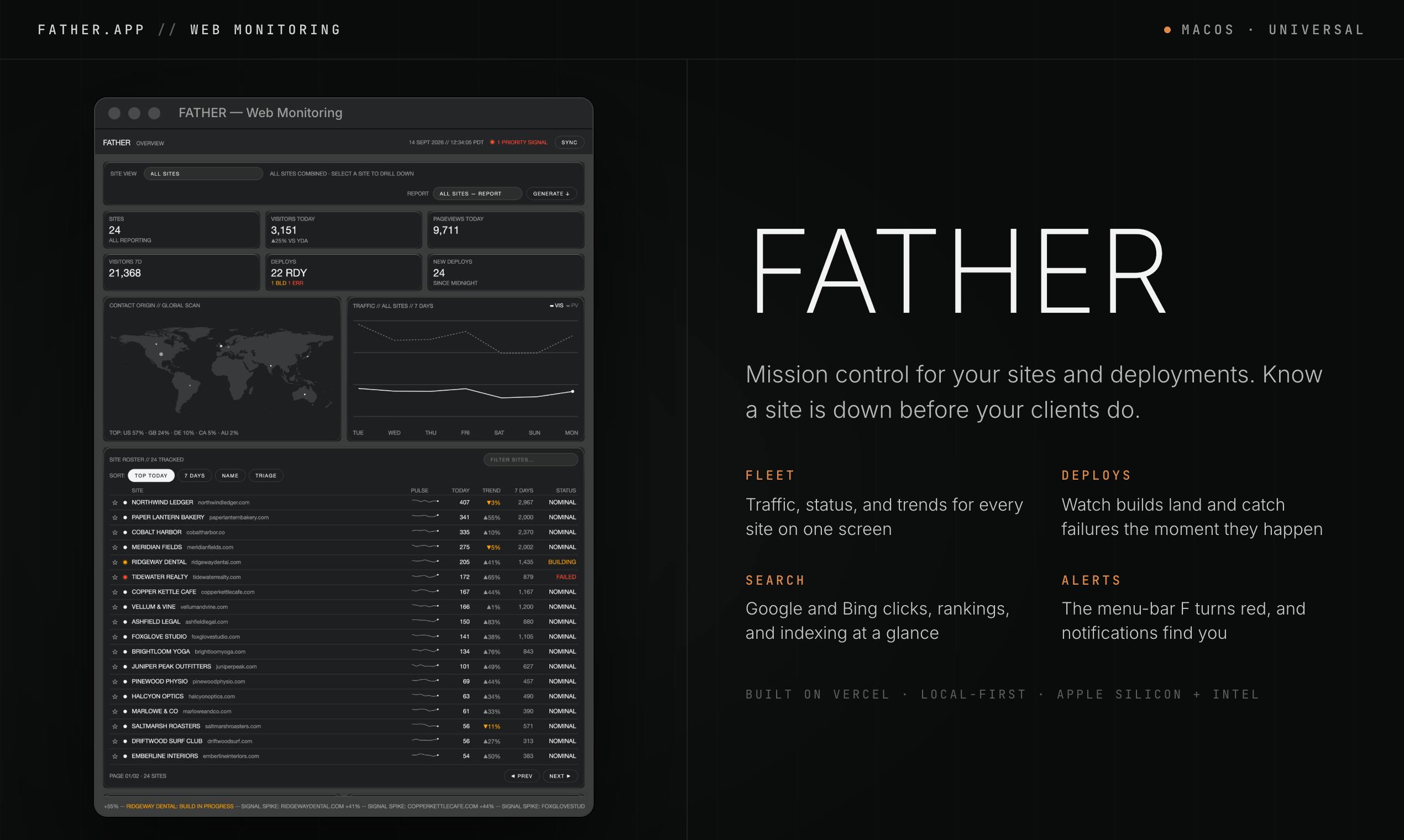
One Panel to See Your Entire Site's Health
FATHER's core positioning is as a "mission-control dashboard" — providing a unified view for teams practicing continuous delivery. Once you connect your Vercel account, every project under your account is automatically populated with real-time data: traffic, deployment history, uptime, and PageSpeed scores.
For solo developers or small teams managing multiple sites simultaneously, this kind of aggregation is genuinely valuable. Previously, you'd have to toggle between the Vercel dashboard, Google Search Console, and performance testing tools. FATHER aims to pull all those signals into a single interface, reducing the cost of context-switching.
SEO and Indexing Monitoring, Integrated
Beyond deployments and performance, FATHER also connects to Google Search Console and Bing data, surfacing clicks, keyword rankings, and indexing status. This sets it apart from purely ops-focused monitoring tools — it also tracks how well your site is being discovered by search engines.
For projects that rely on organic traffic, indexing status and ranking changes are often leading indicators of business health. Having SEO data and technical deployments on the same panel means developers can more quickly correlate "ranking drops" with "a recent deployment change," shortening the path to diagnosis.
Google Search Console (GSC) is a free webmaster tool from Google that records a site's impressions, clicks, average position, and page indexing status in Google Search. Bing Webmaster Tools is Microsoft's equivalent for the Bing search engine. Both require domain verification via DNS records or an HTML file before data becomes accessible. FATHER pulls API data from both platforms into a local dashboard, eliminating the need to log into each backend separately. It's worth noting that GSC data typically has a 2–3 day delay, making it better suited as a medium-term trend reference rather than a real-time alerting source.
Proactive Alerts: Know About Downtime Before Your Clients Do
One of FATHER's most practical design choices is its alerting system. SSL certificate and domain renewal countdowns are shown upfront, and failed GitHub checks are flagged prominently. When a build fails, the "F" icon in the menu bar turns red and fires a system notification — even if the app window is closed.
The team's description of this feature is refreshingly direct: "Know your site is down before your clients do." For service-oriented teams, detecting a failure proactively beats scrambling after a client complaint — both for user experience and for trust. Low-level but high-impact slip-ups like expired SSL certificates or forgotten domain renewals can be avoided with countdown reminders.
PageSpeed Insights is a web performance evaluation tool from Google, powered by the Lighthouse engine. It scores pages from 0–100 across four dimensions: Performance, Accessibility, Best Practices, and SEO. Core performance metrics include LCP (Largest Contentful Paint), CLS (Cumulative Layout Shift), and FID/INP (interaction latency) — all of which are components of Google's "Core Web Vitals" ranking signals. Fluctuations in PageSpeed scores after a new deployment can directly affect search rankings, so having performance scores and deployment records on the same panel makes it much easier to quickly assess whether a release caused a performance regression.
Privacy and Business Model
On the data security front, FATHER emphasizes that all access tokens are stored locally on your Mac and never routed through third-party servers. This directly addresses a common concern about handing production credentials to a monitoring tool.
The business model uses a one-time purchase rather than the subscription model that dominates today's SaaS landscape. For developers who stick with the same set of tools over the long term, a perpetual license typically means a lower total cost of ownership — and it's a popular differentiator among indie tools competing for users.
In the SaaS monitoring space, subscriptions are virtually the industry default: Datadog, New Relic, Sentry, and other major observability platforms all charge monthly or annually, often with tiered pricing based on data volume or seats, making long-term costs substantial. Perpetual License software settles the licensing fee upfront, with update policies varying by product — some offer lifetime updates, others charge per major version. For desktop tools with relatively stable feature sets that don't depend on cloud compute, the perpetual model is more economically friendly for users and is a common pricing strategy in the macOS indie developer community — with notable examples including the pre-Raycast-Pro Setapp model or Sketch's historical licensing approach.
Who Is It For?
FATHER's target user profile is quite clear:
- Independent developers or small teams deploying sites on Vercel
- Those who need to monitor ops, deployments, and SEO status across multiple projects simultaneously
- Users who prefer a Mac-native experience and favor a one-time purchase over a subscription
- Anyone with higher privacy requirements, such as keeping tokens stored locally
It doesn't try to be an enterprise-grade observability platform. Instead, it focuses on the "small but complete" daily inspection use case. As a product launched by an individual Maker (Richard Rogers) on Product Hunt, its feature coverage is already quite comprehensive — though it is deeply ecosystem-tied, currently centered around Vercel. Compatibility for non-Vercel users remains unclear.
Wrap-Up
FATHER addresses a specific and real pain point: the information that delivery teams need is scattered across too many panels. By aggregating traffic, deployments, uptime, SEO, and alerts into a single menu-bar-accessible dashboard, it compresses full-site health into one view. Local token storage and a one-time purchase further lower the barrier to trying it out. For teams heavily invested in Vercel, it's worth a look.
Related articles

SimpliSafe's New Video Doorbell: AI + Live Agents Actively Watching Your Front Door
SimpliSafe's $199.99 Video Doorbell Series 2 pairs with its Active Guard service to combine AI screening and live agents for proactive home security monitoring and intervention.

Fujifilm Instax Pal 2 Mini Camera: A Meaningful Upgrade That Finally Adds a Screen
Fujifilm's Instax Pal 2 mini digital camera adds a screen and viewfinder, fixing the original model's blind-shooting flaw and making it a more practical instant imaging device.

German Companies Are Almost Entirely Dependent on American AI Models and Services
German companies rely almost entirely on US AI vendors like OpenAI and Google. This article examines the causes, GDPR data sovereignty tensions, and Europe's path toward AI autonomy.