Backend to Agent Development: Tech Stack & Hands-On Project Guide

A practical guide for backend engineers transitioning to AI Agent development with enterprise-level depth.
This guide helps backend engineers transition to Agent development by focusing on what big tech companies actually evaluate: enterprise-level RAG implementation, AI engineering thinking, product awareness, and hands-on project depth. It outlines a four-stage learning path from LLM fundamentals to production-grade system design, emphasizing that engineering capability—not framework familiarity—is the real competitive advantage.
Why 90% of Backend Engineers Take the Wrong Path When Transitioning to Agent Development
With the explosion of large model applications, more and more backend engineers want to transition to Agent (intelligent agent) development. But the reality is that about 90% of people are still stuck in a misconception: they think that knowing how to use LangChain and building a few Agent demos is enough to land a job.
However, when it comes to actual interviews—especially at major tech companies—things aren't that simple. Big companies won't give you an offer just because you've called a few framework APIs. What they really care about is: Have you actually delivered enterprise-level projects? How do you solve specific problems? Why did you design it this way? How do you handle production incidents?
This article systematically covers the tech stack needed for backend engineers transitioning to Agent development, and what level your projects need to reach to truly withstand deep probing from interviewers.
Don't Just Focus on Frameworks—Build AI Engineering Thinking
Many people's learning paths go off track from the very beginning: they pour all their energy into frameworks like LangChain and AutoGPT. LangChain is an open-source framework for building large language model applications that lets developers quickly prototype LLM applications through abstracted components like Chains, Agents, and Tools. AutoGPT is an experimental autonomous AI agent project that can automatically decompose large goals into subtasks and execute them step by step. These two tools certainly lower the barrier to entry for AI applications, but this also creates a common misconception: thinking that mastering framework APIs equals mastering Agent development. In reality, frameworks are just tool-level abstractions—the real challenges lie in understanding underlying mechanisms and engineering implementation.
In actual technical interviews, interviewers rarely ask how to call a specific API—that's something you can look up in documentation.
What they prefer to ask are questions that require deep thinking:
- Why does this business scenario need an Agent?
- Why can't a traditional flowchart or rule engine solve it?
- Why did you design the system architecture this way?

The standard you need to reach is: being able to independently own an Agent project. From requirements analysis, Prompt iteration, tool development, RAG implementation, to Memory management and deployment—you should be able to articulate the design logic behind every step. If you've only followed tutorials to build a demo, you'll quickly get exposed once someone digs a little deeper.
RAG Needs Enterprise-Level Depth
RAG (Retrieval-Augmented Generation) is one of the most core technical paradigms in current Agent development. Its core workflow is: first split documents into semantically complete chunks, then convert text into high-dimensional vectors through Embedding models and store them in vector databases (such as Milvus, Pinecone, Weaviate, etc.). When a user queries, relevant content is first retrieved through vector search, then the retrieved results are passed as context to the large model to generate answers. Understanding this basic workflow helps you see why every step of enterprise-level RAG has extensive engineering details that need deep optimization.
Enterprises will never be satisfied with you only knowing how to build a simple knowledge base. What they truly care about are engineering details in complex business scenarios:
- Why did you use this strategy for document chunking?
- Why did you choose this Embedding model?
- What do you do when recall rate drops?
- After the knowledge base updates, how do you ensure users can query the latest data in real-time?
- If the vector database goes down, do you have a fallback plan?
A few key concepts need special explanation here: Hybrid retrieval refers to simultaneously using vector semantic search and traditional keyword search (such as the BM25 algorithm) to improve recall rate. Pure vector retrieval falls short when handling exact matches for proper nouns and IDs, while pure keyword search cannot understand semantic similarity—combining both yields the best results. Re-ranking uses a Cross-Encoder to perform fine-grained ranking on initially recalled results, further improving the relevance of Top-K results, which is much more precise than relying solely on vector similarity scores.
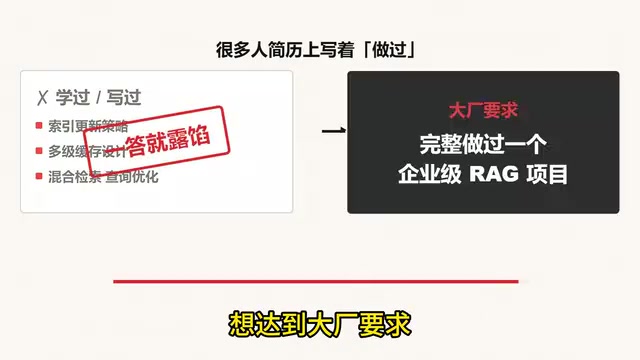
Many people write "built RAG" on their resumes, but when asked about index update strategies, multi-level caching design, hybrid retrieval, or query optimization solutions, they can't answer. This exposes the shortcoming of having only done toy demos from courses.
To meet big tech requirements, you need to have completed at least one enterprise-level RAG project, understanding the trade-offs behind every technical choice, rather than staying at the stage of a runnable demo.
Engineering Capability: The Biggest Advantage for Backend Engineers Transitioning to Agent Development
Once you actually join a team, you'll find that what gets discussed most every day isn't how to write Prompts, but system stability:
- What happens when LLM requests time out?
- How do you retry when tool calls fail?
- How do you handle ever-growing context and Token explosion?
- How do you control API costs?
- How do you design logging, monitoring, and rate limiting?
The Token explosion problem deserves special elaboration: Large language models all have context window limits (e.g., GPT-4 Turbo at 128K Tokens, Claude at 200K Tokens). The more input Tokens per request, the higher the inference latency and API costs. In Agent scenarios, since multi-turn conversation history, tool call results, and retrieved document fragments all accumulate in context, Token consumption grows rapidly. Common solutions include: conversation history summarization and compression, sliding window truncation, importance-based context filtering, and hierarchical memory mechanisms (short-term memory uses full text, long-term memory uses summaries or vector storage). This is one of the most frequently encountered performance and cost challenges in Agent engineering.
These problems are fundamentally all engineering problems. Many people think AI development is all about models, but ultimately, it's essentially a complex distributed backend system—just with a large model component in the middle.
This is precisely the natural advantage of backend engineers. The more solid your backend foundation, the greater your competitive edge in this transition. Compared to people from algorithm backgrounds who need to learn engineering from scratch, backend developers have a clear head start in system stability, observability, and fault-tolerant design.
Have Product Thinking—Don't Be a Code Monkey
Many programmers share a common problem: when a manager gives requirements, they just bury their heads in code. But companies want Agent developers who deeply understand business value.

You need to be able to answer these questions:
- Why does this scenario absolutely need an Agent? Can a rule engine solve it?
- Is a multi-agent architecture actually necessary?
- After going live, how much efficiency improvement or labor cost savings were actually achieved?
- If the AI's benefits don't even cover the cost of API calls, does this solution still make sense?
These questions come up frequently in technical reviews and interviews. Agent development requires not just technical skills, but also a clear understanding of what actual business problems AI is solving. Engineers with product thinking can make correct judgments on technical trade-offs. For example, in a simple customer service FAQ scenario, if rule matching can cover 95% of questions, introducing an Agent actually adds system complexity and uncertainty. Only scenarios that require flexible reasoning, dynamic decision-making, and cross-system coordination are where Agents can truly deliver value.
Hands-On Projects Matter Far More Than "What You've Studied"
Big tech companies almost never ask how many video courses you've watched. They only care whether your projects can withstand deep probing.

One truly deeply engaged hands-on project is worth more than ten superficial demos. What differentiates candidates is never "studied" but "built"—whether you've hit real obstacles in complex real-world scenarios, solved problems, and made trade-offs.
Four-Stage Agent Development Learning Path for Landing Big Tech Roles
If you're preparing to systematically target Agent positions at major tech companies, follow this progressive path:
Stage 1: Build a Solid LLM Foundation
Thoroughly learn LLM principles, API usage, Prompt engineering techniques, and Function Calling. Be able to independently complete basic AI application development. This is the entry threshold and the foundation for everything that follows.
It's especially important to understand the Function Calling mechanism: this is a structured capability provided by LLM vendors like OpenAI that allows the model to determine during a conversation whether it needs to call external functions, outputting function names and parameters in JSON format. This is the core mechanism that enables Agents to "use tools"—the model itself cannot execute code, query databases, or call APIs, but through Function Calling, it can decide which tool to call and what parameters to pass. The external system executes the call and returns results to the model for continued reasoning. Understanding this mechanism is the key step from ordinary chat applications to intelligent agents with action capabilities.
Stage 2: Master the RAG Tech Stack
Focus on breaking through enterprise-level engineering challenges: document chunking strategies, Embedding model selection, hybrid retrieval, Re-rank reranking, storage optimization, and index updates. This is the first critical point for differentiation.
Stage 3: Complete a Full Agent Project
Ideally including long-term and short-term memory management, tool calling, complex workflow orchestration, and multi-turn dialogue. Get the entire pipeline running end-to-end with practical value.
Stage 4: Round Out Engineering and System Design Skills
Including async processing, caching mechanisms, logging and monitoring, circuit breaking and degradation, cost control, and permission management. Circuit breaking and degradation is a classic fault-tolerance pattern in distributed systems, inspired by electrical circuit breakers: when a downstream service (like an LLM API) fails consecutively or response timeouts reach a threshold, the circuit breaker "opens" and subsequent requests go directly to fallback logic (such as returning cached results, calling a backup model, or providing default responses), preventing one node's failure from causing a system-wide cascade. In Agent systems, since they heavily depend on LLM APIs whose stability can't be fully guaranteed, circuit breaking and degradation mechanisms are especially critical. Combined with retry strategies (exponential backoff), timeout controls, rate limiting (e.g., token bucket algorithm), and multi-model failover, you can build a production-grade Agent system.
Finally, polish your project to the point where it can withstand continuous deep probing from interviewers.
Conclusion: The Hard Part Isn't the Model—It's Engineering Implementation
Many people think the barrier to big tech Agent development is very high. In reality, the truly difficult part isn't model algorithms—it's engineering implementation capability and project experience.
Everyone can call models and everyone can learn frameworks. But people who can actually get an Agent system stably deployed, continuously optimized, and genuinely solving business pain points are actually quite rare. For engineers with solid backend foundations, as long as you fill in the AI-related knowledge and hands-on experience gaps, transitioning to Agent development is not only feasible—you actually have stronger engineering competitiveness than those from pure algorithm backgrounds.
Related articles

Apple HomeView Hands-On Review: Is the $300 Smart Home Hub Worth It?
Apple HomeView hands-on: a $300 smart home hub with facial recognition for quick account switching, but no App Store or voice recognition. Is the wall-mounted version worth it? Should you buy the first generation?

Meta Muse Wonder Launch: What It Means for Meta's Return to the Frontier AI Race
Meta releases Muse Wonder and WonderFull, benchmarks reach the frontier, community feedback is polarized. An in-depth look at Meta's return to the frontier AI race, its personal agent strategy, and Zuckerberg's different path.

Apple Home Smart Home Lineup Leaked: LG and Schneider Team Up, UWB Door Lock on Board
Apple Home ecosystem gains new LG and Schneider devices: UWB smart lock with proximity unlock, 2.5K dual-camera doorbell, privacy indoor camera, and AirPods-like seamless pairing.