Bark: The Free BBS for '90s Teens and How It Connected a Generation in the Early Internet

Bark, a free BBS for '90s teens, connected young people at zero access cost and shaped early online community culture.
Using a Hacker News discussion about Bark as a starting point, this article introduces the free BBS platform aimed at 1990s teenagers. In an era when dial-up was expensive and home access was billed by the minute, Bark lowered the barrier through free access, letting young people who couldn't afford commercial online services join online communities. The article notes that BBS had a strong sense of place and tight member relationships, shaping the social habits of the first digital natives through nicknames, signature blocks, and forum discussions. Bark also embodied the early internet's spirit of open sharing—its free access was not a business strategy but a gesture of community mutual aid, contrasting with today's free models that cost users data and attention. Revisiting Bark helps illuminate the fundamental effects of access cost, community size, and management style on online communities.
In an era before broadband and smartphones became ubiquitous, getting online was far from the effortless experience it is today. For many teenagers in the 1990s, dial-up access was not only painfully slow but also meant competing with the family phone line, while expensive per-minute billing made long online sessions a luxury. It was against this backdrop that Bark emerged—a free BBS system that tried to connect young people in a different way.
According to a related discussion thread on Hacker News (item?id=50117504), Bark was a free BBS platform aimed at teenagers in the 1990s. BBS, or bulletin board system, was the quintessential form of online community before the internet went mainstream. Users dialed in via modem and, within a plain-text interface, posted messages, chatted, exchanged files, and even played simple text-based games.
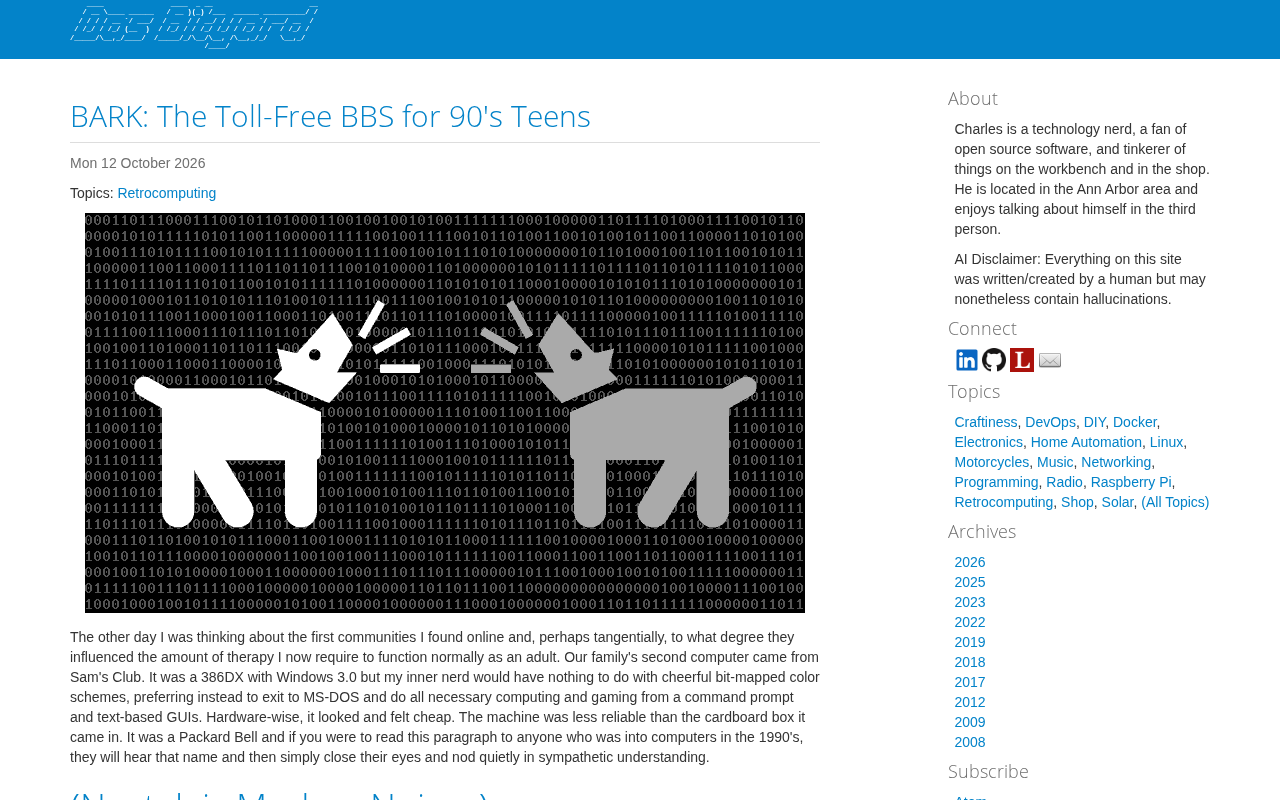
What Problem Did Bark Solve?
To understand Bark's value, you first need to understand the reality of teenage internet access in the 1990s. At the time, home internet access was typically billed by the minute, and many parents strictly limited their children's online time for a very simple reason: the bills were too high. Even when kids got the chance to go online, it was often only briefly, late at night or on weekends.
Bark's core selling point was free access. It lowered the barrier to entry, giving young people who couldn't afford commercial online services a cyberspace of their own. This positioning resembles later free email and free social platforms—opening up capabilities once reserved for paying users to a broader population.
From the perspective of BBS culture, this free strategy was especially important. BBS communities depended on sustained user participation: the more people joined, the livelier the discussions, and the more attractive the community became to each member. The free mechanism directly expanded the potential user base.
In the 1990s United States, home access to commercial online services such as AOL and CompuServe typically involved a fixed monthly fee plus an hourly usage charge, with long-distance dial-up calls adding further phone costs. The way a "free BBS" was often implemented was for the operator to use a local dial-up number or a toll-free line, so that access itself incurred no long-distance charges, shifting the cost from users to the operator. This is precisely the meaning of "Toll-Free" in Bark's name, and it was the key technical condition that allowed it to spread among teenagers.
BBS Culture and the Online Identity of '90s Teens
BBS was more than a technical tool—it shaped how the first generation of digital natives socialized. On systems like Bark, teenagers built identities with nicknames, expressed personality through signature blocks, and discussed music, games, movies, and school life in various forums. These behaviors seem utterly ordinary today, but at the time they were an entirely new social experience.
Unlike web forums, BBS had a distinct "sense of place." You had to dial into a specific system, like walking into a physical store. Each BBS had its own administrators, rules, and regulars. This semi-enclosed community structure made it easier for members to form tight bonds.
Bark's focus on teenagers meant its content and management style likely aligned more closely with young people's interests. It was both a social space and a gateway to learning technology—many BBS users later became programmers, system administrators, or internet entrepreneurs, with their first technical awakening coming from these plain-text interfaces.
BBS relied on a distinctive technical ecosystem. Amateur networks like FidoNet linked thousands of independent BBSs worldwide through nightly batch exchanges of mail, enabling cross-system discussions and file distribution. In this environment, users developed forms of expression such as sigs (signature blocks), ASCII art, and door games. These practices were later inherited and evolved by web forums, instant messaging, and social media, and understanding them helps illuminate the historical roots of contemporary online social habits.
Bark and the Open Spirit of the Early Internet
Bark's emergence reflected an internet philosophy that gradually faded: let as many people as possible connect for free. Before the wave of commercialization swept in, many BBSs were run voluntarily by enthusiasts, sustained through donations or out of their own pockets. They didn't chase ad revenue or user-growth metrics—they were driven more by community passion.
This model stands in sharp contrast to today's platform economy. Contemporary social networks are free in name, but users pay with their data and attention. The free of Bark's era was more a gesture of technological sharing and community mutual aid than a business model. Understanding this helps us rethink what "free" means in the context of the internet.
For enthusiasts of tech history, Bark is a concrete case study of early online communities. It reminds us that today's internet landscape was not inevitable, but the result of countless small systems competing and evolving.
It's worth distinguishing that the "free" of the BBS era is fundamentally different from today's "freemium." The former was mostly self-run by individual hobbyists or small communities, with no investor pressure and no user-conversion funnel; operators often paid out of pocket for phone lines and modems. The latter is a customer-acquisition strategy, where the free tier is merely the gateway to paid subscriptions or ad monetization. This difference determines entirely different incentive structures for the two systems: BBS operators aimed to maintain community atmosphere and member loyalty, while platform operators aim for growth metrics and commercial returns.
Why Bark Is Still Worth Revisiting Today
Looking back at Bark and BBS culture is not just nostalgia. It reveals several fundamental principles of online communities: access cost determines user composition, community size affects activity levels, and management style shapes cultural atmosphere. These principles still apply to product design today.
For readers interested in tech history or community operations, Bark's story offers a starting point for reflection: when technological barriers fall, who enters the network, and how do they change online culture? In the 1990s, Bark provided one answer; today, there's a new version of that question.
Related articles

Andrew Ng Teams Up with Anthropic: A Complete Walkthrough of the Claude Code Hands-On Tutorial
Andrew Ng and Anthropic launch a Claude Code short course covering clear context, parallel sessions, MCP servers, and three hands-on projects: a RAG chatbot, Jupyter data analysis, and Figma-to-frontend.

Only Three Agent Recommendations for Beginners: ZeroStack, Claude Code, and DeepSeek Harness
Bilibili creator recommends three beginner Agents: ZeroStack for lightweight devices, Claude Code with a mature ecosystem, and DeepSeek Harness for easy plugin integration. This article outlines use cases and practical tips for each tool.

How Does an AI Agent Control Your Computer? A Full Breakdown of Hermes' Three-Layer Toolchain
Bilibili creator Xiaoyou breaks down Hermes' three-layer toolchain for operating a computer: the built-in Terminal, file modification, and code execution foundation; optional web search, vision analysis, speech synthesis, and browser/desktop control; and an external ecosystem freely extended via CLI and MCP—plus why SSH connects but still can't operate.