Battledrones v14 Review: Claude Opus 4.5 Builds a Four-Player Map from a Single Prompt
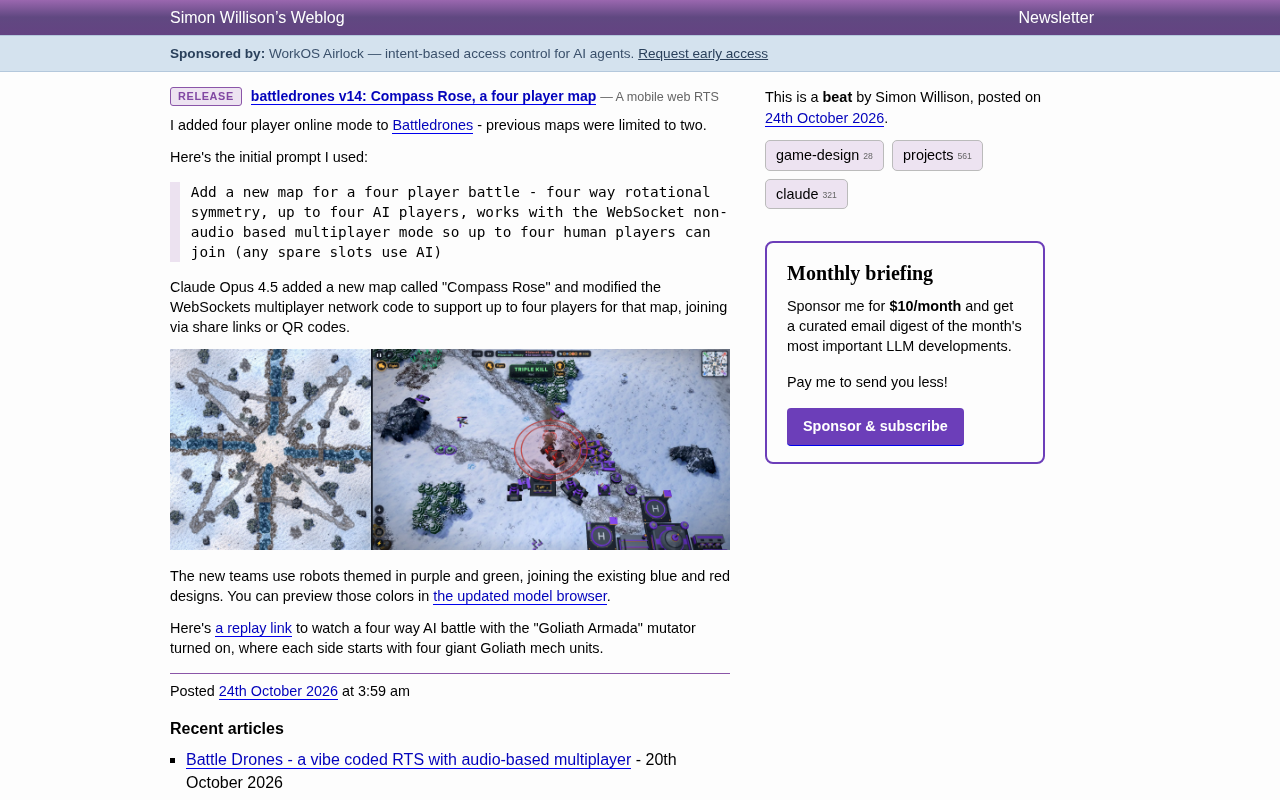
Battledrones v14 uses a single prompt to expand battles to four players and adds a symmetric frozen map.
Simon Willison's Battledrones project released v14 "Compass Rose," expanding player count from two to four. The core changes were driven by a single prompt with multiple constraints: Claude Opus 4.5 simultaneously added a four-way rotationally symmetric frozen map, modified the WebSocket multiplayer networking code to support four players, and implemented matchmaking logic prioritizing humans with AI filling empty slots. The new version also adds purple and green robot factions. The article argues that the real significance of this case isn't "AI writes code" but that the model can handle cross-module dependencies among map geometry, network protocols, and matchmaking logic; however, this success is built on the project's existing clear architecture—a targeted incremental extension on a mature codebase, not generating a game from scratch.
Simon Willison's Battledrones project has reached version 14, codenamed "Compass Rose." This update raises the maximum player count from two to four, and the core development work behind this feature was driven almost entirely by a single prompt.
From Two to Four Players: A Feature Extension Completed with One Prompt
In the release notes, Simon Willison shared the initial prompt he used:
Add a new map for a four player battle - four way rotational symmetry, up to four AI players, works with the WebSocket non-audio based multiplayer mode so up to four human players can join (any spare slots use AI)
This prompt contains several quite specific design constraints: the map needs four-way rotational symmetry, support for up to four AI players, compatibility with the WebSocket-based multiplayer mode (rather than the audio mode), support for up to four human players joining, with empty slots filled by AI. Building on this, Claude Opus 4.5 added a map called "Compass Rose" and modified the WebSocket multiplayer networking code to support four players battling simultaneously.
What makes this case noteworthy isn't "AI writes code" itself—that stopped being news long ago—but that a single natural-language description simultaneously constrained four layers: map geometry, player count, network protocol compatibility, and matchmaking logic. The model needed to understand the interdependencies among these constraints. Simon didn't describe how much follow-up debugging he did, but judging from the completeness of the release, this change was essentially a one-shot success.
Compass Rose Map Design: Four-Way Symmetry and a Frozen Biome
The visual design of the new map genuinely lives up to its name. From the screenshot Simon shared, the map uses a cold/frozen biome, with a layout showing a four-way rotational symmetry reminiscent of rose petals. This symmetry is a common design choice for four-player battle maps: each player's distance to the map center and resource acquisition paths are theoretically equal, avoiding structural advantages arising from spawn position.
Symmetric design in multiplayer games is never a purely aesthetic matter. Four-way symmetry means the map's tactical paths, cover distribution, and resource points all need to be mirrored four times around the center, which places higher demands on procedural map generation than two-way symmetry. Claude Opus 4.5 needed to ensure all four quadrants are geometrically equivalent while preventing the map from feeling mechanically repetitive—judging from the screenshot, the combination of frozen terrain and purple robots does bring a certain visual depth.
Procedural map generation typically relies on noise functions (such as Perlin noise or Simplex noise) to generate terrain undulation, biome distribution, and resource point locations. To enforce four-way rotational symmetry on top of this random generation, a common approach is to generate only one quarter of the map (one quadrant) and then fill the other three quadrants through rotational copying, or to apply symmetric folding to the sampling coordinates so that any point (x, y) takes the same terrain value as points rotated by 90°, 180°, and 270°. This ensures geometric equivalence of the four spawn areas while using the inherent irregularity of noise to prevent the map from feeling completely mechanical—a compromise between symmetry requirements and procedural generation.
Purple and Green Robots: New Factions Join
v14 adds purple and green themed robot factions alongside the existing blue and red designs. Simon mentioned that these color schemes can be previewed in the updated model browser. For a game with robots as its core visual element, adding new factions isn't just about changing colors—it requires ensuring the new color schemes remain sufficiently recognizable against the cold tones of the frozen map, while forming clear visual distinctions from teammate and enemy units.
The visual complexity of four-player battles is an order of magnitude higher than two-player battles: four colors of units are on screen simultaneously, and players need to accurately judge friend-or-foe relationships in fast-moving scenes. Purple and green sit between blue and red in hue; whether this color choice will cause recognition difficulties in chaotic battles may require actual gameplay to verify.
In multiplayer battle games, faction color schemes need to meet "color vision accessibility" requirements: approximately 8% of men have red-green color vision deficiencies, and distinguishing solely by similar hues like red versus green or blue versus purple may fail. A common engineering practice is to give each faction unique shape markers, outline strokes, or unit icons in addition to color, providing a second identification cue when hue is difficult to distinguish. The article notes that purple and green fall between blue and red in hue—precisely the typical scenario where color schemes require additional visual redundancy design.
Multiplayer Networking and Sharing Mechanics
v14's multiplayer mode is implemented via WebSocket, and Simon specifically emphasized "non-audio mode"—suggesting the project previously or concurrently had an audio-channel-based networking solution. Four-player rooms are joined via shared links or QR codes, with empty slots taken over by AI. This "humans first, AI fills gaps" matchmaking design is quite practical in small indie games—it lowers the barrier to filling a four-player room and makes it possible for a single player to test four-player maps.
Simon also provided a replay link for a four-player AI battle featuring the "Goliath Armada" mutator—each side starts with four giant Goliath mech units. This mutator significantly changes the pace of battle in four-player mode: sixteen giant units battling simultaneously on the frozen map is a stress test for both rendering performance and AI decision logic.
WebSocket is a protocol that provides full-duplex communication over a single TCP connection, commonly used for real-time bidirectional data transfer between browsers and servers. In multiplayer games, it allows the server to instantly broadcast any player's actions to other players without clients repeatedly polling. The "audio mode" mentioned in the article is an earlier alternative: transmitting game state data through audio channels like WebRTC, originally intended perhaps to reuse existing voice communication infrastructure, but bandwidth, latency, and data reliability are all inferior to a dedicated WebSocket channel. Hence the emphasis on "non-audio mode" means the project implemented a more direct networking foundation.
Implications for AI-Assisted Game Development
Battledrones' iteration path offers a window into the practical capabilities of AI coding assistants. Simon Willison has long documented his process of developing this project with Claude series models, and v14's progress shows the model is now quite reliable at handling "cross-module constraint" tasks: map generation, networking code, and matchmaking all needed coordinated modifications, while the prompt described only the final behavior in one sentence.
However, it's worth noting that such success cases are built on projects with clear existing architecture. Battledrones' map system, multiplayer networking layer, and AI player logic were already established; v14 is incremental extension on a mature codebase. For projects starting from scratch, the same prompt might not produce usable results. Understanding these cases as "AI excels at targeted extensions on good architecture" is closer to reality than "AI can make a game with one sentence."
Simon's release notes don't mention specific time spent or debugging iterations, so the proportion of human intervention in this change can't be determined. This is itself a common information gap in current AI-assisted development reporting.
One-line Summary
Battledrones v14 uses a single prompt to expand battles to four players and adds a symmetric frozen map.
Paragraph Summary
Simon Willison's Battledrones project released v14 "Compass Rose," expanding player count from two to four. The core changes were driven by a single prompt with multiple constraints: Claude Opus 4.5 simultaneously added a four-way rotationally symmetric frozen map, modified the WebSocket multiplayer networking code to support four players, and implemented matchmaking logic prioritizing humans with AI filling empty slots. The new version also adds purple and green robot factions. The article argues that the real significance of this case isn't "AI writes code" but that the model can handle cross-module dependencies among map geometry, network protocols, and matchmaking logic; however, this success is built on the project's existing clear architecture—a targeted incremental extension on a mature codebase, not generating a game from scratch.
Related articles

AWS Launches Official Agent Toolkit: Letting AI Agents Directly Build and Manage AWS Applications
AWS launches the official Agent Toolkit, letting AI coding agents directly build and manage AWS apps across CDK, CloudFormation, Serverless, Bedrock Agents, and DevSecOps.
Does Agentic AI Need Its Own "Second Foundation"? A Three-Loop Architecture Explored
Inspired by Asimov's Foundation series, a multi-agent AI architecture hypothesis proposes execute, verify, and adapt control loops to reduce correlated errors and improve trust in AI results.
Rewriting a Commercial Engine in Jai: The Trade-off Between Performance and Productivity
Exploring the engineering practice of rewriting a commercial game engine in Jai: compile-time metaprogramming and data-oriented design advantages, plus ecosystem maturity and learning curve challenges.