Bayesian Symbolic Regression: A New Paradigm for Causal Discovery

Reformulating causal discovery as Bayesian symbolic regression to quantify causal strength via posterior inclusion probabilities and return interpretable closed-form mechanisms.
The article introduces a new method that reformulates causal discovery as a Bayesian symbolic regression problem. Traditional constraint-based methods (such as PC) can only recover Markov equivalence classes, and score-based methods (such as GES) provide weak signal in bivariate or strongly autocorrelated data, making it difficult for either to give explicit causal directions. The new method samples closed-form expressions from the posterior distribution over symbolic models for each target variable and uses the frequency with which a candidate variable appears in the sampled expressions as the posterior inclusion probability, i.e., the causal score, thereby replacing pointwise model selection with an "ensemble of plausible mechanisms." Experiments on coupled nonlinear bivariate dynamics, the CauseMe benchmark suite, and a four-variable biogeoscientific structural causal model show that the method is competitive with, and often better than, purpose-built causal discovery algorithms, while returning interpretable closed-form mechanisms. The article also notes its high computational cost and suggests future exploration of more efficient sampling strategies and the incorporation of domain knowledge priors.
Causal discovery is central to scientific reasoning, yet traditional methods often only identify Markov equivalence classes in bivariate or strongly autocorrelated settings, failing to provide a clear causal direction. A recent paper proposes reformulating causal discovery as a Bayesian symbolic regression problem, quantifying causal strength by sampling symbolic expressions from a posterior distribution. The method performs well across multiple benchmarks and returns interpretable closed-form mechanisms.
Limitations of Traditional Causal Discovery Methods
Constraint-based and score-based methods are the two mainstream approaches to causal discovery, but they have inherent limitations. Constraint-based methods (such as the PC algorithm) rely on conditional independence tests and typically only recover Markov equivalence classes, failing to distinguish different causal directions within an equivalence class. Score-based methods (such as GES) can yield finer-grained structures, but the signal is weak in bivariate or strongly autocorrelated data, making them ineffective. These limitations are particularly pronounced in fields such as climate science and biogeochemistry, where data often exhibit strong autocorrelation and low variable dimensionality.
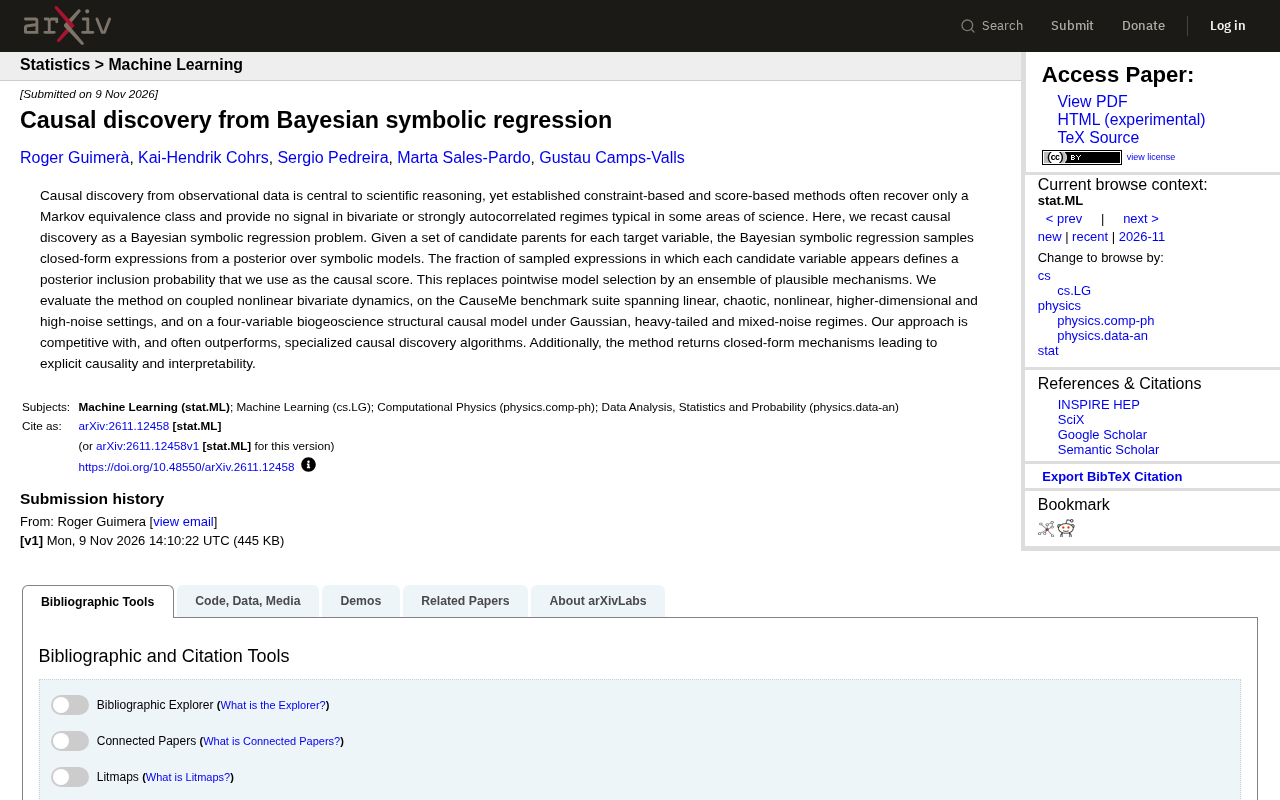
The paper notes that existing methods in these settings "often only recover Markov equivalence classes and provide no signal in bivariate or strongly autocorrelated mechanisms." This motivates researchers to explore new paradigms.
Markov equivalence classes are a fundamental and critical concept in causal graph structure learning. Given a set of observational data, multiple different directed acyclic graphs (DAGs) may be statistically indistinguishable—they entail the same conditional independence relations, and these graphs form a Markov equivalence class. For example, the chain structure X→Y→Z and the common-cause structure X←Y→Z both imply that X and Z are conditionally independent given Y, and observational data alone cannot distinguish between them. The output of constraint-based methods (such as the PC algorithm) is essentially a compact representation of an equivalence class (such as a partially directed acyclic graph, PDAG), in which the orientation of some edges cannot be determined. Breaking this equivalence typically requires additional assumptions (such as linear non-Gaussian noise or nonlinear additive noise) or interventional data. The bivariate setting discussed in the article is precisely the extreme case where the equivalence class degenerates: there are only two possible directions between two variables, and conditional independence tests provide no discriminating signal at all.
How Bayesian Symbolic Regression Is Used for Causal Discovery
The core idea of the method is to transform causal discovery into a Bayesian symbolic regression problem. For each target variable, given a set of candidate parent variables, Bayesian symbolic regression samples closed-form expressions from the posterior distribution over symbolic models. The frequency with which each candidate variable appears in the sampled expressions is defined as the posterior inclusion probability and serves as the causal score.
This design replaces traditional pointwise model selection with an "ensemble of plausible mechanisms." Specifically, traditional methods typically select a single best model, whereas this method evaluates the importance of each candidate variable by sampling a large number of expressions. The higher the posterior inclusion probability, the stronger the evidence that the variable is a causal parent. This approach applies not only to bivariate settings but also handles nonlinear, chaotic, and high-noise data.
Symbolic regression is a class of methods that automatically search for mathematical expressions from data, with a search space consisting of expression trees composed of operators (addition, subtraction, multiplication, division, exponentiation, trigonometric functions, etc.) and variables. Unlike traditional regression, which fits parameters of a fixed functional form, symbolic regression simultaneously learns model structure and parameters, outputting readable closed-form formulas and thus possessing inherent interpretability. However, the search space of symbolic regression grows combinatorially with expression complexity, and traditional methods (such as genetic programming) are prone to local optima and struggle to quantify uncertainty. Bayesian symbolic regression defines a prior distribution over expressions and performs posterior inference combined with a likelihood, using a probability distribution to characterize "which expressions are plausible," thereby naturally quantifying model uncertainty during the search. The article leverages exactly this property: by sampling a large number of expressions from the posterior and counting the frequency with which each candidate variable appears in the expressions, the posterior inclusion probability is obtained. This line of thinking is closely related to Bayesian model averaging (BMA), but extends the model space from regression models with fixed structure to arbitrary symbolic expressions.
Experimental Evaluation and Results
The researchers evaluated the method on multiple datasets. First, it was tested on coupled nonlinear bivariate dynamical data, a setting in which traditional methods struggle to provide signal. Second, it was tested on the CauseMe benchmark suite, covering a variety of settings including linear, chaotic, nonlinear, high-dimensional, and high-noise. Finally, it was tested on a four-variable biogeoscientific structural causal model involving Gaussian, heavy-tailed, and mixed noise mechanisms.
The results show that the method is competitive with, and often outperforms, purpose-built causal discovery algorithms. The paper emphasizes: "Our method is competitive with and often outperforms purpose-built causal discovery algorithms." Moreover, the method returns closed-form mechanisms, enabling explicit causality and interpretability.
Advantages and Significance
The advantages of the method are threefold. First, it overcomes the limitations of traditional methods in bivariate and strongly autocorrelated settings, providing explicit causal directions rather than equivalence classes. Second, it provides interpretable closed-form expressions that help in understanding the causal mechanisms between variables. Third, it improves robustness through ensemble posterior sampling, avoiding the bias introduced by single-model selection.
This research offers a new approach to causal discovery, particularly suited to scientific fields where traditional methods fail. In the future, the method is expected to play an important role in disciplines that rely on observational data, such as climate science, ecology, and biogeochemistry.
Future Outlook
Although the method performs well on benchmarks, the authors also note that its computational cost may be high, as it requires sampling a large number of symbolic expressions. Future work could explore more efficient sampling strategies or extend the approach to larger-scale causal graph learning. In addition, how to incorporate domain knowledge into the prior distribution is also a direction worth exploring.
In summary, Bayesian symbolic regression opens a new path for causal discovery, achieving more accurate and interpretable causal inference in challenging settings by combining Bayesian inference with symbolic regression.
Related articles

Gemini 4 Neon Review: Benchmark Scores Rival Carbon, API Pricing and Quota Breakdown
Google Gemini 4 Neon is now live, benchmark scores closely tracking Carbon, API pricing 3/15 at twice Hydrogen's rate. This article compiles Bilibili creator testing: Neon can replace 90% of Carbon scenarios, AntiGravity quota consumption is only one-third of Carbon, plus subscription channel restrictions and 2API ban risks.

Gemini 4 Helium Coming Soon? Signals of Google Loosening Subscription Restrictions
Google team member hints releases will continue; community speculates Gemini 4 Helium (Flash Lite) may be next. Subscription ban controversy gets a response as product lead says "Soon," suggesting restrictions may be lifted. This article covers Gemini developments, OpenAI Coding Agent and risk management, Doubao real-time audio-video API, and compute business dynamics.

AI-Assisted React Development in Practice: Optimizing a Video App and Handling Errors
A 14-year veteran developer demonstrates AI-assisted React video app optimization: compressing video from 80MB to 5MB (~94%) via ImageKit, plus reliable error handling and retry mechanisms. Includes planning, code understanding, and verification methods for working with AI.