Becoming an AI Agent Engineer: A Detailed 4-Week Hands-On Learning Roadmap

A structured 4-week roadmap to transition into an AI Agent engineer role, from theory to hands-on projects.
This article lays out a practical four-week learning path for anyone looking to become an AI Agent engineer: Week 1 covers core agent architecture, Week 2 explores the ReAct workflow, Week 3 tackles multi-agent collaboration and prompt optimization, and Week 4 focuses on building résumé-worthy projects—plus a rational take on the roadmap's realistic expectations.
Why Most People Take the Wrong Path When Learning AI
As AI Agents have become one of the hottest tech directions in recent years, more and more people hope to use them as a springboard for a career change. But there's a harsh reality: many people fail at learning AI not because they don't work hard enough, but because their learning roadmap was wrong from the very start.
Diving blindly into deep learning theory and mathematical derivations, or falling into the "bookmarking equals learning" trap of endless tutorials, often burns through all of a learner's enthusiasm right at the entry stage. For those whose goal is a "career change and employment," the soundness of the roadmap matters far more than the amount of time spent studying.
This article is based on a four-week learning roadmap shared by a Bilibili creator, refined and expanded in light of the actual engineering requirements of AI Agent technology. It should be noted that "getting started in four weeks and becoming an Agent engineer in three months" is an aspirational goal—actual progress varies from person to person—but a clear roadmap can indeed dramatically boost learning efficiency.
Week 1: Master the Core Architecture of Agents
The first step in learning about AI Agents isn't rushing to write code—it's understanding "what an Agent actually is." A complete agent architecture typically consists of four core modules:
The Four Core Modules
- Large Language Model (LLM): The "brain" of the agent, responsible for understanding, reasoning, and generation.
- Planning System: Breaks down complex tasks into executable subtasks.
- Memory Module: Includes short-term context and long-term memory, giving the Agent task continuity.
- Tool Use: Breaks through the model's inherent limitations by calling external APIs, search engines, code execution, and more.
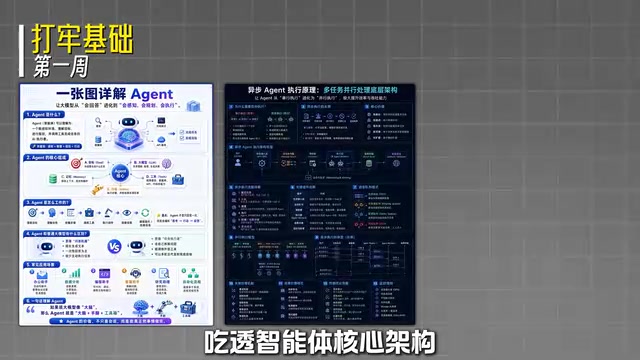
Understanding this architecture essentially means grasping the fundamental difference between an AI Agent and an ordinary chatbot: an Agent can autonomously perceive its environment, make decisions, and take action, rather than merely responding passively. The goal of this week is to establish a correct technical framework and lay a solid foundation for later learning.
Week 2: Break Through the Core Challenges and Understand the Workflow
With an understanding of the architecture in place, Week 2 dives into how Agents operate, focusing on mastering the mainstream reasoning-and-acting paradigms.
ReAct and Chain-of-Thought
ReAct (Reasoning + Acting) is currently the most classic AI Agent working pattern. It has the model loop iteratively between "thinking" and "acting": first analyzing the current state, then deciding which tool to call, observing the result, and continuing to reason until the task is complete.
Beyond ReAct, there are also reasoning approaches like Chain-of-Thought and Reflection. Only by understanding these paradigms can you truly grasp how AI autonomously completes complex tasks—it doesn't produce an answer in a single step, but instead reasons step by step, makes mistakes, and corrects itself, much like a human.
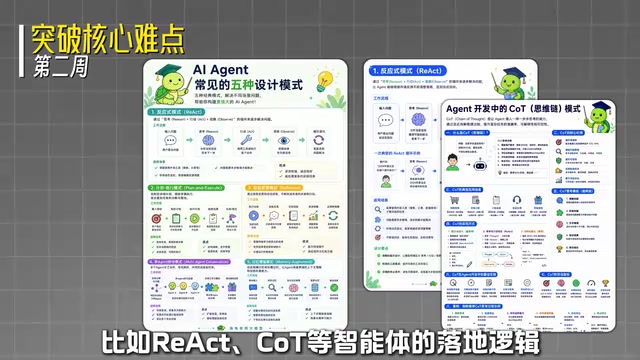
This week is the critical leap from "knowing the concepts" to "understanding the logic," and it's also where many learners get stuck. It's recommended to work through concrete code examples and observe each step of the Agent's thought process.
Week 3: Multi-Agent Collaboration and Prompt Optimization
A single Agent has its limits, and the real engineering value often lies in multi-agent collaboration.
Getting AI to Work Together Like a Team
A Multi-Agent System lets multiple AIs divide labor and cooperate—one handles planning, one handles execution, one handles review—much like an efficient human team. This architecture can handle more complex business scenarios and is the mainstream direction for enterprise-level AI applications today.
On the other side, prompt optimization is a core skill that runs throughout. With the same model, different prompt designs can produce vastly different output quality. Learning to precisely translate business needs into prompts—making the Agent's output stable, controllable, and well-suited to real scenarios—is a key ability that distinguishes an engineer from an ordinary user.
Week 4: Extensive Hands-On Practice—Put Projects on Your Résumé
The biggest taboo in learning AI is "only watching, never doing." The core task of Week 4 is to build projects with your own hands.

A Project Progression from Simple to Complex
- Beginner: Task automation scripts, such as automatically organizing documents or batch-processing data.
- Intermediate: Building an intelligent Q&A assistant with tool-calling capabilities.
- Enterprise-level: Building intelligent assistants for specific business scenarios, such as a customer service Agent or a data analysis Agent.
After completing these projects, you'll have demonstrable hands-on experience—achievements you can put directly on your résumé and use as strong talking points in interviews. A working, demonstrable AI Agent project is far more compelling to an interviewer than empty discussion of concepts.
A Rational Perspective on This Roadmap
The value of this four-week roadmap lies in being clearly structured and goal-oriented: moving from architectural understanding, to working mechanisms, to multi-agent collaboration and optimization, and finally to real project implementation—following the natural progression of technical learning from shallow to deep.
Still, it's important to keep a few things in clear perspective:
- "Getting started in four weeks" is an aspirational goal; actually achieving it requires investing enough time every day and maintaining strong follow-through.
- AI Agent technology iterates extremely fast; mainstream frameworks like LangChain, LangGraph, and AutoGen need to be continuously kept up with through practice.
- A career change into this field tests not only technical skills but also a genuine understanding of business scenarios and accumulated experience in engineering implementation.
For learners hoping to enter the AI Agent field, the most important thing isn't agonizing over "how long it takes to learn," but starting immediately and persisting with hands-on practice. A correct roadmap combined with sustained execution is the true shortcut from zero experience to an engineering role.
Related articles
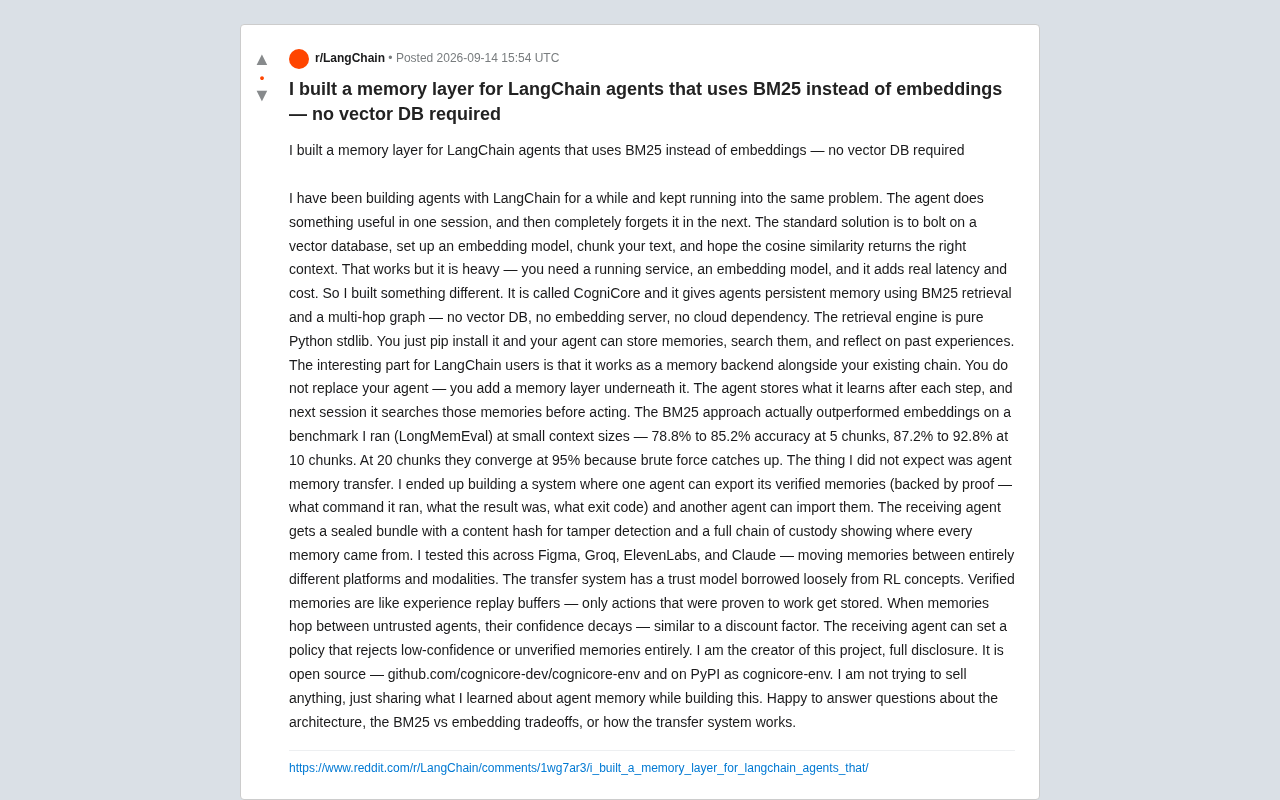
Ditch the Vector Database: Building a Memory Layer for LangChain Agents with BM25
CogniCore replaces vector databases with BM25 retrieval for LangChain agent memory, outperforming embeddings in small-context benchmarks with zero external dependencies.
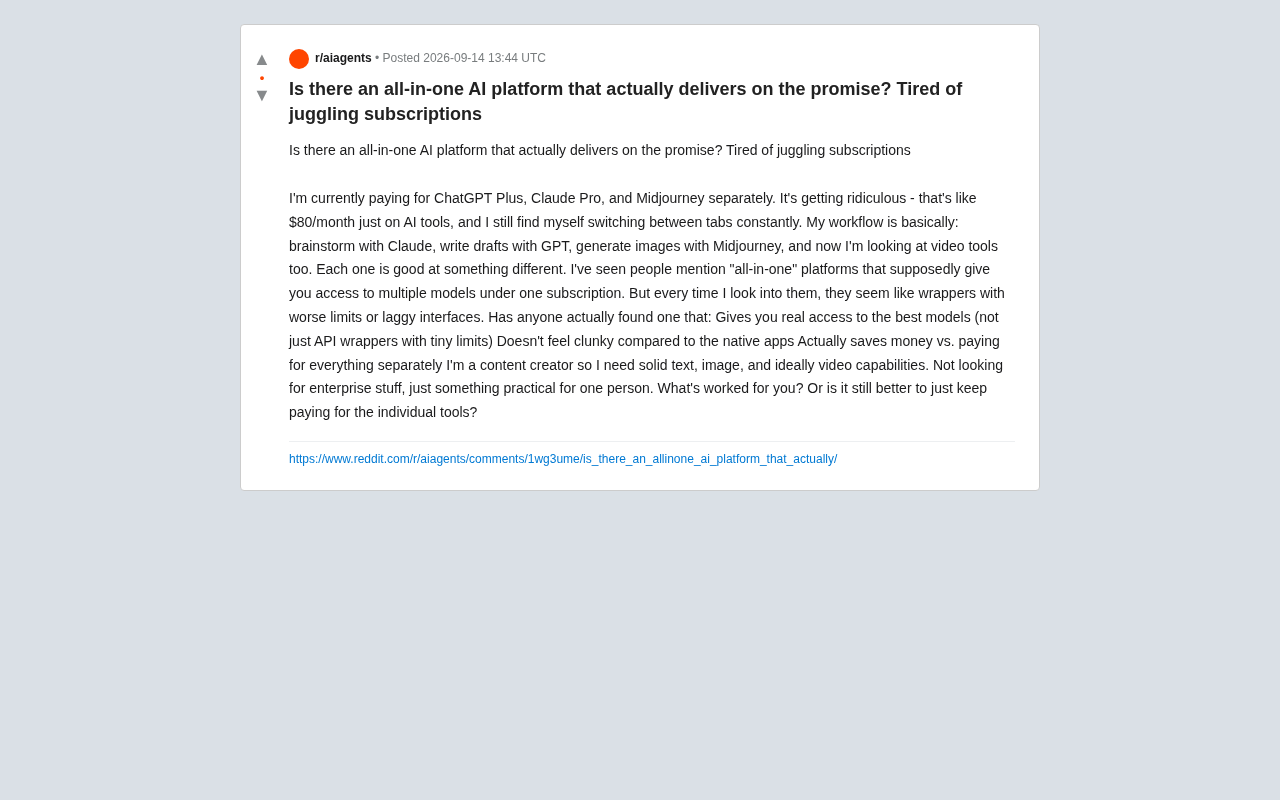
Are All-in-One AI Platforms Actually Worth It? A Practical Guide to Escaping Subscription Overload
Tired of paying for ChatGPT, Claude, and Midjourney separately? We break down whether all-in-one AI platforms are actually worth it — and what a smarter subscription stack looks like.

Volkswagen Mission Efficiency: The World's Lowest-Drag EV Breaks Multiple Efficiency Records
Volkswagen's Mission Efficiency prototype claims the world's lowest drag coefficient, built on MEB+ platform with ID. Polo and ID. Cross components. Here's what it means for EV efficiency.