Behind OpenAI Cutting Off Cursor: The Ecosystem Power Play Triggered by Musk's Acquisition

OpenAI cuts GPT access to Cursor after Musk's $60B acquisition, reshaping the AI coding tool landscape.
Following SpaceX's $60 billion acquisition of AI coding tool Cursor, OpenAI announced it would sever direct GPT model access, citing concerns about SpaceX's compliance with its terms of service. The move reflects both a strategic push toward OpenAI's own Codex product and the personal rivalry between Sam Altman and Elon Musk. Meanwhile, Anthropic finds itself unable to follow suit due to a massive $45 billion compute deal with SpaceX. The incident signals the AI coding tool market's rapid shift from multi-model openness to closed, vertically integrated ecosystems.
The Full Story: From a $60 Billion Acquisition to Model Cutoff
This is a commercial conflict full of dramatic twists. According to a summary from a related Bilibili video, on August 14, SpaceX — under Elon Musk — completed its acquisition of AI coding tool Cursor for $60 billion. Cursor, developed by Anysphere, is an AI-powered code editor built as a deep modification of the VS Code architecture. Since its release in 2023, it has quickly become one of the most popular AI-assisted coding tools in the developer community. Its core competitive advantage lies in deeply integrating large language models (LLMs) into every stage of the coding workflow — from code completion and refactoring to cross-file editing — allowing users to accomplish complex programming tasks through natural language commands. SpaceX's staggering $60 billion price tag is exceptionally rare in the AI tools space, reflecting Musk's strategic ambition for AI programming infrastructure: by controlling the tool developers use daily, he can build a massive distribution channel for xAI's Grok model.
Just two weeks later, on August 29, OpenAI officially announced the termination of its partnership with Cursor — effective November 12, Cursor's built-in direct access to GPT models would be completely severed.
Interestingly, this cutoff is not a total blockade. Users who bring their own API Key and account ID can still use the models via plugins. In the architecture of AI coding tools, "official direct access" and "bring your own API Key" represent two fundamentally different integration models. Under direct access, Cursor and OpenAI have a commercial agreement — users can use the model service without any additional configuration, with the cost typically bundled into the tool's subscription price. The API Key model, on the other hand, requires users to register their own account with OpenAI, obtain a key, and pay based on actual usage. What's being cut off here is the former — platform-level bulk access permissions — not individual developers' API access. But for regular users who rely on official direct access, this decision means the default path for calling GPT models within Cursor is now closed. There's an enormous gap between being technically "available" and commercially "convenient."
OpenAI's official justification was a single sentence: "We cannot be confident that SpaceX will comply with our terms of service." This carefully worded yet deeply suggestive statement immediately set off a firestorm in the developer community.
Both Sides Make Their Case: The Truth Behind "5% of Traffic"
Cursor's CEO responded swiftly, claiming that OpenAI's models "account for only 5% of our user traffic" and stating that negotiations between the two parties were still ongoing. This response attempted to downplay the impact of the cutoff, implying that GPT had long ceased to be a core dependency in the Cursor ecosystem.
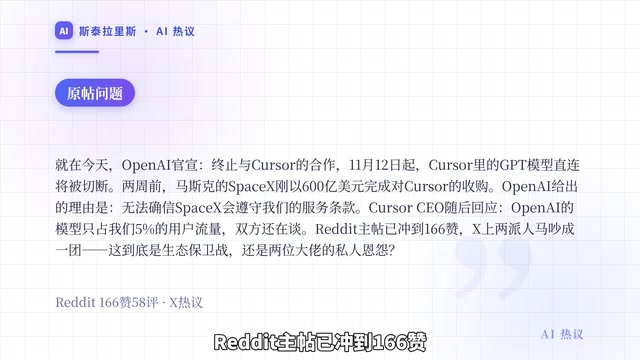
However, interpretations of this figure within the community diverged sharply. One camp argued that if GPT truly accounted for only 5%, Cursor wouldn't need to urgently negotiate with OpenAI at all — the very posture of "negotiating while being cut off" suggested that the actual dependency might be far higher than the official figure indicated.
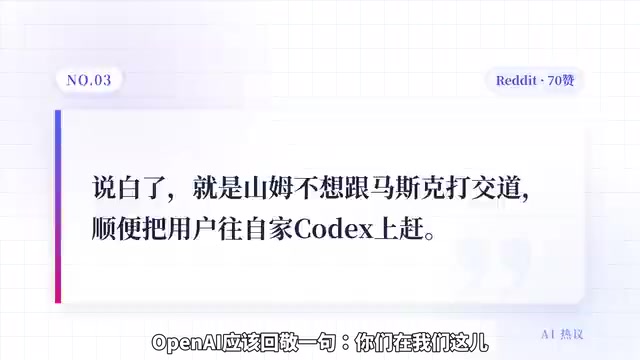
The other camp approached it from OpenAI's perspective: precisely because GPT's share on Cursor had become negligible, cutting ties cost OpenAI virtually nothing. It was more of a statement of position — "We don't need them at all." Some commenters even joked that OpenAI should fire back with, "You don't even account for 0.005% of our business."
Who Is OpenAI Really Guarding Against: Musk's Track Record and Personal Feuds
The debate ultimately zeroed in on one question: who exactly is OpenAI trying to protect against?
Based on public discussions, the prevailing view is that OpenAI's concerns are far from unfounded. Musk himself admitted in court that Grok's training process had "referenced" other models. Grok is a large language model developed by Musk's xAI, initially trained on the massive user data from the X platform (formerly Twitter). The so-called "referencing" of other models is known in the industry as "Model Distillation" — using the output of a powerful model as training data to train another model. This technique can rapidly boost a new model's capabilities at relatively low cost, but it is highly controversial from legal and ethical standpoints because it may violate model providers' terms of service, essentially "copying" a competitor's intellectual property without authorization. With such a track record, OpenAI's concern that its model data and weights could be improperly exploited on a Cursor platform controlled by SpaceX is entirely logical — once Cursor becomes part of SpaceX, GPT model inference data would theoretically be exposed to Musk's technical team.
From another angle, this looks more like a continuation of the personal feud between Sam Altman and Elon Musk. OpenAI was founded in 2015 as a nonprofit AI research organization, with Musk as one of its co-founders who pledged to donate $1 billion. However, by 2018, Musk left the board due to disagreements with management over the organization's direction. Under Altman's leadership, OpenAI subsequently transformed into a "capped-profit" company and established a deep partnership with Microsoft. Musk was deeply dissatisfied, believing OpenAI had betrayed its original mission of open-source and nonprofit principles. In early 2024, he filed a lawsuit against OpenAI, accusing it of violating its founding mission. Altman countered that Musk had tried and failed to gain control of OpenAI, and that his resentment stemmed from that failure. Given that the two went from being partners at OpenAI's founding to open adversaries, it's hardly surprising that personal emotions might color business decisions.
On the other side, OpenAI's secondary motive is also crystal clear — funneling users toward its own coding product, Codex. Codex is OpenAI's AI programming product line, which initially appeared as a code generation model (the underlying technology of GitHub Copilot originated from early Codex models) and later evolved into an integrated cloud-based AI Coding Agent. In 2025, OpenAI repositioned Codex as an intelligent agent capable of autonomously executing multi-step programming tasks: users simply describe their requirements in natural language, and Codex reads the codebase, writes code, runs tests, and submits results in a sandbox environment. This product directly competes with the local AI editor approach that Cursor represents. Cutting off Cursor serves a dual purpose — mitigating potential data risks while carving out growth space for its own ecosystem. It's killing two birds with one stone.
Anthropic's Dilemma: Pinned to the Table by Compute Contracts
In this power play, the most nuanced role belongs to Anthropic.

Anthropic was co-founded in 2021 by former OpenAI Research VP Dario Amodei and his sister Daniela Amodei, with a focus on "AI safety." Its flagship Claude model series is widely regarded as being on par with GPT-4 in coding tasks — and even superior in certain scenarios. However, training and running large language models requires enormous GPU compute resources, making compute supply the lifeblood of any AI company.
After OpenAI announced its cutoff, Anthropic co-founder Tom Brown announced within two hours that they would continue to increase compute support to ensure Claude model availability within Cursor. Behind this "doubling down against the tide" stance lies a ledger that's hard to ignore.
According to public information, Anthropic and SpaceX have a compute partnership agreement worth approximately $45 billion. This means that even though Cursor is now under Musk's umbrella, Anthropic can't simply "flip the table" the way OpenAI did — the breach-of-contract costs and supply chain risks of a massive compute deal far outweigh cutting off a distribution channel. The contract has essentially pinned them to the table, making the cost of walking away prohibitively high.
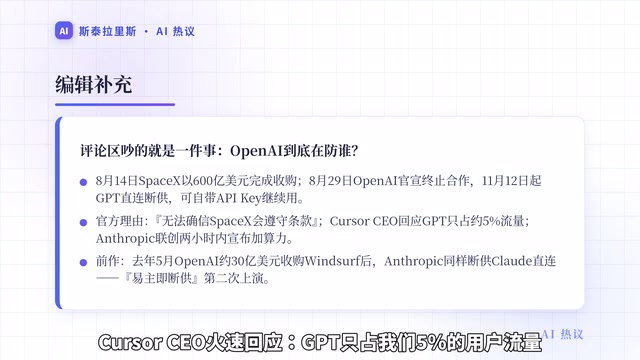
Ironically, a mirror-image scenario played out not long ago. Last May, after OpenAI acquired the coding tool Windsurf, Anthropic similarly cut off Claude's direct access to it. Windsurf (formerly Codeium) is another widely popular AI coding tool that was acquired by OpenAI for approximately $3 billion in early 2025. After the acquisition, Anthropic promptly terminated direct Claude model support for Windsurf, citing the exact same rationale as OpenAI's current cutoff of Cursor — unwillingness to let its core model run on a platform controlled by a competitor. Now the tables have turned. This precedent shows that "model cutoffs" are becoming a standard competitive tactic in the AI coding tools space, and the line between business interests and competitive maneuvering is growing ever more blurred.
The AI Coding Tool Ecosystem Is Consolidating: Cursor Is Becoming a "Grok Exclusive"
Zooming out beyond personal feuds, this incident reflects an accelerating trend of "picking sides" in the AI coding tool market.
Some developers have observed that Cursor has been gradually steering users toward its in-house Composer model and Grok, with GPT's share declining as part of an ongoing trend. After the acquisition, this tendency will only intensify — Cursor is increasingly looking like "one of Grok's dedicated platforms." Meanwhile, OpenAI is determined to pull users toward Codex. The entire market is shifting from "multi-model open access" toward "siloed ecosystems."
This vertical integration trend shares similar underlying logic with the iOS vs. Android ecosystem war of the mobile internet era: controlling the developer tool entry point is tantamount to controlling AI model distribution channels and user data feedback loops. Looking back at 2023-2024, tools like Cursor and Windsurf simultaneously integrated GPT, Claude, Gemini, and other models, allowing users to freely switch based on task type. This "model-neutral" strategy was once the core selling point for tool platforms acquiring users in their early stages. However, as AI giants have been bringing tool platforms into their own ecosystems through acquisitions — Microsoft has GitHub Copilot tied to GPT, Google has Gemini Code Assist, Musk pushes Grok through Cursor, OpenAI promotes Codex — this open landscape is rapidly crumbling.
For everyday developers, this fragmentation is not good news. Some users have explicitly stated they abandoned Cursor after the acquisition, reasoning that "no matter how well the privacy policy is written, I don't trust Musk with my data." The erosion of trust is often harder to repair than technical lockouts.
Advice for Developers: Don't Put All Your Eggs in One Basket
This seemingly distant battle among tech giants actually affects the workflow of every developer on the front lines. When model providers and tool platforms can "break the chain" at any moment due to business disputes or personal grudges, over-reliance on a single channel becomes an inherent risk.
The most pragmatic advice is: maintain the ability to switch between multiple models. Whether through bringing your own API Key or staying familiar with multiple coding tools, preparing backup channels in advance is the only way to respond calmly when the next sudden cutoff hits. Specifically, developers should consider maintaining basic familiarity with alternatives beyond their primary tool — such as VS Code + Copilot, JetBrains AI Assistant, and open-source solutions like Continue.dev — to ensure their core workflow won't be disrupted by a single platform's upheaval.
As the related discussions concluded — don't put all your eggs in one basket. In an era of intense AI ecosystem reshuffling, this old adage carries new weight.
The views in this article are compiled from public discussions. Some figures and details are based on official statements from the respective parties and are provided for reference only.
Related articles

Why Does the Tesla Roadster Need to Fly? A Deep Dive into Musk's Wild Demo
Tesla's Roadster launch showed wall-climbing, upside-down driving, and flying stunts—but The Vergecast notes the demo car may lack a battery, the Rocket version is invite-only and not street-legal, and the website terms don't guarantee delivery. After nine years of delays, why does this car still need to exist?

AI Is Not a Replacement: Human-AI Collaboration Through the Lens of Factory Root Cause Analysis
Starting from factory root cause analysis, this article explains how AI accelerates evidence chain construction rather than replacing human experts, exploring the pragmatic implementation logic and business value of 'AI supporting people rather than replacing them.'

AI Agent Decision Auditing: Building an Evidence Chain in Regulated Workflows
Starting from a Reddit discussion, this article analyzes three core issues in AI agent decision auditing within regulated workflows: what fields audit records should contain, how to handle feedback latency for erroneous decisions, and how to continuously calibrate LLM judge consistency with human judgment.