Behind the Antigravity A1 Drone's Half-Price Deal: Replacing the Headset with a Wristband Controller

The new Antigravity A1 drops the headset for a wristband and halves the price, revealing the trend of drone market segmentation.
Antigravity A1 once became a beginner-friendly drone thanks to its immersive headset and 360-degree post-production reframing capability, but its high price limited adoption. The new version replaces the headset with a wristband-style controller and directly halves the price. Wrist control is lighter, more socially friendly, and easier to learn, but it sacrifices the panoramic field of view and attitude awareness brought by the headset, redefining immersion. Antigravity is betting that most users care more about shooting results than the flight process. Cutting the headset, one of the most expensive components, provides room for the price cut while retaining 360-degree shooting capability, so users can still "fly first, frame later." The article argues that this strategy is essentially market segmentation, splitting the A1 into an "experience version" and a "practical version," and predicts that consumer drones may show a "de-headsetting" trend, with immersion becoming an optional premium feature.
Antigravity A1 was once named "the best drone for beginners," with its immersive headset and ability to reconstruct 360-degree footage in post-production making it easy for many newcomers to get started. But the high price tag kept many people away. Now, Antigravity has released a new version at half the price, and the biggest change is: replacing the headset with a wristband-style controller. Is this trade-off worth it? And what does it reveal about the evolution logic of consumer drones?
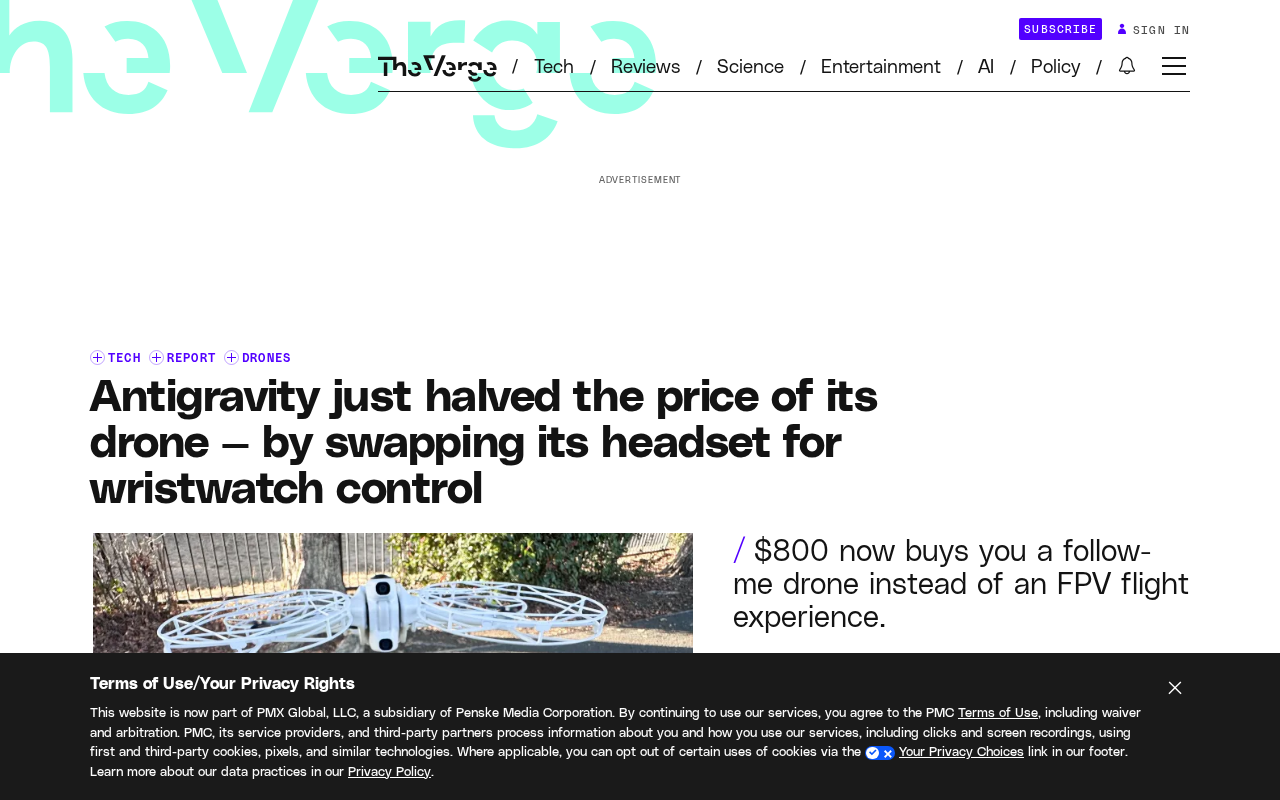
From Virtual Cockpit to Wrist Control: What Changes and What Stays the Same in the A1
The Antigravity A1 released last year was special because it offered a "virtual cockpit" flight experience—put on the headset and you feel like you're sitting inside the drone, with whatever you look at becoming your flight direction. I had a friend who had never flown a drone try it, and they weren't nervous at all the entire time. For people who prefer to "think about flying" rather than "focus on shooting," the A1 has another killer feature: it can record 360-degree panoramic video, and you can reframe the shot after the flight and export a normal-perspective image.
But all of this depends on buying that headset. The new version cuts the headset and replaces it with a wristband-style controller. The price is directly halved, but the core of the flight experience—immersion—is also redefined.
FPV (First-Person View) is a key concept for understanding the headset version of the A1 experience. FPV flight means the user controls the aircraft through real-time footage transmitted from the drone's onboard camera, as if they were inside the cockpit. Traditional FPV drones usually need to be paired with a headset or goggles; the lower the latency and the higher the resolution, the stronger the immersion. Antigravity A1's "virtual cockpit" is an upgraded version of the FPV experience: the headset not only displays the image but also uses head tracking to let the direction of your gaze directly control flight direction, making "fly where you look" a reality. This interaction method greatly lowers the control barrier for beginners, but it also places higher demands on the bandwidth and latency of the video transmission system, which is why the headset solution remains costly.
Wrist Control: Simplification or Compromise?
Controlling a drone with a wristband is not unprecedented, but Antigravity's intention is clear: lower the barrier. Although the headset is immersive, it is cumbersome to wear, prone to causing dizziness, and makes bystanders feel "keep away." A wristband is lighter, more socially friendly, can be operated with a raise of the hand, and has a lower learning curve.
The question is, how much flight information can a wristband convey? The panoramic field of view and attitude awareness provided by the headset are difficult for a wristband to reproduce. For users who seek "the feeling of flying," this may be a downgrade; but for ordinary people who just want to easily capture good footage, a wristband may be just right. Antigravity is clearly betting: most people want the result, not the process.
Attitude awareness refers to the drone's ability to obtain information about its own pitch, roll, yaw angles, and acceleration through sensors such as the inertial measurement unit (IMU). In headset flying, attitude awareness is directly coupled with head movement, and users can "feel" the aircraft's tilt and turning, enabling more precise control. A wristband controller lacks this embodied feedback; it relies more on joystick or touch input, with flight information conveyed through a screen or vibration, and its information bandwidth is clearly lower than that of a headset. For complex shots requiring precise framing or flying through narrow spaces, the lack of attitude awareness may make operation difficult; but for ordinary users who only need stable flight and framing, the simplified information provided by the wristband is sufficient.
The Logic of Halving the Price: Cutting the Most Expensive Part
The headset is one of the biggest cost components of a drone, especially for high-resolution, low-latency video transmission systems. Removing the headset not only lowers material costs but also reduces after-sales and compatibility burdens. The cost of a wristband controller is far lower than that of a headset, which provides room for halving the price.
This strategy is similar to history in fields such as action cameras and phone gimbals: when core functions are sufficient to meet mass demand, removing "professional redundancy" can open up a larger market. The Antigravity A1's 360-degree shooting capability is retained, meaning the new version can still "fly first, frame later"—you just can no longer fly "as if you were there."
Post-production reframing of 360-degree panoramic video means the drone records images in multiple directions simultaneously during flight, and later software reprojects the panoramic material into normal-perspective video. This process relies on high-resolution sensors and stable stitching algorithms, and also places certain demands on storage and computing. Antigravity A1 retains this capability, meaning users can still fly first and frame later, without having to decide composition in real time during flight. But note that post-processing of panoramic material usually requires companion software, and exporting normal-perspective footage will lose some resolution. Although the wristband version cuts the headset, the hardware foundation for 360-degree shooting is unchanged, so post-production flexibility continues—this is also the core support for its cost-effectiveness.
Who Should Buy It? Who Should Hesitate?
If you have never flown a drone, or just want to easily record during travel, the new version of the A1 offers great value. Wrist control lowers the psychological burden, and the post-production flexibility of 360-degree material is retained. But if you seek immersive flight, enjoy the thrill of first-person view, or need precise attitude awareness to shoot complex shots, the headset version is still the better choice—provided it is still on sale.
Antigravity's move is less a technological innovation than market segmentation. It splits the A1 into an "experience version" and a "practical version," letting users with different budgets and needs get what they want.
Conclusion: Will "De-headsetting" Become a Trend for Drones?
Consumer drones are moving from "geek toys" to "mass tools." The headset represents the former, the wristband the latter. Antigravity's choice may inspire followers: when 360-degree shooting and intelligent tracking are mature enough, the importance of the flight process itself will decline. In the future, we may see more "headset-free" drones competing for ordinary users with lower barriers.
But immersion will not disappear; it will simply become an optional premium feature. For beginners, the new A1 version offers core value at half the price; for enthusiasts, the headset remains the dividing line.
Market segmentation of consumer drones is the macro background for understanding Antigravity's strategy. Early consumer drones centered on aerial photography, and users needed to learn control and composition; later, FPV and immersive flight pushed drones into the category of "geek toys," emphasizing the process experience. Once technologies such as 360-degree shooting, intelligent tracking, and automatic return-to-home matured, the necessity of the flight process itself for ordinary users declined, and manufacturers began splitting products into an "experience version" (with headset) and a "practical version" (with wristband or phone). This kind of segmentation has precedents in the action camera and gimbal markets: professional features are retained in high-end models, while mass models focus on core results. Antigravity's "de-headsetting" is exactly the continuation of this logic in the drone field, and more manufacturers may follow in the future, treating immersion as an optional value-added feature rather than a standard one.
Related articles

Cursor AI Programming in Practice: Build a Student Management System from Scratch in 30 Minutes
A Bilibili creator demonstrates Cursor AI programming: generating a student management system in 30 minutes with natural language. Details on Agent mode, Claude selection, prompt techniques, and thresholds.

Top 20 AI Coding Tools Ranking: From Rock-Solid to Lackluster, a Scored Matrix
Bilibili creator releases top 20 AI coding tools ranking, tiered T0–T4 from rock-solid to lackluster, with Claude Code and Codex tied at T0. This article details the scoring dimensions (capability, reliability, robustness, durability, cost, domestic availability) and tool performances to help developers choose the right AI coding assistant.

Vibe Coding Systematic Tutorial: Master AI-Assisted Programming from Zero
A three-month Vibe Coding tutorial from a Bilibili creator covering Codex, ClaudeCode, and Cursor, from core logic to commercial project practice for beginners.