Behind the FAA National Ground Stop: The Aging of U.S. Air Traffic Control and Political Blame-Shifting

FAA nationwide ground stop exposes aging systems and lack of political accountability.
The article reviews the FAA nationwide flight ground stop, criticizing the president's silence and Transportation Secretary Duffy's failure to explain the cause at the press conference, instead demanding $50 billion for ATC modernization—a figure that jumped from $30 billion. The program acknowledged the system is old and underfunded but noted Republicans prioritized ICE funding over ATC modernization while controlling both chambers. Duffy's credibility was questioned due to his reality show background. The article argues a technical crisis was turned into a budget demand while the real failure investigation was sidelined—the unknown cause is more worth pursuing than the $50 billion bill.
Event Recap: A Four-Hour Nationwide Ground Stop
According to the YouTube program Last Week Tonight, the U.S. Federal Aviation Administration (FAA) issued a nationwide ground stop on Friday, forcing all flights to be suspended. The chaos lasted more than four hours before it was finally lifted. As of the time of the program's recording, the specific cause of the ground stop remained unclear.
Even more telling was the president's silence. Throughout Friday, the president made no public comment on the matter. Only after the ground stop ended did he send out the Secretary of Transportation and the Secretary of Homeland Security to speak—and their performances were less a crisis briefing than a "victory lap."

The host sarcastically remarked: a real leader knows when to take credit and when to send a "scapegoat" out to take the bullets—and this time, the scapegoat was Transportation Secretary Sean Duffy. This manner of communication itself reflects the logic of responsibility avoidance in crisis response.
The FAA is a federal agency under the U.S. Department of Transportation, responsible for regulating civil aviation safety, managing the national airspace system, and operating air traffic control. Its administrator is appointed by the president but requires Senate confirmation. A nationwide ground stop is typically an emergency measure reserved for extreme circumstances—such as system failures, security threats, or severe weather—and has historically been rare. The FAA's decision-making independence is often influenced by political factors, particularly in crisis communications, which require coordination with the White House, the Department of Homeland Security, and other agencies.
Sean Duffy's Press Conference: Missing Information and Scene-Stealing Demands
Logically, the press conference after a nationwide ground stop should above all make things clear to the public: what happened, why it happened, and when operations can resume. But according to the program's account, Duffy turned the press conference into an occasion for expressing grievances and making demands.

His core argument was straightforward: the problem lies in "old legacy equipment." He acknowledged that this equipment had already failed and "will continue to fail." He then pivoted to a clear political demand—that the president has spent the past year asking Congress to fully fund the construction of a brand-new air traffic control system.
The Budget Number Jumping On Stage
In his remarks, Duffy first mentioned that the president had requested $30 billion, then immediately said, "I want $50 billion." This budget figure jumping mid-sentence was seized upon by the host: a transportation secretary trying to reassure the public who suddenly demands $50 billion sounds less like he's calming panic and more like a Batman villain holding Gotham City hostage.
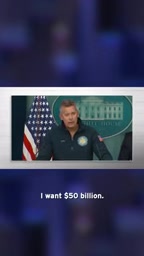

Sean Duffy is a former U.S. Representative from Wisconsin and is known for appearing on the MTV reality show The Real World: Boston. He was appointed Secretary of Transportation in January 2025, despite lacking deep aviation management experience. As the FAA's superior, the Secretary of Transportation typically serves as the primary spokesperson during aviation crises, responsible for delivering accurate information to the public and coordinating cross-agency response. Duffy's press conference performance drew controversy partly because of his role definition—the line between technical explainer and political advocate was blurred.
Who Should Bear the Blame for the Aging System?
The program did not entirely dismiss Duffy's complaints. A key factual judgment is that the U.S. air traffic control system is indeed old and underfunded. This point was explicitly acknowledged on the program.
But the issue lies in the direction of accountability. The program pointed out that Republicans controlled both chambers of Congress for the past two years but chose to direct large amounts of funding toward Immigration and Customs Enforcement (ICE) rather than air traffic control modernization. This means that "the system has no money" is not just a technical problem but a question of budget priorities.
That said, Duffy's own credibility was also questioned. The program noted that he spent considerable time during his tenure filming a reality show with his family, encouraging Americans to take more road trips. The host summed up half-jokingly: if the goal was to get people to fly less and drive more, then this ground stop could be considered "mission accomplished."
The U.S. air traffic control (ATC) system is operated by the FAA, with core infrastructure including radar, communications, navigation, and flight data processing systems—much of the equipment dates back to the 1960s and 1970s. The FAA's modernization program (such as NextGen), launched in 2007, aimed to replace ground-based radar with satellite navigation, but has suffered from delays and cost overruns. Congress has long been divided over FAA modernization funding, partly due to competing budget priorities. ICE's budget has grown significantly in recent years, reflecting the political contestation between the two parties over immigration enforcement, while ATC modernization is often seen as a bipartisan consensus long-term project lacking urgency.
Technical Perspective: Why the Aging ATC System Is Hard to Replace
Setting aside the political satire, this incident exposes a long-standing technical governance challenge. A nationwide ATC system involves multiple subsystems—radar, communications, flight data processing—and the aging of any single link can trigger a chain reaction. Upgrading such systems involves long cycles, high costs, and the need for gradual replacement without shutting down operations, making the engineering complexity far greater than ordinary IT infrastructure.
Duffy's statement that "old equipment will continue to fail" is technically credible. But the narrative presented by the program reminds us: when a system failure occurs, what the public needs is a clear cause of the incident and a recovery timeline, not a budget negotiation. Turning a technical crisis into a budget demand may help push funding through, but it also easily sidelines the actual failure investigation.
As of the program's recording, the cause of the ground stop remained unclear. This unresolved question may be more worth pursuing than the $50 billion bill.
ATC system upgrades involve "system of systems" complexity: radar, communications, flight data processing (such as the ERAM system), and ground automation equipment must work together seamlessly. Replacement typically follows a gradual strategy—for example, deploying new technology in remote areas first while retaining old systems as backup—resulting in the coexistence of old and new and compounded maintenance costs. In addition, the FAA must ensure that any change does not affect the safety of tens of thousands of daily flights, so certification processes are strict and testing cycles are long. Technical teams also face talent attrition and rigid procurement processes, further slowing modernization.
One-line Summary
A four-hour FAA nationwide ground stop exposed system aging and a lack of political accountability.
Paragraph Summary
The article reviews the FAA nationwide flight ground stop, criticizing the president's silence and Transportation Secretary Duffy's failure to explain the cause of the incident at the press conference, instead demanding $50 billion to modernize the ATC system, with the budget figure jumping from $30 billion to $50 billion. The program acknowledged that the ATC system is old and underfunded but pointed out that Republicans, while controlling both chambers, prioritized funding for ICE over ATC modernization. Duffy's credibility was questioned due to his reality show background. The article argues that a technical crisis was turned into a budget demand while the real failure investigation was sidelined—the unknown cause of the ground stop is more worth pursuing than the $50 billion bill.
Related articles

Zed Editor Releases v1.29.2: Observations on a Routine Version Iteration
Zed editor releases patch v1.29.2, version bump by @JosephTLyons, commit verified via GitHub signature. This article covers the release's basic info, what a patch version means, and practical upgrade advice for users.

Anthropic IPO Questioned: Hacker News Debates Timing of Going Public
A Hacker News post titled "Just say no to Anthropic's IPO" sparks debate on the timing of Anthropic's public listing and AI capitalization, touching on valuation bubbles and mission independence.

Hands-On with the Genie 4 World Model: Directing Worlds in Real Time Like a Puppeteer
Google DeepMind's Genie 4 world model in depth: Special Guest X's hands-on demo of real-time scene direction via prompts, custom interactive apps in Project Genie, and prompts-as-seeds reproducibility.