Benchmark Prediction with Sparse and Unpaired Data: A Deep Dive into the PKPS Method
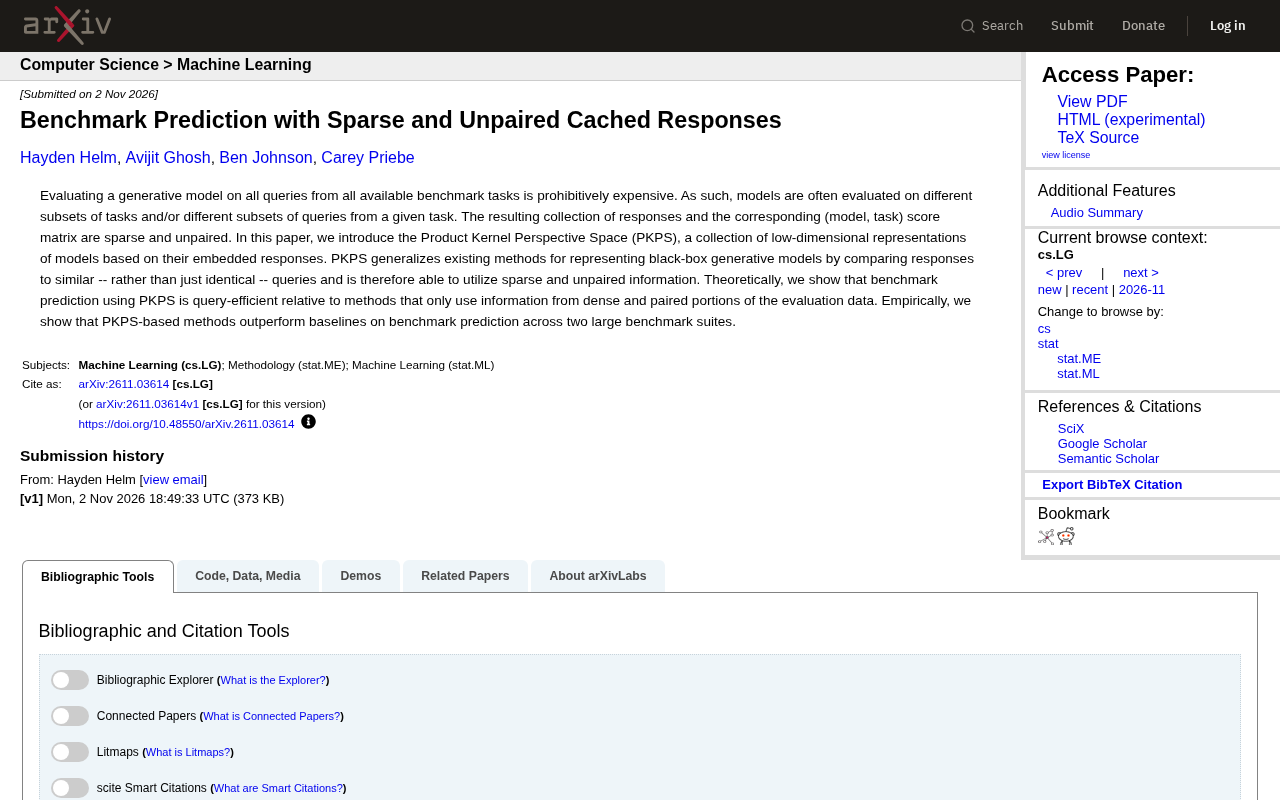
PKPS uses a kernel perspective space with sparse unpaired responses for query-efficient model benchmark prediction.
This article addresses the high cost of comprehensive generative model evaluation and the sparsity and unpaired nature of real-world response data by proposing Product Kernel Perspective Space (PKPS). PKPS embeds model responses into a low-dimensional space and uses kernel methods to compare responses to similar queries, characterizing model capabilities beyond the limitations of dense paired data. Theoretical analysis proves query efficiency, and experiments on two large benchmark suites show PKPS outperforms baselines, offering a more efficient and reliable approach for model comparison under resource constraints.
In an era where AI model evaluation costs are skyrocketing, accurately predicting model performance from sparse, unpaired response data has become a critical challenge. This article introduces a new method called PKPS, which achieves query-efficient benchmark prediction through a kernel perspective space and outperforms baselines on two major benchmark suites.
The Evaluation Dilemma: The Prevalence of Sparse and Unpaired Data
Comprehensively evaluating generative models across all queries of all benchmark tasks is prohibitively expensive. Consequently, in practice, models are often evaluated only on different subsets of tasks or different subsets of queries. This results in collected response sets and the corresponding (model, task) score matrices being sparse and unpaired—many model-task pairs lack direct scores, and different models are evaluated on different queries.
This data sparsity poses significant challenges for model comparison and selection. Traditional methods typically use only the dense and paired portion of the data, discarding a wealth of valuable sparse information. How to extract effective representations of model capabilities from this seemingly incomplete data has become an urgent problem to solve.
PKPS: An Innovative Approach via Kernel Perspective Space
The paper proposes Product Kernel Perspective Space (PKPS), a set of low-dimensional representations based on model response embeddings. Its core innovation is that PKPS no longer requires comparing responses to identical queries; instead, it characterizes models by comparing responses to similar queries. This generalization ability enables PKPS to leverage sparse and unpaired information, breaking through the limitations of traditional methods.
Specifically, PKPS embeds each model's responses into a space and captures similarities between responses using kernel methods. Since responses to similar queries are comparable, even if two models are not evaluated on exactly the same queries, their relative capabilities can be inferred from their responses to similar queries. This provides a more flexible framework for representing black-box generative models.
Kernel Methods are a class of machine learning techniques that implicitly map data into a high-dimensional feature space via kernel functions, thereby computing similarities in that space. Common kernel functions include the Gaussian kernel (RBF kernel) and polynomial kernels. Their core advantage lies in the "kernel trick": without explicitly computing the high-dimensional mapping, the inner product between samples can be obtained directly through the kernel function, efficiently capturing nonlinear relationships. In PKPS, kernel methods are used to measure the similarity between different models' responses to similar queries, so that even if models are not evaluated on identical queries, the relative relationships of model capabilities can be inferred through kernel similarities of response embeddings. This design extends "response comparability" from exact query matching to similar query matching, which is the key technical foundation enabling PKPS to handle sparse and unpaired data.
Low-dimensional Embedding refers to the process of mapping high-dimensional, complex raw data (such as a model's textual responses to queries) into a low-dimensional continuous vector space, with typical methods including principal component analysis, autoencoders, or contrastive learning. Low-dimensional embeddings can preserve the most important factors of variation in the data while removing noise and redundancy, making subsequent similarity computation and prediction more stable and efficient. In PKPS, each model's responses are embedded into a low-dimensional space, and the model's capability is represented as a point or vector in that space. Since distances or inner products in the embedding space can reflect semantic similarities of responses, PKPS can infer a model's performance on unevaluated tasks through geometric relationships under sparse observations—this is precisely the origin of the term "perspective space."
Theoretical Advantage: Query Efficiency
On the theoretical front, the paper proves that benchmark prediction based on PKPS is query-efficient relative to methods that use only dense and paired data. This means that to achieve the same prediction accuracy, PKPS requires fewer query evaluations, significantly reducing evaluation costs. This theoretical guarantee provides a solid foundation for the practical application of PKPS.
The key to query efficiency is that PKPS can extract more information from sparse data. By leveraging responses to similar queries, PKPS effectively expands the scope of available information, maximizing the value of each query evaluation. This is particularly important for large-scale model evaluation scenarios, where each query may involve expensive computation or human annotation.
Query Efficiency in the context of benchmark prediction refers to the number of queries or query-model pairs a method needs to evaluate to achieve a given prediction accuracy target. Higher query efficiency means obtaining reliable model performance rankings or score predictions with fewer expensive evaluations. Through theoretical analysis, the paper proves that PKPS-based methods have a lower upper bound on prediction error under the same query budget, or require fewer queries for the same accuracy, compared to methods using only dense paired data. This property is especially important for large model evaluation, as each query may involve inference computation, API calls, or human annotation costs; query efficiency directly determines the scalability and economic viability of evaluation.
Empirical Results: Outperforming Baselines
Empirically, the paper conducts experiments on two large benchmark suites, and the results show that the PKPS-based method outperforms baseline methods on benchmark prediction tasks. This validates the effectiveness of PKPS in real-world scenarios and demonstrates its strong ability to handle sparse and unpaired data.
The experiments cover various combinations of models and tasks, and PKPS exhibits consistent performance improvements. Compared to traditional methods that use only paired data, PKPS can more accurately predict model performance on unevaluated tasks, providing a more reliable basis for model selection and deployment.
Significance and Outlook
The introduction of PKPS opens new avenues for generative model evaluation. It not only reduces evaluation costs but also improves data utilization efficiency, enabling reliable model comparison even under resource constraints. In the future, this method is expected to extend to more types of models and tasks, further promoting the standardization and efficiency of AI evaluation.
For researchers and engineers, PKPS provides a practical tool to extract more insights from existing sparse evaluation data. As model sizes continue to grow, such query-efficient methods will become increasingly important.
One-line Summary
PKPS leverages sparse unpaired responses via a kernel perspective space to enable query-efficient model benchmark prediction.
Paragraph Summary
This article addresses the problem of prohibitively expensive comprehensive evaluation of generative models and the fact that real-world response data is often sparse and unpaired, proposing the Product Kernel Perspective Space (PKPS) method. PKPS embeds model responses into a low-dimensional space and characterizes model capabilities by comparing responses to similar queries via kernel methods, thereby overcoming the limitation of traditional methods that rely solely on dense paired data. Theoretical analysis proves that PKPS is query-efficient, achieving the same prediction accuracy with fewer queries. Experiments on two large benchmark suites show that PKPS-based benchmark prediction outperforms baseline methods, providing a more efficient and reliable approach for model comparison and selection under resource constraints.
Related articles

9 AI Subscription Plans Compared: The Real Cost Per 100M Tokens Revealed
Bilibili creator tests 9 AI subscription plans from Volcano, Alibaba, Tencent, Baidu, Zhipu, Xiaomi, MiniMax and more, converting them all to real cost per 100M tokens, breaking down fixed-quota vs. three-tier coefficient billing and how caching, time-of-day discounts, and window limits affect actual quota.

Vibe Coding for Beginners: Expressing Intent Instead of Handwriting Code
What is Vibe Coding? A 137-episode Bilibili course defines it: the core is expressing intent, not writing code. This article analyzes Vibe Coding's productivity logic, target audience, and entry expectations to help beginners decide if it's worth learning.

LangChain Beginner's Guide: An Agent Development Roadmap from LangGraph to Deep Agents
Clarify the encapsulation relationship among LangChain, LangGraph, and Deep Agents, and master the learning path and selection logic for agent development frameworks—suitable for beginners in large model development.