Benchmark's Full Partner Team Takes the Stage at TechCrunch Disrupt to Discuss the Next Breakout Startup Opportunity

Benchmark's entire partner team is set to discuss the next wave of startup opportunities at TechCrunch Disrupt.
Benchmark's full partner team will make a rare collective appearance on the TechCrunch Disrupt main stage to explore where the next breakout startup will come from. Known for its equal partnership model, small fund size, and early bets on Uber, Twitter, eBay, and Snapchat, Benchmark's collective view typically leads market consensus by one to two cycles. The session arrives at a pivotal moment as AI valuations soar and application-layer crowding intensifies — making Benchmark's signals on which verticals and founder profiles they favor especially valuable for early-stage founders.
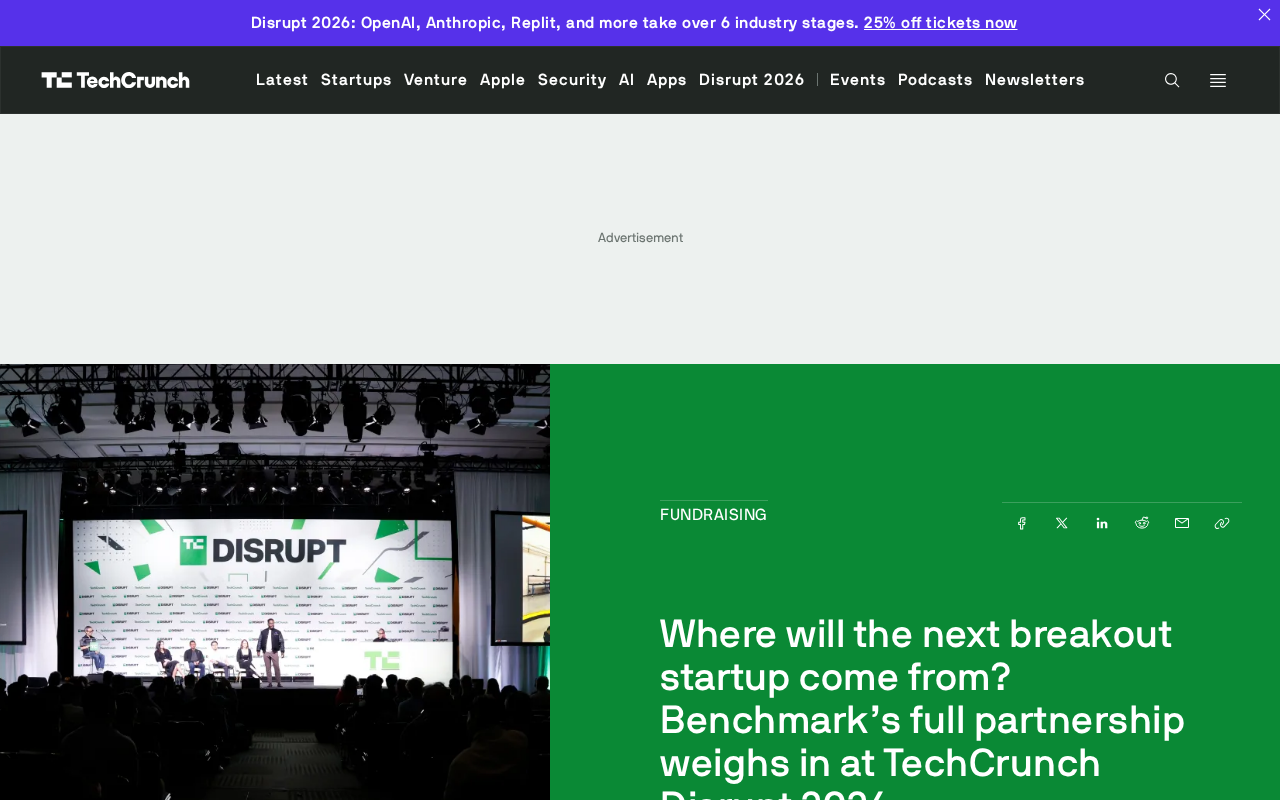
The entire partner team at top venture firm Benchmark will take the main stage at TechCrunch Disrupt to explore a question every founder and investor is asking: where will the next breakout startup come from? The very fact that this session is on the agenda sends a strong signal — in a moment when AI is reshaping the technology landscape, some of the sharpest minds in venture capital are actively trying to map where the next wave of opportunity lies.
Why Benchmark Deserves Your Attention
Benchmark occupies a unique position in the Silicon Valley VC ecosystem. The firm is known for its small, tight-knit partnership structure and has long maintained a flat equal-partnership model with no seniority hierarchy. Its track record includes early bets on Uber, Twitter, eBay, and Snapchat — companies that fundamentally transformed their industries. Unlike many large funds that scale up to chase management fee income, Benchmark has consistently kept its fund size relatively modest, staying focused on high-conviction early-stage bets.
That's precisely why it matters when Benchmark's full partner team makes a rare collective appearance on a public stage to discuss "where the next breakthrough will come from." Their perspective carries real weight for founders making path decisions and for other investors calibrating their portfolios. A joint statement from all partners also signals that this isn't one individual's personal call — it's closer to an institutional, collective read on where the future is heading.
Benchmark's equal partnership model is genuinely uncommon in the venture industry. Most VC funds maintain a hierarchy of general partners, principals, and associates, with compensation tied to seniority. Benchmark's structure has all partners sharing carry equally — the fund's excess returns — which theoretically reduces internal politics and gives every partner equal weight in investment decisions. Historically, Benchmark has also kept its fund sizes around $500 million, far smaller than firms of comparable reputation. This is a deliberate choice: a smaller fund means less pressure to deploy capital through large late-stage follow-ons, allowing the firm to stay focused on seed and Series A bets where risk and return are both highest. These structural constraints have, in practice, shaped a distinctive investment philosophy: Benchmark would rather pass than settle.
The Industry Context Behind the Question
The question of "where will the next breakout startup come from" takes on particular weight in the current environment. Generative AI has rapidly become the center of gravity for both capital and talent, with massive funding flowing into foundation models, the AI application layer, and related infrastructure. But as valuations have climbed and competition has intensified, investors are beginning to ask harder questions: where does the real next wave of opportunity actually sit? Is it in continuing to build on top of AI, or in finding traditional industries ripe for technological restructuring that the market has overlooked?
For early-stage founders, understanding how top-tier investors frame "opportunity" is often more valuable than chasing whatever is currently trending. Firms like Benchmark typically operate one to two cycles ahead of market consensus. What they say on the main stage may reveal meaningful signals about their preferences — which verticals they're excited about, what founder profiles they're looking for, and how quickly they expect business models to be validated.
The investment landscape in generative AI has developed a clear tiered structure. The foundation model layer — OpenAI, Anthropic, and peers — has attracted the largest pools of capital, but competitive moats are extraordinarily high and new entrants have almost no path to disruption. The infrastructure layer (GPU clouds, vector databases, inference optimization) follows closely behind. The application layer, meanwhile, is crowded and increasingly commoditized — a large number of "wrapper" products face the constant risk of being made redundant as the underlying model capabilities expand. Against this backdrop, some investors have begun shifting their attention toward "AI-enabled traditional industries" — healthcare, legal, construction, manufacturing, and other verticals that have historically been slow to digitize but are characterized by deep data complexity and intricate workflows. The barriers to entry in these spaces don't lie in the model itself, but in domain expertise, regulatory relationships, and long sales cycles — precisely the kind of moat that large tech companies struggle to replicate quickly.
The Platform Significance of TechCrunch Disrupt
TechCrunch Disrupt has long been a landmark event at the intersection of startups, investors, and media. Many companies that later became household names first entered the public consciousness on this stage. Placing a conversation with Benchmark's full partner team on the main stage reflects the organizers' recognition of how important the current conversation about venture direction really is.
According to official information, early-bird ticket discounts for this year's event are available until 11:59 PM Pacific Time on September 25th, with savings of up to $200. For founders and industry practitioners hoping to access front-line investor perspectives, the value of attending sessions like this isn't just the insights themselves — it's also the network connections that happen around them.
What This Means for Founders
From the conversation that's about to unfold, founders should pay attention to several dimensions. First, how does Benchmark define "breakout growth" — is it about market size, growth velocity, or the depth of a technology moat? Second, what is their posture toward the AI boom — continued conviction or growing caution? Third, what do they look for in founding teams? That last point often determines whether early-stage fundraising succeeds or fails.
It's worth noting that publicly available information right now is limited to agenda previews and event registration details — the actual conversation hasn't happened yet. This article is therefore primarily a forward-looking analysis grounded in Benchmark's historical investment style and current industry context. The real substance will need to come from the session itself.
Related articles

Frontend to AI Agent Development: A Frontline Architect Explains Career Paths and Opportunities
A frontline AI architect explains the industry changes and practical paths for frontend developers transitioning to AI Agent development: why pure frontend jobs are disappearing, why Agent + full-stack has become mainstream in hiring, and three transformation routes—Agent development engineer, FDE, and remote contracting—along with corresponding learning strategies.

How to Choose an AI Agent Development Course: Five Pitfall-Avoidance Guidelines
A mechanical-engineering career changer's two-year pitfall-tested checklist for screening AI Agent development courses: complete delivery pipeline, resume-worthy projects, real development perspective, update frequency, and coaching feedback—with concrete judgment methods and pitfall-avoidance tips.

Coze AI Agent Building for Beginners: A Zero-Code AI Agent Development Guide
Coze, ByteDance's one-stop AI application development platform, supports zero-code drag-and-drop AI agent building. This article outlines Coze's core concepts, three advantages, differences between the domestic and international versions, and the distinction between agents and apps, helping beginners quickly get started with AI Agent development.