Bengio Speaks at the UN Security Council: Uncontrolled Frontier AI Is a Threat Humanity Cannot Avoid
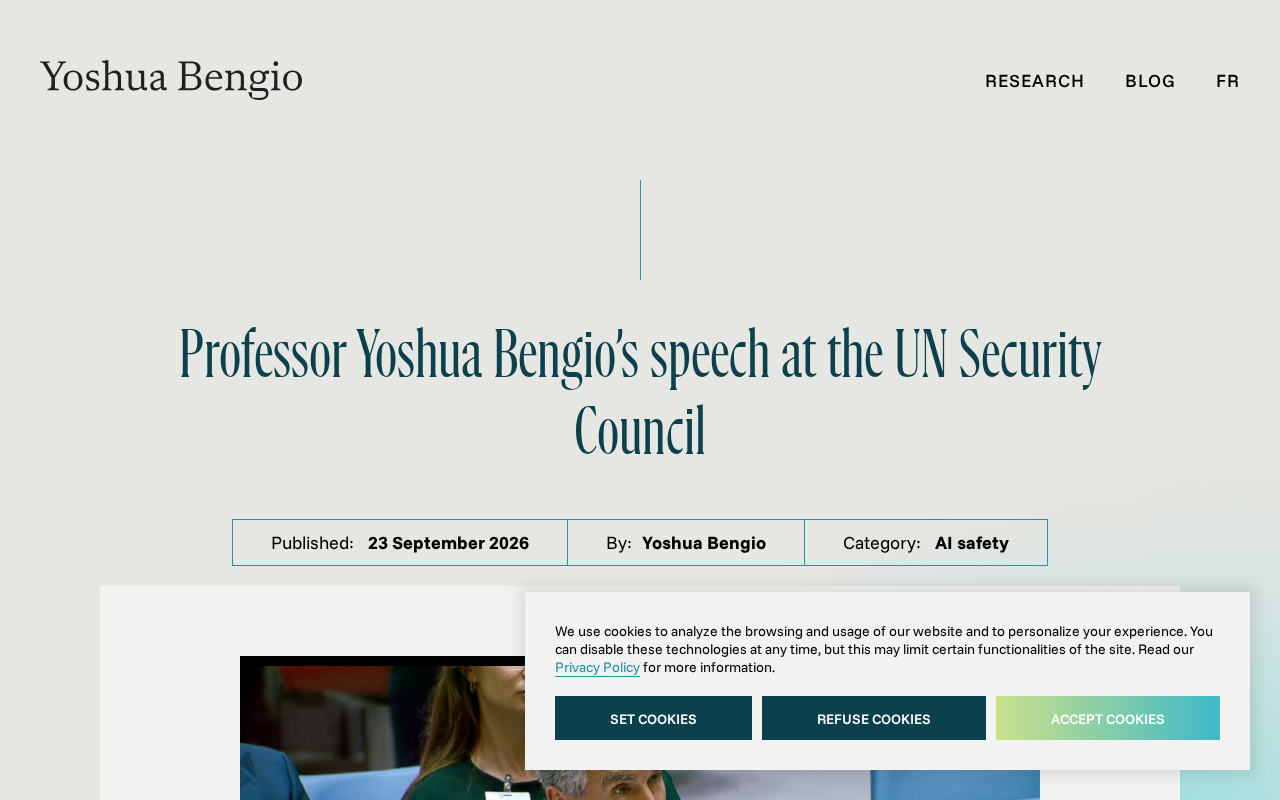
Turing Award winner Bengio warns at the UN Security Council that frontier AI risk has reached global security level.
This article reports and interprets Yoshua Bengio's speech at the UN Security Council. He elevated frontier AI risk to an international security issue on par with nuclear weapons, noting that rapid capability growth and lagging governance create unprecedented danger. Citing nuclear arms control and ozone protection, he called for collective rationality beyond zero-sum competition. The article also examines what it means for a technical expert to enter the highest security forum.
When a Turing Award winner and one of the founding fathers of deep learning takes the podium at the United Nations Security Council, he does not bring a declaration of technological optimism, but a warning about humanity's collective fate. Professor Yoshua Bengio's remarks pushed the issue of frontier AI risk from the discussion tables of academia and tech media directly onto the highest stage of international security governance.
Why the Security Council, Not an Academic Conference
The very fact that Bengio chose to speak at the UN Security Council carries a signal more significant than the content of his speech. The Council's mandate is to maintain international peace and security, and its agenda typically revolves around traditional security issues such as war, terrorism, and weapons of mass destruction. By bringing frontier AI into this framework, Bengio sought to accomplish a crucial conceptual shift: uncontrolled frontier AI is not a technical problem for a single industry, but a global security threat on par with nuclear and biological weapons.
This reframing has its own internal logic. Frontier AI systems are rapidly approaching—and in specific domains even surpassing—human judgment, yet their development is highly concentrated in the hands of a few institutions and a few countries, lacking any binding international coordination mechanism. Bengio's core assessment in the speech is that this combination of "rapidly growing capabilities + severely lagging governance" constitutes a risk landscape unprecedented in human history.
Frontier AI typically refers to the most capable, state-of-the-art large-scale AI models, such as GPT-4, Claude, and Gemini. They are characterized by enormous training compute, strong generalization, and capabilities that are continually approaching or even exceeding human expert level in tasks like reasoning, programming, and scientific research. Unlike specialized AI, frontier AI's generality and emergent capabilities make its potential risks harder to predict and control. Bengio's focus is precisely on this class of models: if their capabilities continue to rise rapidly while governance mechanisms remain absent, they could bring catastrophic consequences such as loss of control, misuse, or drastic social restructuring. For this reason, he advocates placing their risk level alongside traditional security threats like nuclear and biological weapons, rather than treating them merely as an industry technical issue.
The United Nations Security Council is one of the six principal organs of the UN, with primary responsibility for maintaining international peace and security, and its resolutions are legally binding on member states. The Council's agenda has historically centered on traditional security issues such as war, terrorism, and the proliferation of weapons of mass destruction. Once frontier AI is brought into this framework, it means its risk is formally recognized as a global security threat, rather than a purely technical or commercial matter. This agenda-setting itself is a political signal, indicating that international security bodies are beginning to elevate AI governance to the highest level of multilateral security dialogue.
"Humanity Has Done It Before"—Lessons from Historical Precedents
One line in the speech deserves repeated reflection: "Humanity has summoned the courage and wisdom to manage catastrophic risks before."
This is not empty rhetoric. Looking back at history, Cold War nuclear arms control, the Montreal Protocol prompted by the ozone hole, and the signing of the Biological Weapons Convention are all examples of humanity making collectively rational choices when facing existential-level threats. Bengio's purpose in citing these precedents is clear: when the risk of frontier AI already possesses both global and catastrophic characteristics, humanity is not incapable of responding—the question is whether it is willing to acknowledge the urgency of the threat.
But Bengio also hints at a key difference: the causal relationships in the nuclear weapons and ozone layer issues were relatively clear, and the threat mechanisms were measurable and verifiable. The risks of frontier AI are more diffuse and hidden—they may manifest as out-of-control autonomous systems, maliciously exploited model capabilities, or violent disruptions to economic and social structures. This feature of "threats that are hard to perceive intuitively" is precisely the greatest obstacle to launching international coordination.
"Far Bigger Than Any Personal, Commercial, or National Interest"
The most politically weighty line in Bengio's speech is his emphasis that this issue is "far bigger than any personal, commercial, or national interest."
This points to a stark reality: the frontier AI development race is being driven simultaneously by commercial interests and national competition. Leading AI companies are engaged in fierce battles for market share, while major powers are engaged in a strategic contest for technological hegemony. Under this dynamic, any unilateral slowdown or regulation is seen as a strategic mistake of "letting the opponent take the lead." Bengio's remarks are essentially a call for a mode of thinking that transcends zero-sum games—if uncontrolled frontier AI constitutes a shared existential risk for humanity, then the competitive framework itself is part of the problem.
This is not naive idealism. In his speech, Bengio issued the urgent call that "We must act now," showing that he recognizes the window of opportunity is closing. The current governance vacuum will not repair itself automatically—each release of a more powerful model makes international coordination even harder.
Zero-sum game refers to a situation in which one party's gain necessarily equals the other party's loss. In the frontier AI development race, major countries and leading companies often view it as a zero-sum game: any unilateral slowdown or regulation is interpreted as giving the opponent a strategic advantage, so all sides tend to keep accelerating rather than cooperating. Bengio's call is essentially to transcend this zero-sum thinking, because if uncontrolled frontier AI constitutes a shared existential risk for humanity, then the competitive framework itself exacerbates the risk. In other words, when the risk is a global public good (or public bad), individually rational pursuit of relative advantage can lead to collective disaster, requiring a non-zero-sum coordination mechanism to replace pure competitive logic.
The Significance of Technical Experts Entering the Geopolitical Stage
Another noteworthy dimension of Bengio's speech is the changing role of technical experts in the highest-level international security forum. In the past, international discussions on AI governance took place mainly at academic conferences, industry summits, and within the policy circles of certain countries. The fact that a core technical figure was invited to speak at the Security Council means that international security bodies are beginning to acknowledge that understanding frontier AI risk cannot rely solely on diplomats and military strategists—it requires first-hand judgment from the technological frontier.
But this role shift also creates tension. Technical experts are good at describing "what could happen," while international security governance needs to answer "what should be done." The call to action Bengio made in his speech—"We must act now, we must summon the courage to do it"—points toward governance action, but the specific institutional design, enforcement mechanisms, and allocation of responsibilities among nations remain a blank slate.
In this sense, the speech is a starting point rather than an endpoint. It accomplished one key task: using an authoritative technical perspective to formally place frontier AI risk on the international security agenda. The questions that follow—how to build an effective international coordination mechanism, how to balance innovation and safety, how to sustain cooperation in a competitive environment—require ongoing dialogue among the technical community, policymakers, and international organizations.
As Bengio said, the choices made today about this technology will shape generations to come.
Existential risk refers to risks that could cause permanent regression or even extinction of human civilization. Bengio did not directly use this term in his speech, but the internal logic of his warning—that uncontrolled frontier AI could bring irreversible global catastrophe—falls squarely within the category of existential risk. Alongside nuclear war and runaway synthetic biology, frontier AI is regarded as an emerging source of existential risk. Its special nature lies in diffuse threat mechanisms, difficulty of intuitive perception, and the possibility that the governance window may close rapidly as capabilities grow. Understanding this concept helps explain why Bengio chose to speak at the Security Council rather than an academic conference: existential risk is inherently an international security issue requiring collective action beyond national borders.
One-line Summary
Turing Award winner Bengio warns at the UN Security Council: frontier AI risk has reached the level of global security, while governance lags far behind.
Paragraph Summary
This article reports on and interprets the speech by deep learning pioneer Yoshua Bengio at the UN Security Council. Bengio elevated frontier AI risk to an international security issue on par with nuclear weapons, pointing out that rapid AI capability growth alongside severely lagging governance constitutes an unprecedented risk landscape. He cited historical precedents such as nuclear arms control and ozone layer protection, calling on humanity to once again demonstrate collective rationality, and stressed that this issue far exceeds personal, commercial, and national interests and requires transcending zero-sum games. The article also analyzes the significance of technical experts entering the highest security forum, arguing that this is a major upgrade in the level of AI governance discussion, but that the speech itself is a call to action rather than a solution, and concrete international coordination mechanisms remain to be established.
Related articles
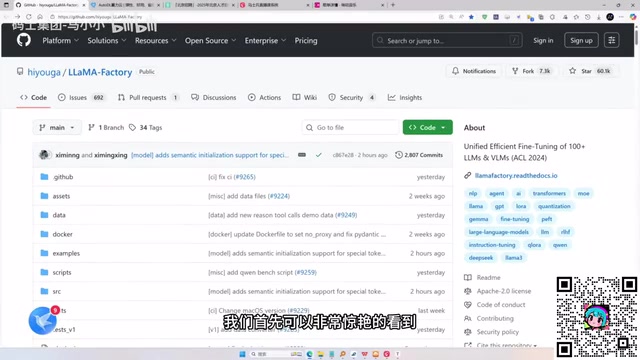
LLaMA-Factory in Practice: A Complete No-Code Guide to Fine-Tuning Large Models
An introduction to LLaMA-Factory, the open-source fine-tuning tool: its 60.1K-star background, supported models and algorithms, local vs. cloud deployment, and CUDA setup steps.

Zeng Ming's Deep Retrospective: Why OpenAI May Not Be the Ultimate Winner — and Why the Corporate System Will Disappear
Zeng Ming's deep retrospective on the AI endgame: model companies are just infrastructure, OpenAI and Anthropic won't be the final winners; the next battle is the Agent entry point standard; the corporate system will disappear as AI restructures collaboration, and only mission-driven companies can survive the cycle.

OpenHands v1.28.0: OpenCode and PI Added as Built-in Agents, API Keys Requestable In-Conversation
OpenHands ships 5 releases in 21 days: v1.27.0 adds OpenCode and PI as built-in agents, v1.28.0 enables in-chat key requests. ACP integration, credential reuse, model list changes, and upgrade advice.