Beyond Large Models: A Developer's Call for Help and Reflections on GNN Systems

An independent developer asks for help: the GNN system runs at toy scale but is stuck on scaling and high-quality corpora.
An independent developer posted on Reddit asking for help with a GNN-based deep learning system that runs at toy scale but faces bottlenecks in deployment, scaling, and high-quality training corpora. They seek dense, clean, open-source corpora in mathematics, human languages (including historically incomplete languages), physics, and other sciences. The article notes that GNNs rely on relationship-dense, high-quality annotated graph data, unlike LLMs that can use massive internet text, and highlights the dual resource and attention challenges for independent developers exploring alternative architectures.
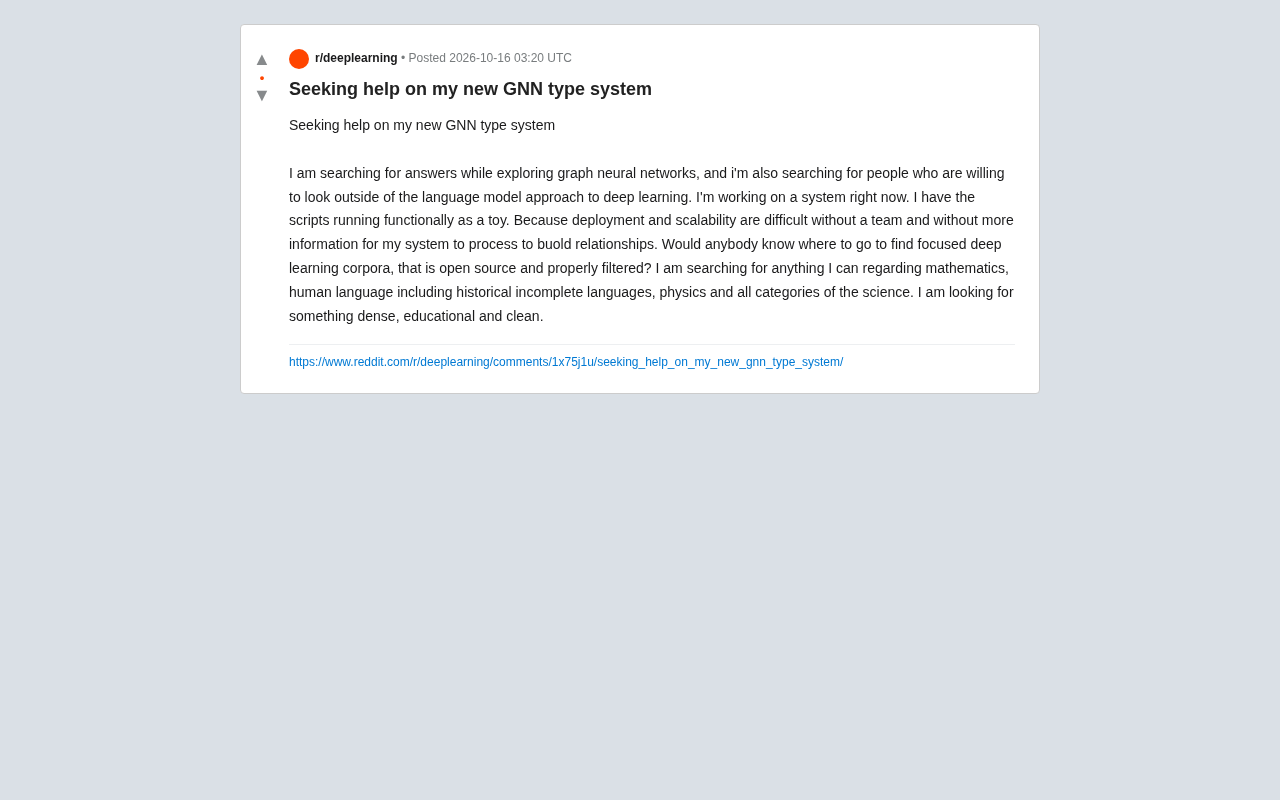
At the fork between graph neural networks (GNNs) and large language models (LLMs), an independent developer has sent out a call for help. According to a Reddit post, the developer is building a GNN-based deep learning system that can already run scripts at a toy scale, but has hit bottlenecks in deployment, scaling, and high-quality training corpora.
A Non-Mainstream Technical Choice
The poster explicitly states that they are "looking for people willing to step outside the language model paradigm and look at deep learning." This sentence reveals a noteworthy signal: in the current LLM-dominated discussion environment, there are still some developers exploring technical paths different from Transformers, such as graph structures and relational modeling.
The core advantage of GNNs lies in handling relationship networks between entities, while language models excel at sequence prediction and text generation. The poster mentions that their system needs "more information to process in order to build relationships," which indicates a strong dependence on structured, relationship-dense data—exactly the typical application scenario for GNNs.
Graph Neural Networks (GNNs) are a class of deep learning models specifically designed for graph-structured data. Their core idea is to aggregate neighbor information through message-passing mechanisms between nodes, thereby learning representations of nodes, edges, or entire graphs. Unlike Transformers, which treat input as sequences and rely on self-attention to capture long-range dependencies, GNNs explicitly model entities and their relationships. Typical architectures include GCN, GAT, GraphSAGE, and others. GNNs excel in relationship-intensive tasks such as social network analysis, molecular property prediction, knowledge graph completion, and recommendation systems. Their limitations include: training depends on high-quality graph-structured data, scaling up graphs easily leads to neighbor explosion and over-smoothing, and unlike LLMs, they cannot directly self-supervise from massive unlabeled text. This is precisely the technical root of what the poster means by "needing more information to process in order to build relationships."
Toy-Scale Operation and Scaling Dilemma
The poster admits that the system "can functionally run scripts as a toy," but faces difficulties in deployment and scaling. There are two reasons: lack of team support, and insufficient system processing information to establish relationships.
This dilemma is not uncommon among independent developers. Training GNN systems often requires large-scale graph-structured data, and constructing such data itself demands substantial manpower and domain knowledge. Unlike LLMs, which can leverage massive text from the internet, GNNs have higher requirements for relational density and annotation quality of data.
Urgent Need for High-Quality Corpora
The poster raises a specific question: where can one find focused, open-source, properly filtered deep learning corpora? Their needs span a wide range—mathematics, human languages (including historically incomplete languages), physics, and all scientific categories.
The keywords are "dense, educational, and clean." This reflects a common pain point in current open-source datasets: large-scale ones tend to be noisy, while clean ones tend to be narrow in domain. For GNN systems that need to build entity relationships, data quality directly determines the effectiveness of the graph structure.
The need for historically incomplete languages is particularly noteworthy—such corpora naturally have characteristics of fragmentation and missing relationships. How to model and complete them using GNNs is itself a direction with research value.
For high-quality open-source corpora, common options include: Common Crawl (extremely large but noisy, requiring self-cleaning and filtering), Wikipedia Dumps (clear structure, good multilingual coverage, suitable for extracting entity relationships), arXiv and PubMed Central open-access subsets (high-density text in scientific fields such as mathematics, physics, and biomedicine), Project Gutenberg and Perseus Digital Library (important sources for historical languages and classical literature). For GNN tasks that need to build entity relationships, knowledge graphs such as Wikidata and DBpedia are usually also needed as structured supervision signals. For historically incomplete languages, academic projects such as CLTK (Classical Language Toolkit) and Trismegistos provide digitized resources of fragmented texts. Aligning these heterogeneous corpora and transforming them into graph structures is itself a heavy engineering task—which is also a key link that independent developers find difficult to complete alone.
The Community Help-Seeking Pattern of Independent Developers
From the post itself, the poster did not attach code or papers, but instead sought community guidance through open-ended questions. This way of seeking help is common in Reddit's machine learning communities, but the premise for receiving effective responses is that the question is specific enough. The poster provides a clear domain scope and data quality requirements, which makes it easier to get valuable answers than vaguely asking "where to find data."
For developers interested in GNNs, knowledge graphs, or non-LLM paths, this post is both a request for help and a reflection of a reality: at a time when both compute and data are concentrating toward large models, independent developers exploring alternative architectures face dual challenges in resource acquisition and community attention.
One-line Summary
An independent developer publicly asks for help: the GNN system runs at toy scale, but is stuck on scaling and high-quality corpora.
Paragraph Summary
An independent developer posted on Reddit asking for help, saying they are building a GNN-based deep learning system that can already run scripts at toy scale, but has encountered bottlenecks in deployment, scaling, and high-quality training corpora. They explicitly state they hope to find people willing to step outside the LLM paradigm and are seeking dense, clean, open-source corpora in mathematics, human languages (including historically incomplete languages), physics, and various scientific fields. The article points out that GNNs depend on relationship-dense, high-annotation-quality graph-structured data. Unlike LLMs, which can leverage massive text from the internet, constructing such data requires substantial manpower and domain knowledge. The post reflects the dual challenges in resources and attention faced by independent developers exploring alternative architectures against the backdrop of compute and data concentrating toward large models.
Related articles

Free Unlimited Claude Code Solution: Agnes AI + CC Switch Setup Guide
No paid subscription needed — pair the free AI platform Agnes AI with the open-source tool CC Switch to provide a backend for Claude Code, enabling unlimited free calls to text, image, and video models. This guide covers the full setup, test results, and usage boundaries.

A Complete Zero-Cost Guide to Getting Started with Claude Code for Beginners in China
A beginner's guide to Claude Code for users in China: two installation methods (command line and IDE plugin), full configuration steps for replacing the official API with the free domestic LongCat model, and a hands-on demo of building a small tool with natural language, plus tips.

When the NSA Gets Involved: The AI Supply Chain Crisis Behind Open-Source CVEs and API Key Hijacking
Multiple open-source projects disclosed severe CVEs in one day, PHP flaws alarmed the FBI, and Railway and OpenCode were breached with API keys stolen. This article breaks down the vulnerability window, AI-accelerated exploitation, and the AI supply chain crisis behind the API key black market, with a developer defense checklist.