Beyond the "AI Look": How Claude Code Projects Can Escape Homogenized UI

The Reddit community discusses UI homogenization in Claude Code projects and proposes style templates and concrete constraints as paths to improvement.
The article centers on a popular Reddit post in the Claude Code community complaining that many AI-assisted project interfaces look identical and carry obvious "vibecoded" traces, and questioning why excellent websites aren't used directly as style templates. It reviews traits of projects considered "non-AI-generated," such as restrained gradients, intentional font choices, and layouts that follow information hierarchy, while analyzing the technical feasibility and practical obstacles of style transfer. On this basis, it offers four improvement strategies: replacing vague descriptions with concrete constraints, providing multimodal references, iterative refinement, and using MCP and custom skills. Finally, it presents the controversy over the causes of homogenization—whether it is a problem of tool default output or of developers' design literacy—and calls on the community to share dissectable counterexamples rather than remain stuck in complaints.
Why Your Claude Code Project Looks "AI-Generated"
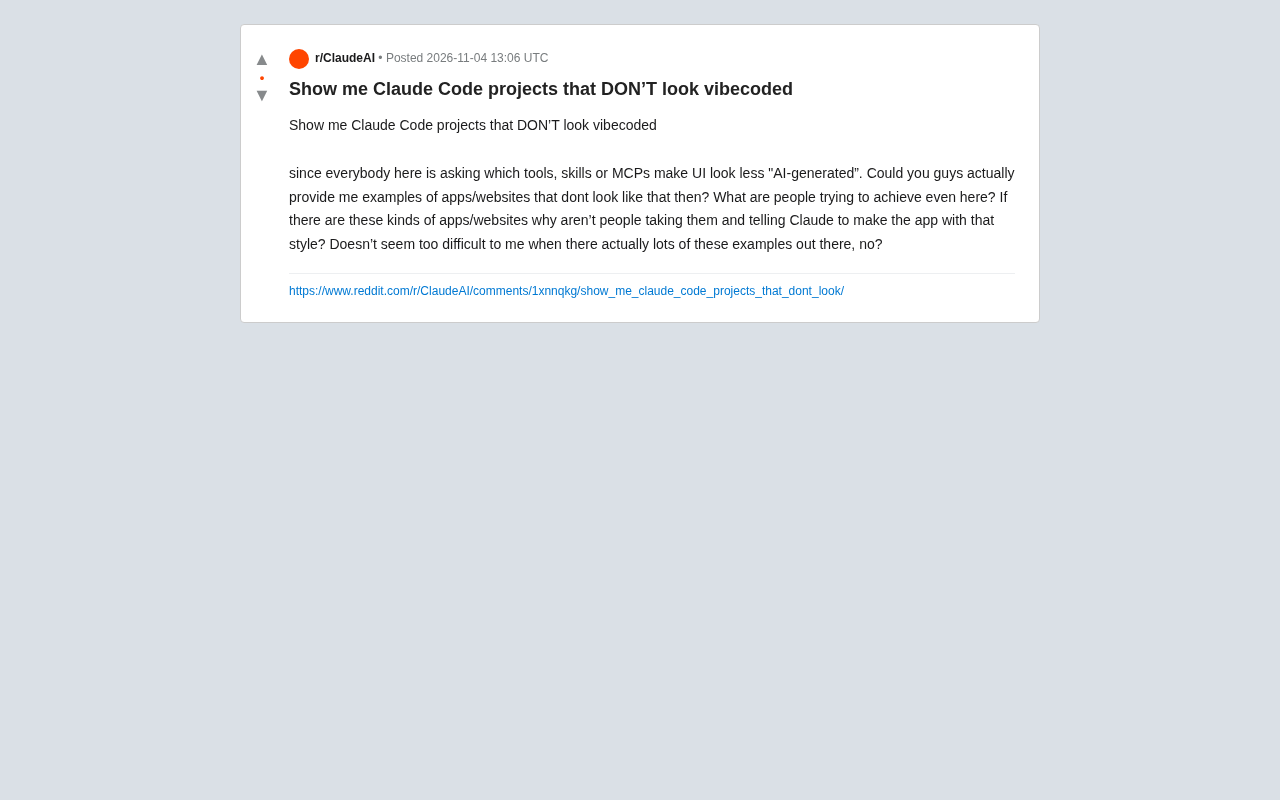
In the Reddit Claude Code community, one post struck a chord: users complained that too many project UIs bear obvious "AI-generated" hallmarks—identical gradient backgrounds, rounded cards, and piles of sans-serif fonts. The poster asked directly: Are there any Claude Code projects that don't look "vibecoded"? If such examples exist, why not use them directly as style templates for Claude to reference?
This question hits a pain point of current AI coding tools. Claude Code and similar tools lower the barrier to development, but they also introduce a new risk of homogenization. When everyone uses similar prompts, similar skill libraries, and MCP servers, the resulting UIs inevitably converge.
But the other side of the question is: what kind of design actually counts as "not AI-generated"? The poster himself admitted that many people are just complaining without being able to articulate what they want to achieve. This reveals a deeper dilemma—developers' understanding of "good design" is itself vague.
The term "vibecoded" comes from the developer community's self-deprecating name for "vibe coding": building code quickly by feel with the help of large language models rather than writing it line by line. The term spread around 2025 alongside the rise of AI coding tools like Cursor and Claude Code, and it often carries a joking tone: the project runs, but the code style and interface design expose obvious model default preferences. Understanding this term helps grasp the context of the original post—the poster is not rejecting AI-assisted development itself, but rather the kind of output that lacks design intent and simply accepts the model's default output.
Real Cases and Experiments in the Community
Although the original post did not directly list specific project links, the comment discussions point in several directions. According to Reddit users and analyses from some YouTube tech channels, projects considered "non-vibecoded" usually have the following characteristics:
- Restrained use of gradients and shadows, adopting a flatter or more structured visual language
- Font choices with clear intent, rather than default system fonts or common AI-preferred fonts
- Layouts that follow information hierarchy, rather than uniformly blocked grids
- Interaction feedback with detail, such as transition animations, loading states, and micro-interactions
Some developers mentioned that they deliberately have Claude reference specific design systems (such as Material Design or IBM Carbon) instead of vague descriptions like "modern and clean." Other users suggested feeding Claude real website screenshots or Dribbble examples directly, rather than describing style in words.
However, these discussions remain at the level of experience sharing and lack a systematic methodology.
Style Templates: An Underused Solution
The core challenge raised by the poster is sharp: since so many excellent websites exist, why not use them directly as templates? Technically, this is not complicated. Claude Code supports reading images, analyzing CSS, and even directly scraping web page styles. You can have Claude reference the visual style of a specific site to generate new components.
But there are several obstacles in practice. First, style transfer is not the same as copy-paste. Simply telling Claude to "make it like this website" often leads to structural cloning rather than style abstraction. Second, design intent is hard to quantify. A website's aesthetic comes from the subtle balance of spacing, proportion, color scheme, and motion, which is difficult to convey through screenshots alone. Third, Claude's default output has inertia. Even with a reference given, the model may still drift toward common patterns in its training data.
This explains why the community is still looking for "non-vibecoded" examples—what people need are actionable, validated style references, not abstract design principles.
MCP (Model Context Protocol) is an open protocol proposed by Anthropic to let AI models connect to external tools, data sources, and services in a standardized way. In Claude Code, MCP servers can act as plugins, providing the model with additional capabilities such as reading databases, calling design review interfaces, or scraping web page styles. The "design review MCP server" mentioned in the article uses this mechanism to automatically scan and flag common AI style patterns after code generation. It is crucial to understand the boundaries of MCP: it extends the set of tools the model can call, not the model's own aesthetic judgment, so developers still need to define review rules.
How to Make Claude Code Produce More Distinctive Designs
Drawing on community discussions and practical experience, there are several strategies worth trying:
1. Replace vague descriptions with specific constraints
Don't say "modern and clean"; specify instead: "Use an 8px baseline spacing, primary font Inter, no more than three heading levels, avoid box-shadow, background color pure white or #F5F5F5." The more specific the constraints, the more controllable the output.
2. Provide multimodal references
Give Claude screenshots, CSS snippets, or even design tokens files. Some developers shared that after feeding their existing design system's variable tables to Claude, the style consistency of generated components improved significantly.
3. Iterative refinement
After the first round of generation, request changes to specific elements: "Change this card's border radius from 12px to 4px," "Remove the button gradient and replace it with a solid color." Claude usually responds better to local adjustments than to full rewrites.
4. Use MCP and custom skills
Some people in the community have developed MCP servers specifically for design review that can detect "AI style" patterns in generated code and suggest corrections. Other users have created custom skills that force Claude to output a design decision document before generating UI.
Design tokens are the underlying variable set of a design system, using named key-value pairs to describe foundational styles such as color, typography, spacing, border radius, and shadows—for example,
color-primary: #0055FForspacing-md: 8px. They were initially popularized by companies such as Salesforce in design system practice and have now become a common intermediate layer connecting design and code. Providing a design tokens file to Claude is equivalent to translating vague visual preferences into structured constraints the model can directly consume. This is also the technical reason behind the "significant improvement in style consistency" mentioned in the article: the model no longer needs to guess specific values but generates components according to established variables.
Controversy: Is Homogenization a Tool Problem or a Human Problem?
Clear divisions emerged in the discussion. One side argues that Claude Code's default output style is a product of its training data, and the tool itself should provide more diverse design presets. The other side argues that developers' own prompts and aesthetic judgment are the key—the tool is only an amplifier, and if the input is vague requirements, the output will naturally be mediocre.
One user put it bluntly: "If the only instruction you give Claude is 'make a nice-looking dashboard,' then you'll get an AI-flavored dashboard. If you can clearly state what you want, the result will be completely different."
This view received considerable agreement, but some pushed back: most developers are not designers, and they lack the vocabulary and frameworks to describe design intent. Requiring everyone to express visual requirements precisely is unrealistic in itself.
Both views have merit. Tools can indeed be improved—for example, by offering style presets, design system integration, and smarter defaults. But developers also need to improve their own design literacy, at least learning to guide the model with specific constraints.
Conclusion: Look for Benchmarks, Not Complaints
The value of the original post lies in the constructive question it raises: rather than complaining about the AI look, find counterexamples and analyze why they are good. The community needs more specific project cases, reusable style templates, and validated prompt patterns.
If you have a Claude Code project that doesn't look AI-generated, consider sharing it. More importantly, break down its design decisions—what fonts it uses, what spacing system it follows, how it handles color and motion. This specific information is far more useful than the word "good-looking."
Homogenization is not the fate of Claude Code. It is simply a reminder: AI can generate code, but design judgment still requires human involvement.
Related articles

Non-Coding Dad Builds 3D Earth Toy with Claude Code, Unexpectedly Goes Viral in Classrooms
A non-coding father used Claude Code to build My Earth Toy, a 3D interactive Earth with 830+ landmarks, 470+ animals, and 180+ vehicles—now used in classrooms worldwide. Discover how AI coding lowers the barrier to creation.

Meta, Google, and TikTok Sue California Attorney General: The Battle Over Youth Social Media Law
Meta, Google, and TikTok jointly sue the California Attorney General to block a state law restricting social media use by minors under 16. This article analyzes the lawsuit's background, the law's core provisions, and its potential impact on tech industry regulation.

T-Mobile Parent Company CEO on Musk's Telecom Ambitions: Welcome, But You'll Need $200 Billion
Deutsche Telekom CEO Tim Höettges responds to Musk's SpaceX Starlink Mobile plan, saying "welcome to the party" but questioning feasibility—estimating at least $200 billion needed to become a major U.S. carrier.