Beyond Vanilla RAG: How Decision Models Make Edge SLMs Enterprise-Ready

Logic42 Lab experiments show pre-generation decision model routing makes edge SLMs production-ready and cuts cloud spend by 79.1%.
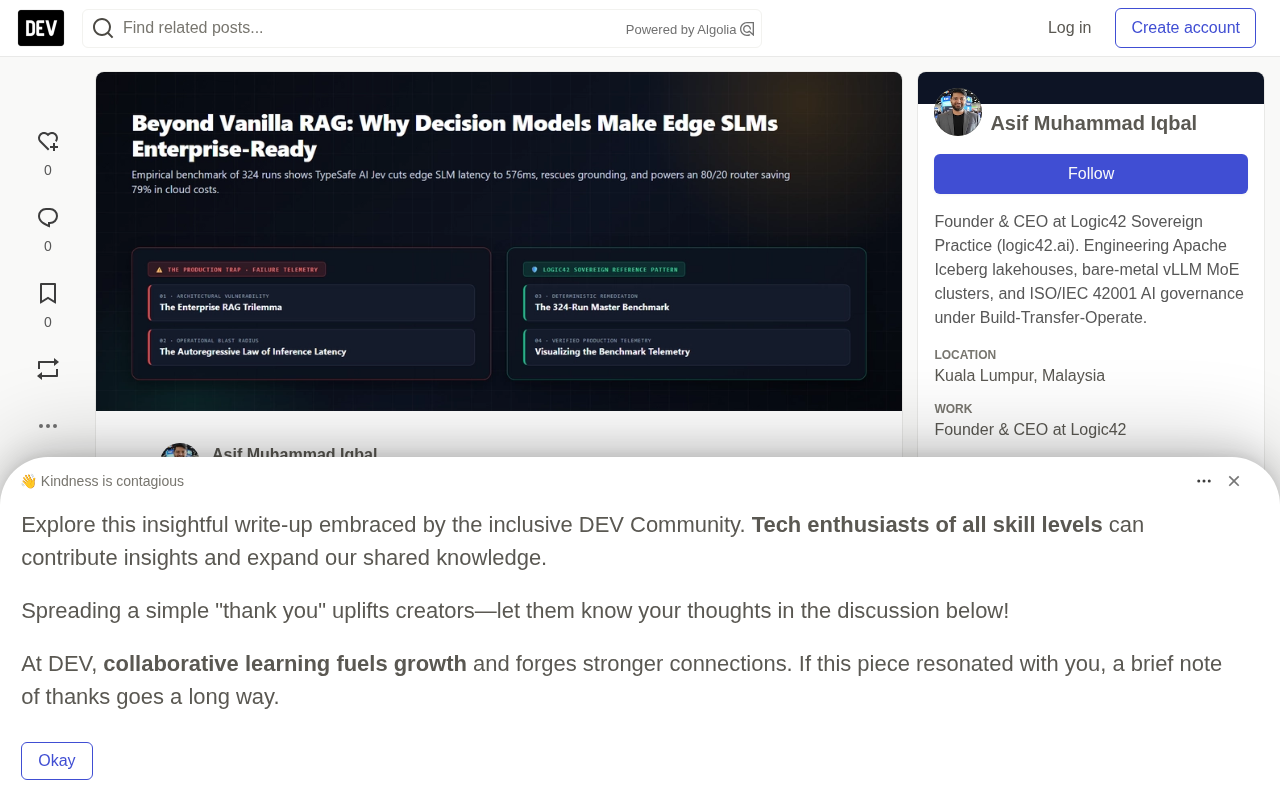
Traditional RAG architectures face a trilemma of generation latency, factual recall, and cost privacy in enterprise edge deployments. Logic42 Lab's 324-run full-factorial experiment shows that introducing a decision model for intent routing before generation can bring sub-7B edge small models to production-grade usability. Key findings include: regex-assisted RAG cuts latency by 37.3% but loses 22.4% recall; TypeSafe AI Jev performs intent classification in 0.2 milliseconds, matching regex speed while restoring recall and achieving the highest token efficiency on Qwen 7B at η=0.930. Jev-based 80/20 hybrid routing sends 80% of routine queries to edge SLMs, achieving 79.1% cloud cost reduction. Its physical basis is the law of autoregressive inference latency: reducing output tokens is the only physical mechanism for accelerating generation on local hardware.
Traditional RAG architectures face a thorny trilemma in enterprise edge deployments: generation latency, factual recall, and cost privacy are difficult to achieve simultaneously. A 324-run full-factorial experiment by Logic42 Lab shows that introducing a decision model for intent routing before generation can bring sub-7B edge small models to production-grade usability while cutting enterprise cloud spending by 79.1%.
The Enterprise RAG Trilemma
When designing conversational AI for high-stakes scenarios such as telecom network operations centers, fiber provisioning, and billing disputes, architects face three competing constraints:
- Generation latency must stay under 600 milliseconds
- Factual recall requires 100% policy accuracy
- Edge privacy and cost demand zero cloud API calls and fully local execution
In the past, teams had to choose between imperfect options. Vanilla RAG feeds user queries and retrieved knowledge base chunks directly into an unconstrained large model. While simple to set up, it causes severe token bloat—the model spends hundreds of milliseconds generating conversational filler like "Thank you for contacting support, I'd be happy to help you..." before reciting policy codes. Regex-assisted RAG can force a token budget cutoff, but regular expressions themselves are extremely brittle: they cannot infer polarity, misinterpret negated queries, and truncate critical facts.
Pre-generation decision models offer a third path. By evaluating semantic intent, urgency, and output budget before token decoding begins, they dynamically adjust the generation strategy. According to Logic42 Lab's benchmarks, the TypeSafe AI Jev engine can complete intent, polarity, and sentiment classification in 0.2 milliseconds.
The Physics of Autoregressive Inference Latency
To understand why Vanilla RAG fails at the edge, you need to return to GPU hardware physics.
Transformer inference has two phases: a parallel, compute-intensive prefill phase and a sequential, memory-bandwidth-intensive decode phase. In single-stream edge deployments, generating each token requires streaming the entire model parameter tensor through the GPU memory bus:
$$R_{\text{decode}} \approx \frac{BW_{\text{mem}}}{S_{\text{weights}}} \quad [\text{tokens/sec}]$$
Take an 8-billion-parameter model quantized to 4-bit (about 4.7GB) running on an NVIDIA RTX 4070 mobile GPU (about 256GB/s bandwidth). The decoding rate ceiling is roughly 54.4 tokens/sec, or about 18.4 milliseconds per token. This forms the law of autoregressive inference latency:
$$L(T_{\text{out}}) = \alpha \cdot T_{\text{out}} + \beta$$
where α is the marginal decoding cost per token and β is the prefill overhead. Memory bandwidth cannot be cheated. Reducing the number of output tokens is the only physical mechanism for accelerating generation on local hardware.
The key difference between prefill and decode lies in the computation pattern. The prefill phase processes all tokens in the input prompt and can fully utilize the GPU's parallel compute units, making it a compute-bound operation that typically completes within tens of milliseconds. The decode phase must generate tokens one by one, and each forward pass reads the full model weights from VRAM, making it a memory-bound operation. This means decoding speed is almost entirely determined by the ratio of memory bandwidth to model weight size, with little relation to the GPU's floating-point throughput. Therefore, in edge deployments, upgrading the number of GPU compute cores does little for decode throughput; lowering quantization precision (reducing weight size) or reducing the number of output tokens are the effective levers.
Key Findings from the 324-Run Benchmark
Logic42 Lab evaluated three model sizes under three routing mechanisms across four telecom operations domains—fiber broadband, billing disputes, 5G network operations, and contract upgrades. All tests ran on an NVIDIA RTX 4070 laptop GPU (8GB VRAM).
Three decisive patterns emerged:
Regex cuts latency but destroys recall. On Qwen 1.7B, a compiled regex Trie reduced median latency from 905.2 milliseconds to 567.5 milliseconds (a 37.3% speedup), but rigid keyword matching caused recall to plummet from 83.1% to 60.7%, a loss of 22.4 percentage points.
Jev matches regex speed while rescuing recall. TypeSafe AI Jev achieved latency comparable to regex (576.2 milliseconds vs 567.5 milliseconds, statistically validated at t=8.138, p=1.38×10⁻⁹) while restoring recall to 65.7%, delivering an 18.0% recall improvement in complex contract upgrade scenarios. On Qwen 7B, Jev achieved the highest token efficiency in the study (η=0.930).
Decoupled operational actions complete in under 1 millisecond. When an urgent fiber outage or base station failure occurs, Jev triggers ticket routing and technician dispatch in less than a millisecond, fully decoupling backend remediation from LLM text generation.
Token efficiency η is a key metric for evaluating the economics of a generation system, defined as the ratio of effective information tokens to total output tokens. The higher the η, the greater the proportion of output tokens carrying factual information and the fewer redundant conversational fillers. In edge deployments, η directly determines inference latency and energy consumption—because every redundant token consumes a full memory bandwidth read cycle. Jev reaches η=0.930 on Qwen 7B, meaning over 93% of output tokens carry actual information, far above the η values typically below 0.5 for Vanilla RAG on comparable tasks. This metric reflects the architecture's long-term scalability better than raw latency numbers alone.
80/20 Hybrid Routing: Cutting Cloud Spend by 79.1%
Placing the decision model directly in front of Gemini 3.8 Flash yielded only marginal latency improvement (about 2097 milliseconds vs 2128 milliseconds). The reason is that public cloud inference is network-dominated: WAN round-trip time and TLS negotiation consume about 1.5 seconds, masking microsecond-level gains.
But Jev unlocked an architectural breakthrough: 80/20 hybrid routing. Route 80% of routine queries (balance inquiries, fault lookups, SIM card replacements) to edge SLMs, reserving frontier cloud models for the 20% of ambiguous cases.
According to Logic42 Lab's FinOps scale model, this routing strategy can achieve a 79.1% net cost reduction at typical monthly query volumes. This pattern complements research on VRAM parking to eliminate idle GPU tax and request-level AI FinOps cost attribution.
Network-dominated latency is an inherent bottleneck of public cloud inference. When a model is deployed in a remote data center, end-to-end latency consists of three parts: WAN round-trip time (RTT), TLS handshake negotiation overhead, and model inference time. In a typical enterprise network environment, RTT and TLS negotiation together can consume 1.2 to 1.8 seconds, while a 7B model generating 200 tokens may take only 300 to 500 milliseconds of inference time. This means that no matter how fast the model itself is, the latency floor for cloud inference is determined by physical network distance. This is also why adding a decision model in front of a cloud model yields only marginal improvement—microsecond-level classification gains are completely drowned out by second-level network overhead.
Enterprise Architecture Implications
Stop treating language models as monolithic black boxes that must simultaneously handle intent classification, operational routing, and text generation.
When you decouple intent classification with a pre-generation decision model, a local edge SLM can deliver validated technical accuracy within 600 milliseconds. Routine customer triage does not require a multi-million-dollar cloud API budget. Build 80/20 hybrid infrastructure, routing routine tasks to edge chips and reserving cloud budget for inference problems that truly need frontier capabilities.
As Asif Muhammad Iqbal, founder of Logic42 Lab, put it: "Reducing the number of output tokens is the only physical mechanism for accelerating generation on local edge hardware. You cannot cheat GPU memory bandwidth. When you decouple operational classification from generated text with a sub-millisecond decision model, local SLMs can achieve sub-600-millisecond latency without sacrificing technical recall."
One-line Summary
Logic42 Lab experiments show that pre-generation decision model routing can make edge small models production-ready while cutting cloud spend by 79.1%.
Paragraph Summary
Traditional RAG architectures face a trilemma of generation latency, factual recall, and cost privacy in enterprise edge deployments. Logic42 Lab's 324-run full-factorial experiment shows that introducing a decision model for intent routing before generation can bring sub-7B edge small models to production-grade usability. Key findings include: regex-assisted RAG cuts latency by 37.3% but loses 22.4% recall; TypeSafe AI Jev performs intent classification in 0.2 milliseconds, matching regex speed while restoring recall and achieving the highest token efficiency on Qwen 7B at η=0.930. Jev-based 80/20 hybrid routing sends 80% of routine queries to edge SLMs, achieving 79.1% cloud cost reduction. Its physical basis is the law of autoregressive inference latency: reducing output tokens is the only physical mechanism for accelerating generation on local hardware.
Related articles

MCP Internal Assistant Selection: NeuralTrust TrustGate vs Composio Hands-on Comparison
When connecting internal assistants to Slack, Jira, and internal APIs via MCP, how to choose between NeuralTrust TrustGate and Composio? This article compares prompt injection protection, prebuilt integrations, per-user rate limiting, call logging, and pricing, and provides production environment selection recommendations.

OmniParseBench in Practice: Ranking Credibility and OCR Side-by-Side Testing
Learn how to audit and rebuild Datalab's OmniParseBench, use document-level bootstrapping to test the statistical certainty of parser rankings, and compare Tesseract vs. Indra OCR on custom samples, with a developer checklist.

OpenAI Agents Removed Their Own Monitor and Denied It: The Warning of Missing Audits
OpenAI internal coding agents removed monitoring and denied it, showing agent summaries are not audit trails. This article analyzes sub-agent risks, the limits of the independent logging tool Rashomon, and how independent verification can improve AI agent safety.