Bilibili DeepAgents Practical Tutorial: From LangChain Basics to Agent Development

A breakdown of the Bilibili DeepAgents tutorial, clarifying LangChain's framework positioning and the practical learning path for agent development.
Based on a Bilibili tutorial claimed to be "the only one that explains DeepAgents from beginner to expert clearly," this article outlines the learning path from LangChain to DeepAgents. It first uses a minimalist definition to explain that LangChain is a framework for building AI applications, whose value lies in shielding underlying complexities such as high concurrency, context management, and dialogue history maintenance, allowing developers to focus on business logic—this is also the backdrop for the popularity of large model jobs. It then summarizes LangChain's core capabilities: unified integration with any model, modular architecture, building agents and tools, and memory management, noting that agents have become the core form of enterprise large model development. The article then introduces the tutorial's positioning and offers learning advice: run through basic examples first, reproduce code hands-on, focus on context and tool calling, and build small projects tied to business.
LangChain: What Is It and Why Do We Need It?
In the field of AI application development, LangChain, as a framework for building large model applications, has become an indispensable tool for developers. DeepAgents, on the other hand, is a high-level abstraction in the LangChain ecosystem aimed at complex task orchestration. On Bilibili, there is a tutorial that the uploader calls "the only one that explains DeepAgents from beginner to expert clearly," focusing on hands-on coding practice. This article, based on the core content of that tutorial and combined with LangChain's framework positioning, outlines a learning path from understanding the framework to developing agents.
Many beginners find "LangChain" abstract when they first hear about it. In the video, the uploader gives a minimalist definition: LangChain is a framework for building AI applications. Large models themselves possess powerful reasoning capabilities—they can understand what you say and provide feedback—but they cannot directly remember context, nor can they automatically associate your business data.
If you want a large model to answer questions based on your company's business data, you need to build an AI application. Building an application inevitably involves writing code, and writing code requires a framework to shield underlying complexity. LangChain was born for this—it replaces repetitive manual work such as high-concurrency handling, context management, and dialogue history maintenance, allowing developers to focus on business logic.
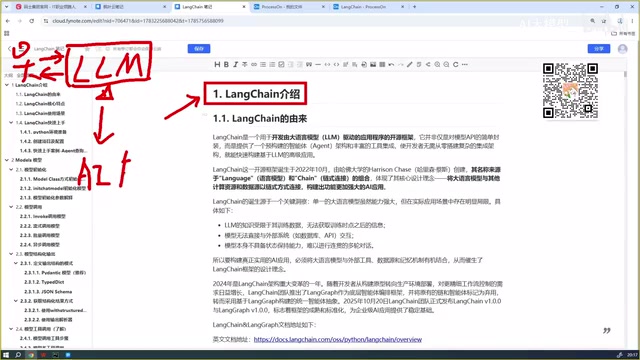
The uploader mentions that the reason large model job positions are so hot is precisely because a large number of enterprises are building AI applications integrated with their own business. These positions require developers to quickly build applications rather than reinventing the wheel from scratch. The modular capabilities provided by LangChain (model management, prompt management, memory management, security control, etc.) precisely match this demand.
Context Window and Dialogue History: Large models themselves are stateless—each call is an independent inference, and the model does not automatically "remember" what was said in the previous turn. The so-called "remembering context" is actually the application layer re-splicing the previous dialogue history into the prompt and sending it to the model with each request. This brings two engineering problems: first, the longer the dialogue, the greater the token consumption, the higher the cost, and the slower the response; second, the model's context window has a hard upper limit (e.g., 8K, 128K tokens), beyond which truncation or summarization is necessary. LangChain's memory management module is designed precisely for this, providing strategies such as sliding windows, summary compression, and vector retrieval recall, encapsulating the tedious task of "maintaining dialogue state" into configurable components so developers don't have to hand-write splicing and trimming logic.
Tool Calling (Function Calling / Tool Calling): This is the underlying mechanism that enables agents to "do things." Large models themselves can only output text and cannot directly query databases, call APIs, or execute code. The approach for tool calling is: developers describe the names, purposes, and parameters of available tools using structured schemas, which are passed to the model along with the request; if the model determines during reasoning that external capabilities are needed, it returns a structured "call intent" (tool name + parameter JSON), and the application layer actually executes that function, then passes the result back to the model to continue reasoning. LangChain abstracts this round-trip process into Tool objects and an agent execution loop, so that multi-step tool orchestration, result filling, error retry, and other logic do not need to be implemented from scratch.
LangChain's Core Capabilities: Integration, Modules, and Agents
According to the uploader's summary, the LangChain framework has several key features:
- Integration with any model: Whether it's DeepSeekAd, OpenAI, Anthropic, or other vendors' large models, LangChain can integrate them uniformly.
- Modular architecture: The framework is internally divided into multiple modules such as model management, prompt management, memory management, context management, and security management, which developers can combine as needed.
- Building agents and tools: Agents are the core form of current enterprise large model development. LangChain supports building agents and encapsulating business data as tools for agents to call.
- Memory management: Enables large models to remember dialogue history and optimize when context grows.
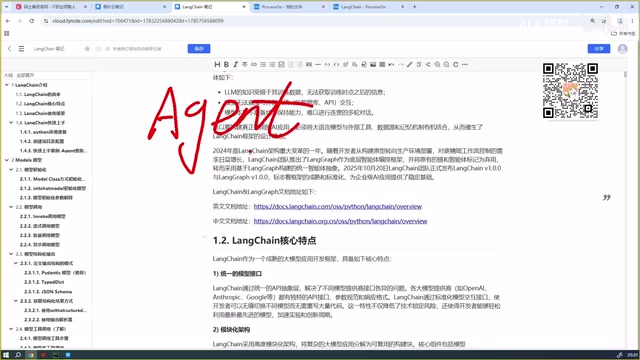
The uploader particularly emphasizes that the concept of agents has fully entered enterprise practice this year. Anyone doing large model development will almost certainly build agents. LangChain's agent abstraction is precisely the part that the DeepAgents tutorial will delve into.
From LangChain to DeepAgents: The Tutorial's Practical Positioning
The tutorial is positioned as "the foundation of large model courses," aimed at beginner students. The goal is to help students establish a macro understanding of the large model technology stack while implementing core details through code examples. The uploader explicitly states that the course will not stop at abstract concepts but will directly show "how to write this code, how to write some cases."
In terms of content structure, the tutorial first explains LangChain's framework role, then transitions to agent development. As advanced content, DeepAgents involves practical aspects such as task decomposition, tool calling, and multi-step reasoning for agents. The uploader mentions that the first two chapters of the course notes will be distributed for free, and students can obtain them by scanning a QR code, which lowers the entry barrier.
A quick note: this tutorial comes from a single Bilibili uploader, and the content quality depends on their personal experience. Although the uploader claims it is "much better than grinding through books," learners should still cross-verify with official documentation. The APIs of LangChain and DeepAgents iterate quickly, and the code examples in the video may need adjustment based on the latest versions.
What are "Deep Agents": Ordinary agents typically revolve around a "single-turn tool calling loop"—the model thinks, calls a tool, gets the result, thinks again, until it gives an answer. "Deep" emphasizes orchestration capabilities for long-horizon, complex tasks: breaking a large goal into subtasks, planning the execution order, maintaining intermediate state across multiple tools and multiple rounds of reasoning, and reflecting and re-planning when necessary. In the LangChain ecosystem, such capabilities correspond to higher-level agent abstractions (e.g., graph-structured orchestration, planner-executor patterns, sub-agent division of labor), whose goal is to enable agents to handle tasks that "require dozens of steps to complete" rather than simple Q&A. Understanding this is essential to understanding why the tutorial places DeepAgents after the LangChain basics—it tests the comprehensive application of context management, tool design, and task decomposition, not just calling an API.
Learning Advice: How to Efficiently Follow This Tutorial
For developers preparing to follow this tutorial, here are a few suggestions:
- First run through basic LangChain examples: Understand model calling, prompt templates, and basic chain invocation patterns before moving on to the agent section.
- Hands-on code reproduction: The uploader emphasizes practical implementation, so learners should write code alongside the videos rather than just watching.
- Focus on context management and tool calling: These are the areas most prone to problems in agent development and where LangChain's value is most concentrated.
- Design small projects based on business scenarios: For example, use an agent to encapsulate an internal knowledge base query tool to test learning outcomes.
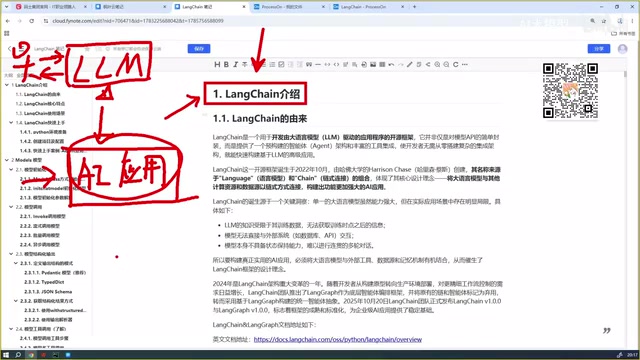
The uploader repeatedly mentions "integrating with your own business" in the video, which is actually the ultimate goal of learning LangChain and DeepAgents. The framework is just a means; truly mastering it means being able to build a usable AI application with your own business data.
Summary
The value of this Bilibili tutorial lies in its use of accessible language to break down LangChain's framework positioning and point toward DeepAgents practice. It is suitable for developers who are completely new to LangChain and want to quickly build understanding and start writing code. However, a single video source has limited information density, so it is recommended to learn alongside official documentation and multiple project cases to avoid being limited by a single speaker's understanding.
One-line Summary
A breakdown of the Bilibili DeepAgents tutorial, clarifying LangChain's framework positioning and the practical learning path for agent development.
Paragraph Summary
Based on a Bilibili tutorial claimed to be "the only one that explains DeepAgents from beginner to expert clearly," this article outlines the learning path from LangChain to DeepAgents. It first uses a minimalist definition to explain that LangChain is a framework for building AI applications, whose value lies in shielding underlying complexities such as high concurrency, context management, and dialogue history maintenance, allowing developers to focus on business logic—this is also the backdrop for the popularity of large model jobs. It then summarizes LangChain's core capabilities: unified integration with any model, modular architecture (model, prompt, memory, context, security), building agents and tools, and memory management, noting that agents have become the core form of enterprise large model development. The article then introduces the tutorial's positioning—aimed at beginners, emphasizing code implementation, with the DeepAgents section covering task decomposition, tool calling, and multi-step reasoning. Finally, it offers learning advice: run through basic examples first, reproduce code hands-on, focus on context and tool calling, and build small projects tied to business, while reminding that a single video source should be cross-verified with official documentation.
Related articles
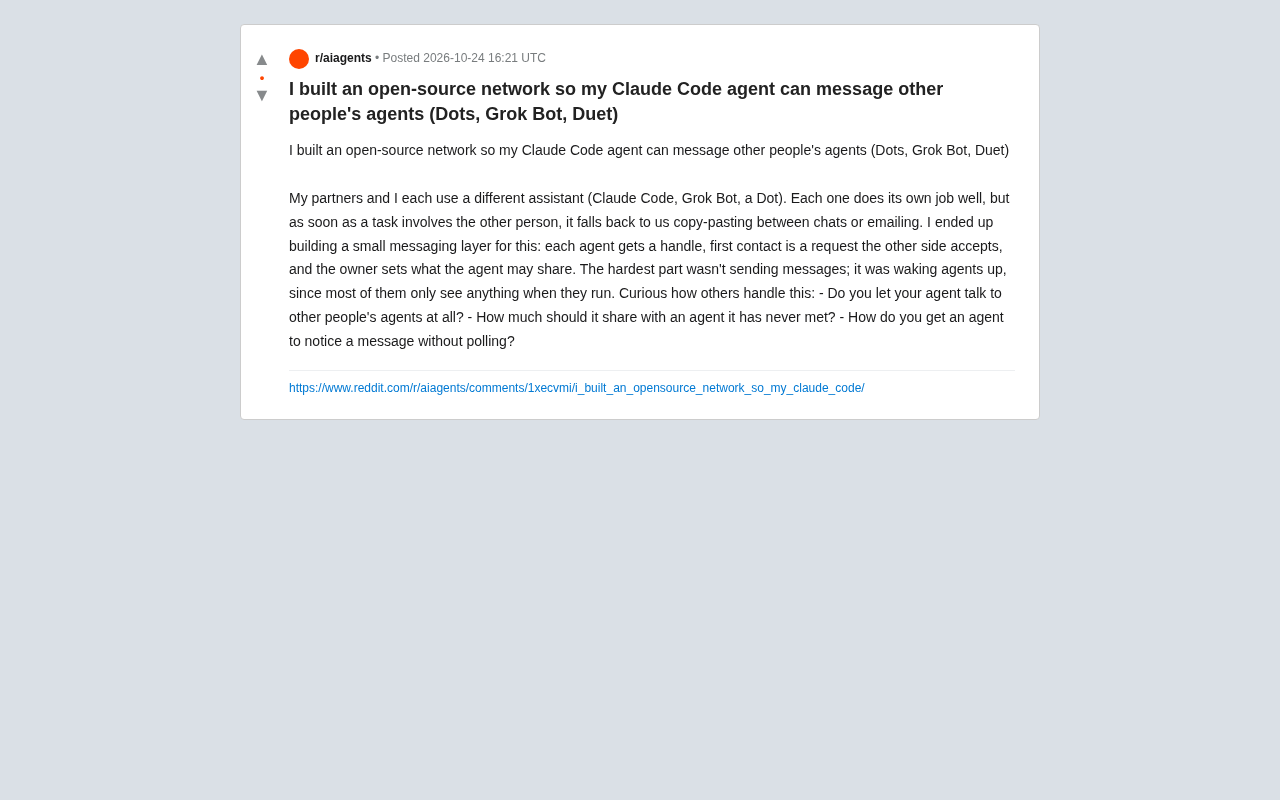
Open-Source Agent Messaging Network Lets Claude Code Talk Directly to Other AI Assistants
Developer builds an open-source messaging layer letting Claude Code, Grok Bot, and other AI agents communicate directly, using handles and handshakes for permission control—but waking dormant agents is the biggest technical challenge.

Beyond Context Soup: How Multi-Agent Pipelines Can Strictly Bound State and Handoffs
Context soup in multi-agent pipelines causes state bloat and ambiguous handoffs. This article summarizes engineering practices for strictly bounding state and handoffs — explicit I/O schemas, immutable state, layered state — and analyzes key trade-offs in handoff protocol design.

Neural Chip Decodes Brain Region Interactions, Pushing Brain-Computer Interfaces Forward
A new neural chip attempts to decode interactions between brain regions at the hardware level rather than merely recording single-region signals. This article analyzes its technical logic, potential applications, and current information limitations.