Neural Chip Decodes Brain Region Interactions, Pushing Brain-Computer Interfaces Forward

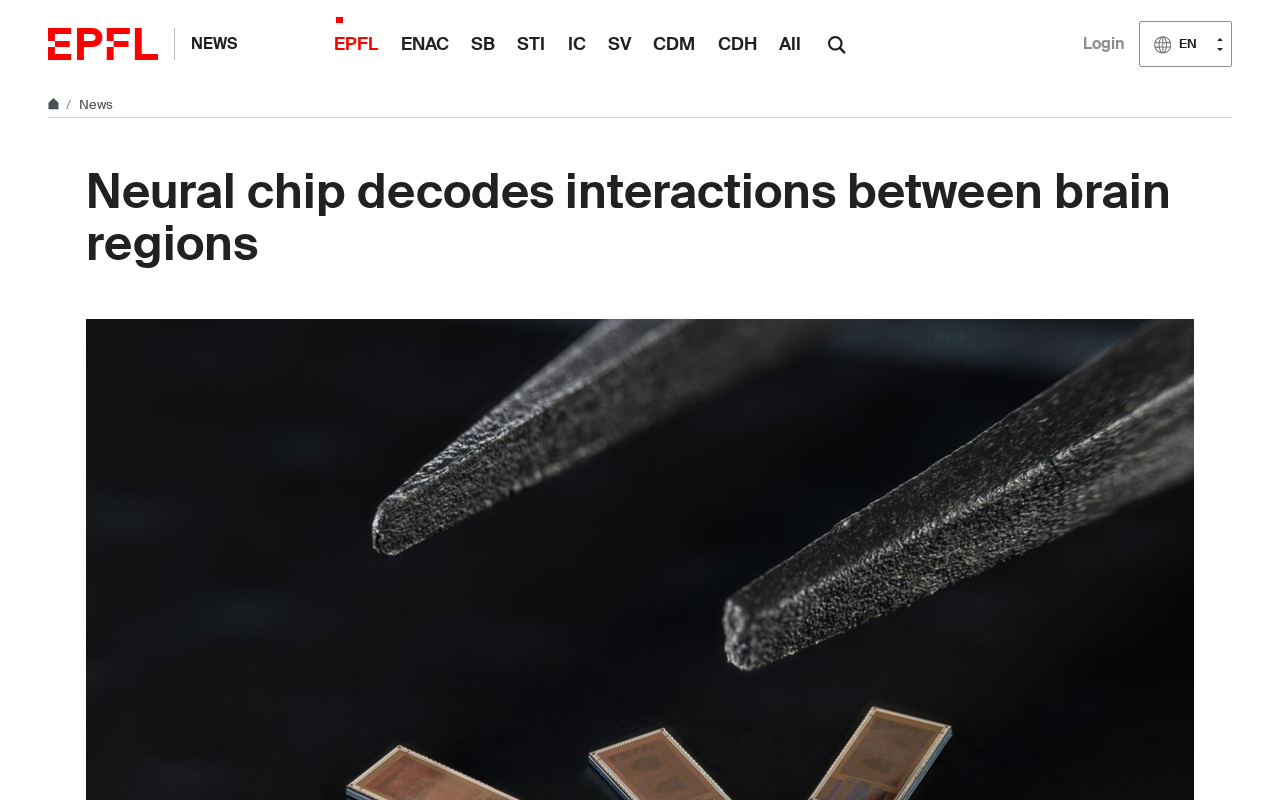
A new neural chip moves computation to the acquisition front end to decode cross-region interactions in real time instead of recording single-region signals.
The article discusses an early-stage neural chip that shifts from traditional neural probes' focus on channel density and signal-to-noise ratio to cross-region interaction decoding. Its core innovation embeds coherence, phase synchronization, and information-flow computations at the acquisition front end, using edge computing to reduce bandwidth and enable millisecond-scale closed-loop intervention. Potential applications include real-time observation of how interventions alter brain-region coupling and adaptive stimulation control signals for Parkinson's disease and epilepsy. However, key metrics such as channel count, power consumption, latency, and in vivo stability remain undisclosed, and algorithmic accuracy lacks peer-reviewed support.
Neural Chip: From Signal Recording to Interaction Decoding
The brain-computer interface (BCI) field has long faced a core bottleneck: traditional devices can read electrical activity from a single brain region but struggle to capture how different regions "talk" to one another. According to a technical development discussed in the Hacker News community, a new type of neural chip shifts the focus from single-signal recording to decoding interactions between brain regions, offering a new hardware pathway for understanding brain network dynamics.
This shift in approach is noteworthy. Cognitive functions are rarely carried out by isolated regions—memory, decision-making, and emotion all depend on cross-region coordination. If a chip can parse the coupling relationships between regions in real time at the hardware level, researchers may be able to observe neural circuits under conditions closer to the natural state.
Technical Logic: How the Chip "Understands" Brain Region Dialogue
From Channel Density to Interaction Patterns
The main line of evolution for traditional neural probes has been to increase channel count and improve signal-to-noise ratio—essentially packing more electrodes into a smaller volume. The difficulty of interaction decoding, however, lies not in acquisition but in computation: coherence, phase synchronization, and information flow between two brain regions require low-latency correlation analysis.
According to information revealed in community discussions, the chip's design philosophy is to embed cross-channel correlation computation at the acquisition front end, rather than transmitting all raw data to an external processor for analysis. This "edge computing"-style architecture can significantly reduce data transmission bandwidth pressure and also makes real-time closed-loop intervention possible.
Coherence and phase synchronization are two fundamental metrics for characterizing interactions between brain regions. Coherence measures, in the frequency domain, the degree of linear correlation between two signals within a specific frequency band, ranging from 0 to 1, reflecting "whether the rhythms are synchronized"; phase synchronization focuses on the stability of the instantaneous phase difference between two oscillating signals—even if amplitudes are uncorrelated, phase locking may still indicate functional coupling. Both require spectral or Hilbert transforms within short time windows, with computational loads far exceeding single-channel statistics.
Granger causality testing is used to infer directed influence between signals: if adding the history of signal A significantly improves prediction of the current value of signal B, then A is said to "Granger-cause" B. It is essentially prediction-based statistical causality rather than physical causality, and is sensitive to sampling rate, stationarity, and model order. Implementing such analysis on a chip requires completing covariance estimation and regression solving under limited compute and power budgets—this is precisely the main engineering challenge of hardware-based interaction decoding.
Differences from Existing Solutions
Currently, mainstream neural data analysis relies on offline processing, using software to perform coherence analysis or Granger causality testing after experiments conclude. The value of chip-level interaction decoding lies in moving this process forward, enabling the system to respond to dynamic changes between brain regions on a millisecond timescale. For experimental paradigms requiring real-time feedback (such as closed-loop neural modulation), this is a key capability leap.
Closed-loop neural modulation refers to a system that acquires neural signals in real time, decodes states instantaneously, and adjusts stimulation parameters accordingly, forming a "sense—compute—stimulate" feedback loop. Compared with traditional open-loop stimulation (fixed frequency, fixed amplitude), the key metric for closed-loop is loop latency: the process from signal acquisition to stimulation output must be completed within tens of milliseconds, otherwise the window of the target network state is missed. This requires decoding and stimulation control to be as close to the acquisition end as possible, which is why chip-level correlation computation is regarded as an enabling technology. Adaptive deep brain stimulation (aDBS) for Parkinson's disease is currently the closed-loop paradigm closest to clinical application; its biomarkers are mostly drawn from a single target, and cross-region interaction information has not yet been fully utilized.
Potential Impact: From Basic Research to Clinical Intervention
If the chip can operate stably in vivo, the most direct application scenario is neuroscience research. Researchers would no longer need to rely on post-hoc statistics but could observe in real time during experiments how interventions alter coupling between brain regions.
On the clinical side, diseases such as Parkinson's disease and epilepsy all involve abnormal network synchronization. A chip capable of real-time interaction decoding could theoretically provide finer control signals for adaptive neural stimulation—not merely "stimulate when an abnormality is detected," but "adjust stimulation parameters according to network state." Of course, there is still a long road from chip validation to clinical application, and currently available public information is insufficient to judge its maturity.
What Deserves a More Measured View
The discussion热度 on Hacker News (26 points, 3 comments) indicates that this direction is attracting attention, but the community information is limited. The chip's specific metrics—channel count, power consumption, latency, in vivo stability—are not disclosed in the available material. The algorithmic accuracy of interaction decoding also lacks support from peer-reviewed data.
A common narrative risk with this kind of hardware progress is equating "demonstration" with "usability." Moving a neural chip from a laboratory prototype to a reproducible research tool typically requires years of iteration. Readers should regard it as a technical direction worth tracking rather than an already deployed solution.
Conclusion
The shift of neural chips from recording to interaction decoding reflects a subtle paradigm adjustment in the BCI field: the value of hardware is no longer defined solely by channel count but also by how deeply it can extract network information. If this direction is validated, it will affect research pathways in both basic neuroscience and neuromodulation therapy.
One-line Summary
A new neural chip moves computation to the acquisition front end, decoding cross-region interactions in real time rather than merely recording single-region signals.
Paragraph Summary
The article centers on a neural chip still in an early disclosure stage, noting that its design philosophy shifts from the traditional neural probe approach of "increasing channel density and improving signal-to-noise ratio" to cross-region interaction decoding. The core innovation is embedding correlation computations such as coherence, phase synchronization, and information flow into the acquisition front end, using edge computing to reduce data transmission bandwidth and making millisecond-scale closed-loop intervention possible. Potential applications include observing in real time during experiments how interventions alter coupling between brain regions, and providing control signals for adaptive stimulation in diseases involving abnormal network synchronization such as Parkinson's disease and epilepsy. However, the article emphasizes that key metrics such as channel count, power consumption, latency, and in vivo stability have not been publicly disclosed, and algorithmic accuracy lacks peer-reviewed support; it should be viewed as a direction worth tracking rather than a mature solution.
Related articles

OneMemory 1.4.2 Released: A Self-Hosted Shared Memory Tool Built for AI Agents
OneMemory 1.4.2 released: a self-hosted shared memory server supporting MCP and REST, with writer tracking, distrusted list, offline command queuing, and safer upgrade backups. Ideal for individual developers and AI agents.

How Can RAG Debugging Knowledge Be Retained? The Knowledge Management Pain of AI Teams
How can AI teams effectively retain and reuse knowledge from RAG debugging and audits? This article analyzes three current knowledge management modes and their pain points, and explores the technical feasibility and business challenges of an evidence-supported case memory system.

Reactive Optimizers: Rewriting Optimizer Source Code During Training — A New Paradigm for Performance Gains
Reactive Optimizers dynamically rewrites optimizer source code during training for code-level adaptivity. This article explains its core mechanism, differences from meta-learning, and challenges in stability and reproducibility, and explores its potential impact on AI training frameworks.