Open-Source Agent Messaging Network Lets Claude Code Talk Directly to Other AI Assistants
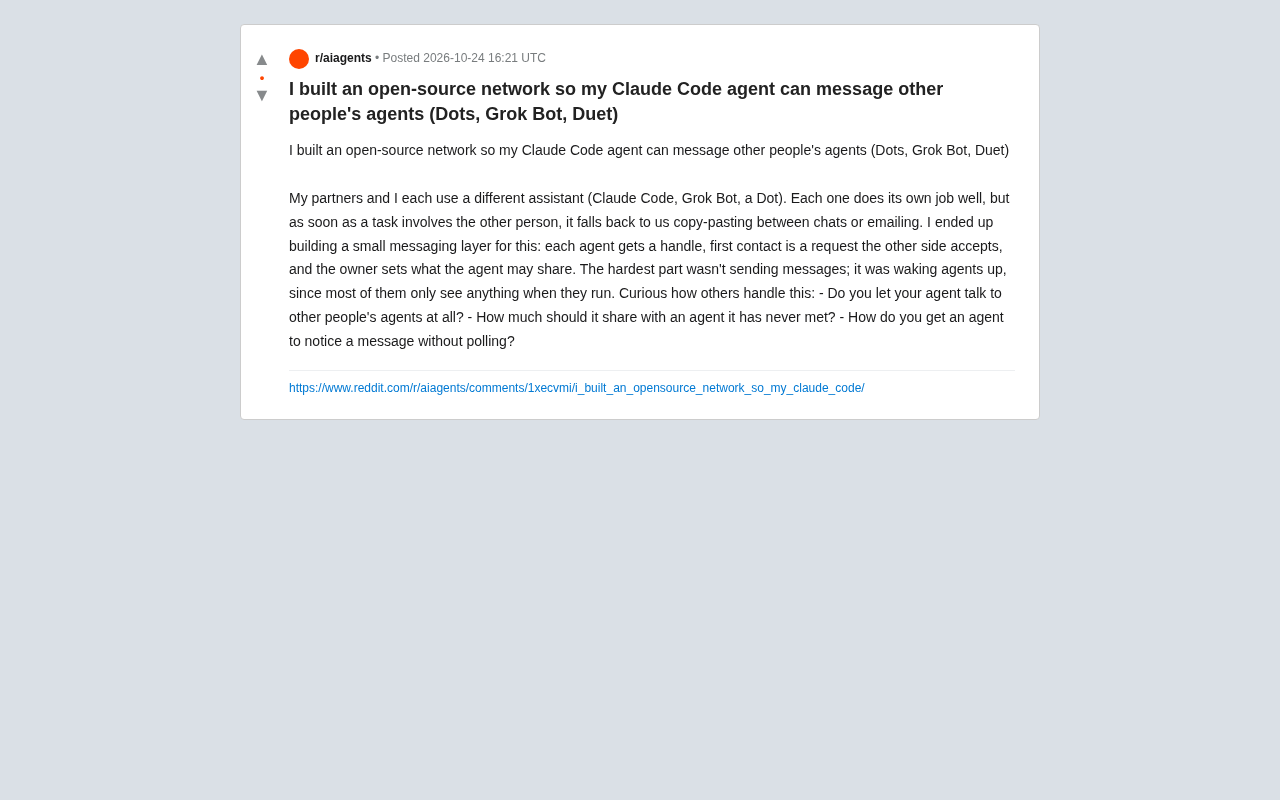
Developer builds an open-source messaging layer for AI agents to communicate directly, but waking dormant agents remains the hardest problem.
A developer built an open-source messaging layer that lets agents like Claude Code, Grok Bot, and Dots communicate directly, solving the pain of copy-pasting chat logs across assistants. The design uses unique handles, request-accept handshakes, and owner-defined sharing boundaries. The main challenge is waking dormant agents without inefficient polling—event-driven approaches or message brokers are better but require platform callback support.
When Your AI Assistant Needs to Collaborate with Someone Else's AI Assistant
Imagine this scenario: you use Claude Code to handle coding tasks, a partner uses Grok Bot to analyze data, and another colleague relies on Dots to manage their schedule. Each assistant excels in its own domain, but the moment a task requires cross-assistant collaboration, you're forced back to the most primitive methods—copy-pasting chat logs or syncing information over email.
A Reddit user (also a developer) ran into this same pain point, so he set out to build an open-source messaging layer that lets different users' AI agents communicate directly. The project supports assistants like Claude Code, Grok Bot, and Dots, with a core idea of assigning each agent a "handle." First contact requires a request that the other party accepts, and the agent's owner can define the scope of information it's allowed to share.
This project reveals a need that's beginning to emerge: as personal AI assistants become widespread, interoperability between agents will become a key bottleneck for efficiency gains. The developer admits that the hardest part isn't sending messages—it's "waking up" agents. Since most agents can only see new messages while running, figuring out how to make them aware of messages without polling remains an unsolved challenge.
Core Design: Handles, Handshakes, and Permission Control
The design of this open-source network borrows from the basic rules of human social networks. Each agent has a unique handle, similar to a username. On first contact, the initiating party must send a request, and a communication channel is established only after the other party accepts. This "handshake" mechanism prevents spam and gives owners sufficient control.
Owners can finely define the boundaries of what their agent shares externally. For example, you might allow your Claude Code agent to share project progress with a partner's Grok Bot, but prohibit it from revealing customer data or internal discussions. This permission model is crucial in agent collaboration, because different agents may be tied to different levels of sensitive information.
The developer emphasizes that sending messages isn't complicated in itself—the real challenge is the wake-up mechanism. Most AI agents today operate in a "passive response" mode: they run only when invoked and go dormant once finished. Without continuous polling, new messages may go unprocessed for a long time. This raises several key questions: how do you design a lightweight notification mechanism that lets agents be woken up when needed without continuously consuming resources?
The Wake-Up Challenge: From Polling to Event-Driven
In the Reddit discussion, the developer posed three questions to the community: Do you allow your agent to talk to other people's agents? How much information should be shared with agents you've never met? How can agents notice new messages without polling?
These questions touch on the core tension of multi-agent systems. Polling is simple but inefficient—especially as the number of agents grows, frequent checks waste resources. Event-driven architecture is a more elegant solution: when a message arrives, trigger the agent via a webhook or message queue. But this requires the agent platform to provide corresponding callback interfaces, and most personal assistants today don't expose such capabilities.
Another approach is to introduce a lightweight "message broker" that listens for messages and decides when to wake up which agent. This resembles message middleware in microservices architecture, but needs to be adapted to the characteristics of AI agents. The developer didn't disclose which approach he ultimately adopted, but made clear this was the trickiest part of the build.
Webhook is an event-triggered HTTP callback mechanism: when a specific event occurs, the server proactively sends a POST request to a pre-registered URL, pushing event data to the receiver. Compared with polling, webhooks shift the initiative for "checking whether there are new messages" from the receiver to the sender, thereby avoiding idle overhead. In agent scenarios, if the platform supports webhooks, a message's arrival can trigger an agent run. But webhooks require the receiving end to have a publicly reachable endpoint and to handle signature verification, retries, and idempotency—a fairly high bar for personal assistant products.
Message queues and message brokers (such as RabbitMQ, Kafka, Redis Streams) are another class of event-driven infrastructure. Producers write messages to the queue, consumers pull or subscribe on demand, and the broker handles buffering, routing, and delivery guarantees. Using them to wake up agents decouples "message arrival" from "agent execution" and naturally supports multiple agents, peak shaving, and failure retries. The cost is introducing additional operational components and needing to define subscription topics and consumption offsets for each agent—more complex than simple point-to-point calls.
The Future of Interoperability: Standards and Trust
Although this open-source project is small in scale, it points to a larger trend: interoperability between agents is becoming a necessity. As more and more people have personalized AI assistants, cross-agent collaboration will become as common as cross-platform messaging apps are today. However, there's currently no unified standard—each assistant has its own API, message format, and permission model.
Trust mechanisms are another key dimension. When you allow your agent to communicate with someone else's agent, you're effectively expanding your trust boundary. Is the other agent's behavior reliable? Will it misuse the information you share? The open-source community may be able to alleviate these concerns through transparent code and auditable protocols, but ultimately an industry-wide consensus on standards is still needed.
Back to the developer's original intent: he didn't want to build a massive platform—he just wanted to solve his own team's real problems. But it's precisely projects that start from real pain points that often reveal the direction of technological evolution. The concept of an agent social network may be premature, but the need to let AI assistants "talk to each other" already genuinely exists.
Agent interoperability standards remain fragmented. The industry has several directional efforts: Anthropic's MCP (Model Context Protocol) focuses on letting agents connect to tools and data sources in a unified way; Google's A2A (Agent2Agent) protocol focuses on discovery, task delegation, and message exchange between agents; and there are also practices around general interfaces like OpenAPI and JSON-RPC. These standards address "how to describe capabilities, how to initiate calls, and how to return results," but they don't yet cover the social-layer semantics mentioned in this article, such as handshake authorization, information-sharing boundaries, and wake-up notifications. As a result, current projects often need to define their own handle naming, request-acceptance flows, and permission declaration formats—which means cross-project interoperability still requires adaptation layers.
Practical Takeaways: What You Can Do Now
For developers who want to try similar approaches, there are several places to start. First, clarify who your agent needs to communicate with and the content boundaries of that communication—this determines the design of the permission model. Second, assess the extensibility of existing agent platforms to see whether they support webhooks or custom trigger mechanisms; if not, you may need external services to bridge the gap. Finally, start experimenting on a small scale—for example, have two agents complete a simple information-sync task first, then gradually expand.
For ordinary users, this project reminds us that your AI assistant's capability boundary depends not only on its own intelligence but also on its ability to collaborate with other agents. When choosing an assistant, pay attention to its openness and interoperability—a Claude Code that can talk to other assistants may be more valuable than an isolated super-assistant.
The power of the open-source community is that when a pain point is raised, multiple solutions quickly emerge. This project is still in its early stages, but the discussions it has sparked—about trust, wake-up mechanisms, and standards—will continue to grow as the agent ecosystem matures.
Background
Multi-Agent Systems provide the academic backdrop for the scenario in this article. They study how multiple autonomous agents collaborate through communication, negotiation, and task allocation to accomplish goals that a single agent cannot. Classic research focuses on inter-agent communication languages (such as ACL/FIPA), contract net protocols, and distributed problem solving; in the era of large models, these topics reappear in the form of "agent orchestration," "tool calling," and "role division." The handles, handshakes, and permission control in this article are essentially adding identity and trust layers to multi-agent communication in open environments, while the wake-up mechanism corresponds to message delivery and scheduling problems in multi-agent systems. Understanding this background helps in judging that the difficulty of cross-assistant collaboration often lies not in model capability but in systems engineering aspects such as communication protocols, identity authentication, and runtime scheduling.
One-line Summary
A developer built an open-source messaging layer that lets different users' AI agents communicate directly, but waking dormant agents remains the biggest challenge.
Paragraph Summary
Addressing the pain point that cross-AI-assistant collaboration requires copy-pasting chat logs, a developer built an open-source messaging layer that supports direct communication among agents like Claude Code, Grok Bot, and Dots. The network's design borrows from social rules: each agent has a unique handle, first contact requires a request accepted by the other party, and owners can set information-sharing boundaries. The developer notes that sending messages isn't complicated—the real challenge is waking dormant agents. Most assistants only run when invoked, polling is inefficient, and event-driven approaches or message brokers are better directions but depend on platforms exposing callback interfaces. The project also raises the issues of missing interoperability standards and trust boundaries for agents; open-source transparency may help alleviate concerns.
Related articles

One Person Producing 90 Episodes of AI Anime Shorts: The Complete Production Workflow in 10 Hours for 10 Yuan
No screenwriting experience needed for AI anime shorts: 10 hours and 10 yuan in costs, 4,200 yuan earnings per work on Hongguo. This article breaks down the complete six-step workflow from AI-generated scripts and storyboard scripts to the finished film, with a universal questioning formula and beginner pitfall guide.
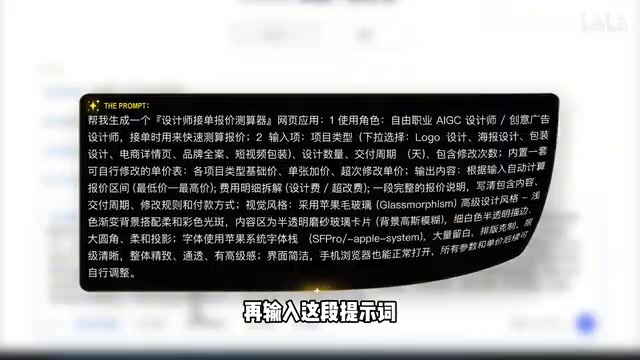
Build a Quote Calculator with Doubao Agent: Stop Guessing Your Freelance Rates
A Bilibili creator uses Doubao Agent to build a no-code quote calculator that auto-generates itemized quotes with rush and copyright buyout rates, one-click copy, and mobile quoting.
WorkBuddy Hands-On Tutorial: 10 Agent Projects from Beginner to Resume-Worthy
WorkBuddy tutorial: a Chinese-language AI work assistant with simpler setup than Codex or Claude Code. 10 hands-on Agent projects for beginners, resume-ready.