Bilibili MCP Tutorial in Practice: From Fundamentals to LangChain Integration
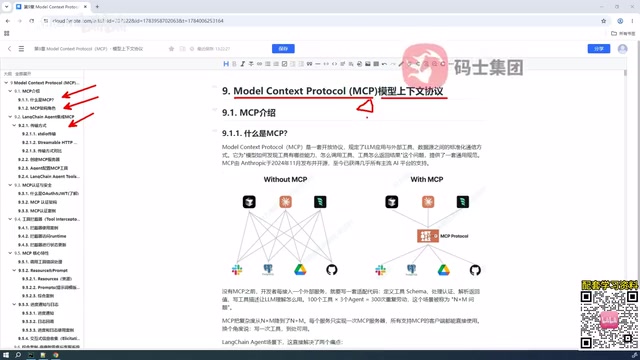
Breaks down the Bilibili MCP tutorial's framework and assesses its learning value for MCP integration in LangChain.
Based on a Bilibili MCP tutorial billed as the clearest explanation available, this article organizes the knowledge framework behind its chapters. It argues that MCP is a communication contract and role architecture between models and external capabilities rather than simple tool wrapping, and that LangChain integration involves transport modes, server implementation, and Agent client tool configuration. It also covers authentication, tool interceptors, error retries, resources and prompt templates, progress and logging, and interactive information gathering, ending with an e-commerce customer service case. The tutorial targets developers with LangChain experience.
Recently, a set of MCP tutorials billed as "the only one that explains it clearly" has been circulating on Bilibili. Its content covers a complete path from conceptual introduction to hands-on coding. For developers who want to understand what MCP actually is and how to really put it to use in LangChain, the chapter design of this tutorial does offer a relatively systematic learning thread. This article doesn't repeat the video line by line; instead, it breaks down the knowledge framework revealed in it to help you decide which parts are worth your time.
MCP Is More Than Just "Tool Calling"
The tutorial opens by pointing out a common misconception: many people, upon hearing MCP (Model Context Protocol), immediately think "it's about tools." That intuition isn't wrong, but it falls far short. What MCP really defines is the communication contract between models and external capabilities. It includes a clear division of architectural roles, rather than simply wrapping an API and feeding it to an Agent.
Judging from the tutorial's plan, the first part explains the architectural roles of MCP before moving into LangChain integration. This order makes sense—without first understanding the role division within the protocol itself, you'll easily end up copying code when writing MCP servers and client configurations later without really understanding why.
MCP was proposed by Anthropic at the end of 2024. Its positioning is to unify how large model applications connect with external data sources and tools, and it is often compared to "USB-C for the AI world." The protocol adopts a client–server architecture and defines three roles: Host (the host application running the model), Client (created by the Host, maintaining a one-to-one connection with a single Server), and Server (the party exposing capabilities). At its foundation, it uses JSON-RPC 2.0 for message exchange and supports capability negotiation and lifecycle management. The Server side can expose three types of primitives: Tools (functions callable by the model), Resources (data or files that can be read), and Prompts (reusable prompt templates). The Client side can also provide reverse capabilities to the Server, such as Sampling and Roots. It is precisely because of this clear set of roles and message conventions that capabilities from different vendors and different processes can be discovered and invoked by models in a unified way—which is the fundamental difference from "wrapping an API and giving it to an Agent."
Practical Path for Integrating MCP into a LangChain Agent
This is the part the tutorial spends more time on, and also the part most learners care about. According to the video, integration involves at least three levels: choosing a transport mode, writing the MCP server, and configuring tools when the Agent acts as a client.
Transport mode is an easily overlooked but critical aspect. MCP supports different connection methods, and the choice directly affects the subsequent deployment form and debugging difficulty. The tutorial mentions that it will introduce these modes one by one, but the overview doesn't detail the specific differences—you'll need to watch the main content for those details.
Another noteworthy point is that the tutorial specifically includes a comparison section on "the difference between MCP tools and LangChain native tools." This perspective is valuable—LangChain already has its own tool-building system, and MCP tools are not a simple replacement but rather another abstraction for cross-process and cross-service scenarios. Understanding the boundary between the two is more important than simply learning how to call them.
MCP currently defines two standard transport methods. stdio communicates via standard input/output as a subprocess on the same machine; it is simple to configure and low-latency, making it suitable for local tools and development debugging. Streamable HTTP, on the other hand, targets remote deployment: the client interacts with the server via HTTP requests, can support multiple client connections, and facilitates horizontal scaling and centralized authentication. An earlier specification also had an HTTP+SSE-based transport, which has now been replaced by Streamable HTTP—you should keep this evolution in mind when reading old tutorials or legacy code. Choosing a transport is effectively choosing a deployment topology: stdio means the Server shares the same machine and lifecycle as the Agent, while HTTP requires additional consideration of networking, authentication, and service governance—which is exactly why the tutorial emphasizes understanding transport modes before writing code.
Authentication, Security, and Tool Interceptors
The tutorial treats authentication and security as a separate major section. This is often skipped in real development, yet it is precisely the key to moving MCP from demo to production. According to the video, when an Agent calls an MCP tool, permission authentication can be added, and calls are not allowed without the corresponding permissions. This means MCP's permission control is not decorative but a mechanism that can genuinely limit the boundaries of an Agent's behavior.
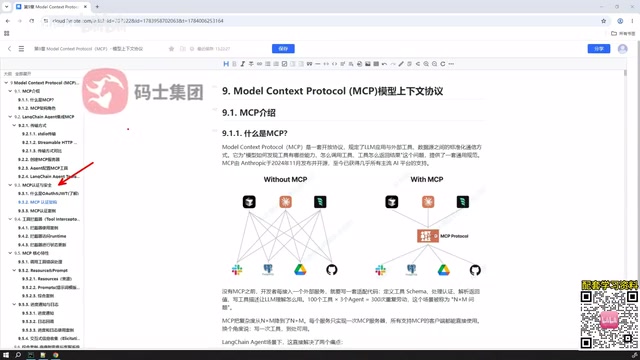
Tool interceptors are another feature with practical value. The tutorial mentions that interceptors are triggered when MCP tools are called, can access the Agent's context information, and can even modify the Agent's state. This capability makes interceptors more than just "logging hooks"—they can be used as policy injection points.
In LangChain, tool interceptors are typically mounted on the Agent execution chain as callbacks or middleware. They can read runtime context before and after tool calls, modify input parameters, block calls, or rewrite returned results. They operate at a different layer from MCP's own permission mechanisms: protocol-level OAuth and token validation determine "can this client connect to this Server," while interceptors determine "should this call be allowed in the current business context, and does it need redaction." Only together do they form a complete control loop—protocol authentication solves the identity problem, while interceptors solve policy and audit problems, such as filtering high-risk tools by user role, recording call chains, and performing compliance checks on returned content.
Error Handling, Resource Templates, and Progress Feedback
The latter part of the tutorial covers several lower-level core features. The error handling section explains the retry mechanism when an MCP tool call fails—the video's exact words are "we need to understand this principle," suggesting this part is more about comprehension than hand-writing an implementation.
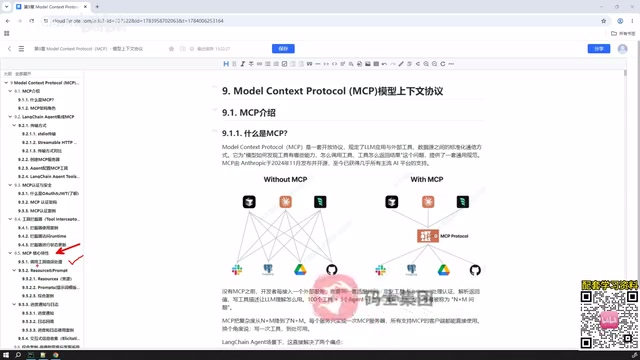
Resources and prompt templates extend MCP's capabilities: the protocol can publish not only tools but also resources and prompt templates. This part is covered only briefly in the overview; the specific configuration methods require watching the corresponding chapters.
Progress notifications and logging address a very concrete experience problem—when a remote MCP tool takes a long time to execute, users wait too long on the Agent side. By having the server send back execution progress and logs, this waiting anxiety can be alleviated. This is an engineering detail, but it is unavoidable when building real products.
MCP distinguishes between errors at the protocol layer: one type is standard JSON-RPC errors (such as method not found or invalid parameters), and the other is business errors from tool execution itself, which are returned via the isError flag in the tool call result so the model can decide whether to retry or change strategy. Progress feedback relies on the progressToken carried in the request; the Server sends multiple notifications/progress notifications during execution, and the client updates the interface accordingly. Logs are pushed via notifications/message and classified by levels such as debug, info, warning, and error. These mechanisms are all built on the notification semantics of JSON-RPC—once you understand this, configuring retries, timeouts, and progress display becomes much easier.
Interactive Information Gathering: Teaching the Agent to "Ask the User"
One of the more interesting design points in the tutorial is interactive information gathering. The scenario is clear: when calling a remote MCP tool, if required parameters are missing, without this mechanism the large model might rely on its own reasoning to try filling them in over multiple rounds, or even fail to fill them in at all. Interactive information gathering instead directly asks the user for the missing information.
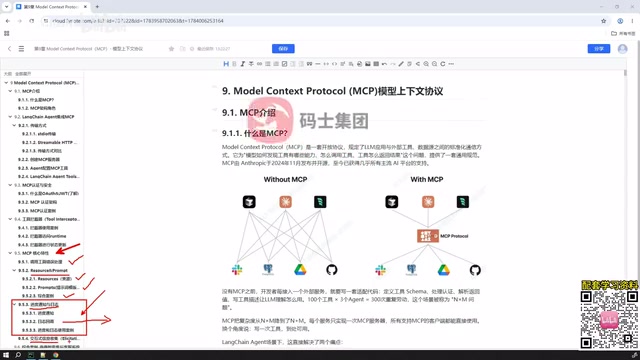
The essence of this approach is to shift responsibility for "parameter completion" from model reasoning to user confirmation. This reduces invalid rounds and also lowers the risk of the model fabricating parameters. For business scenarios requiring high accuracy, this design is worth borrowing.
Comprehensive Case Study: E-commerce After-sales Customer Service System
The tutorial concludes with an e-commerce intelligent after-sales customer service system that combines the knowledge points covered earlier. Judging from the chapter arrangement, this case covers multiple modules including tool calling, permission authentication, and interactive information gathering—making it a串联-style exercise. For learners, walking through the case once makes it easier to build an overall sense than studying each feature in isolation. [Note: "串联-style" means a connected, end-to-end exercise.]
Who This Tutorial Is For
Judging from the content plan, this tutorial targets developers who already have a basic understanding of LangChain and Agent development, not complete beginners. If you are not yet familiar with the basic ways of building Agents, jumping straight into the MCP integration section will be difficult. Conversely, if you are already using LangChain in projects and have encountered specific problems such as cross-service tool calls, permission control, or feedback for long-running tasks, the corresponding chapters in the tutorial will have direct reference value.
One caveat: the actual quality of a Bilibili tutorial depends on whether the code demonstrations in the main content are complete and whether the examples are runnable. This article only organizes the knowledge framework based on the tutorial; when watching, it is recommended to focus on the coding segments and cross-check protocol details against the official documentation.
One-line Summary
Breaks down the knowledge framework of a Bilibili MCP tutorial and assesses its learning value for integrating MCP into LangChain.
Paragraph Summary
Based on a Bilibili MCP tutorial billed as "the only one that explains it clearly," this article organizes the knowledge framework behind its chapters rather than repeating the video line by line. The author points out that MCP is essentially a communication contract and division of architectural roles between models and external capabilities, not just simple tool wrapping; LangChain integration involves three levels: transport mode selection, writing an MCP server, and configuring tools on the Agent client side. The tutorial also covers authentication and security, tool interceptors, error retries, resources and prompt templates, progress notifications and logging, and an interactive information gathering mechanism that shifts parameter completion responsibility to the user, concluding with an e-commerce after-sales customer service system as an end-to-end case. The article judges that the tutorial targets developers with a LangChain foundation and reminds readers to pay attention to code demonstration quality and verify protocol details against official documentation.
Related articles

Anthropic Files S-1: $16.3B Revenue, $80.7B Net Loss in Half a Year — Who Controls the Company?
Anthropic files S-1 for a Nasdaq IPO: H1 2026 revenue of $16.3B, an $80.7B net loss from valuation remeasurement rather than cash burn, founders' Class F shares holding 50.1% voting power, and no price or date yet.

Anthropic Files S-1: The Truth Behind $16.3B Revenue and $80.7B Loss
Anthropic's S-1 reveals $16.3B revenue and $80.7B net loss in H1 2026, with $72.4B from accounting effects. The filing also discloses $265.6B compute commitments, cloud deal details, and a 50.1% founder voting control structure, while IPO pricing remains blank.

Anthropic Financials Leaked: Revenue Far Exceeds Compute Costs, Claude Inference Gross Margin Hits 68%
Leaked Anthropic financials show revenue roughly twice total compute costs, Claude inference gross margin at 68%, while frontier training burns $2.8B per quarter. This article breaks down the two accounts and analyzes shifts in AI company valuation logic.