Bilibili's 748-Episode AI Agent Development Course: A Complete Guide from Zero to Real-World Projects
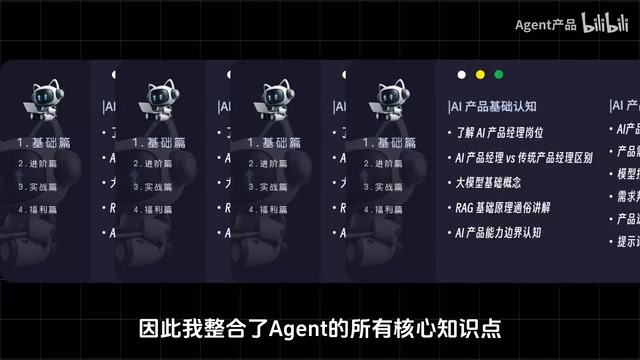
Bilibili's 748-episode zero-foundation Agent course covers concepts, frameworks, and enterprise projects in three parts.
This article outlines the knowledge system of a Bilibili AI Agent zero-foundation tutorial billed as "748 episodes." It is divided into Foundations (everyday analogies for ReAct, planning, memory, plus a first Demo), Advanced (LangChain, AutoGen, Function Calling, RAG+Agent, evaluation and safety), and Real-World Projects (intelligent customer service, automated data analysis, multi-agent production line). Each lesson includes code materials, lowering the learning barrier. The structure is complete and content sincere, suitable for beginners, but the 748-episode volume means a long cycle and framework versions need updating; the value ultimately depends on persistence.
As AI Agent development becomes a sought-after skill, Bilibili has launched a zero-foundation course billed as a "full 748 episodes," claiming to cover everything from foundational understanding to enterprise-level practice. According to the uploader, the course took three months to prepare and aims to solve the problem of "mixed quality" in current Agent learning resources. Based on the course introduction, this article outlines its knowledge system and design approach, and analyzes whether it can truly help beginners "take fewer detours."
Course Positioning: Filling the Gap from Zero Foundation to Real-World Practice
According to the uploader, before preparing the course he spent a month browsing Agent tutorials across platforms and found view counts ranging from a handful to tens of thousands, but with uneven quality. Therefore, the course goal is clear: make it easy for complete beginners to understand, while also providing after-class practice resources. The entire course is divided into three parts—Foundations, Advanced, and Real-World Projects—using everyday analogies combined with case demonstrations.
This layered design follows the pattern of skill learning—first build a cognitive framework, then master tool frameworks, and finally land it through projects. For learners without a programming or AI background, the biggest fear is piles of concepts and gaps in code; the course explicitly emphasizes that "every lesson comes with accompanying code materials," which to some extent lowers the barrier to following along.
Foundations: Breaking Down Core Concepts with Everyday Analogies
The Foundations section focuses on "what an Agent is" and "how it differs from chatting directly with a large model." The course covers intimidating-sounding concepts like the ReAct framework, planning and reasoning, and memory mechanisms, but the uploader says everyday analogies will help students "get it." Specifically, the ReAct framework can be understood as a "think-as-you-do" loop, planning and reasoning is like "making a task list before executing," and memory mechanisms are like "giving the agent short-term and long-term memos."
More importantly, the Foundations section walks students through their first Agent Demo.
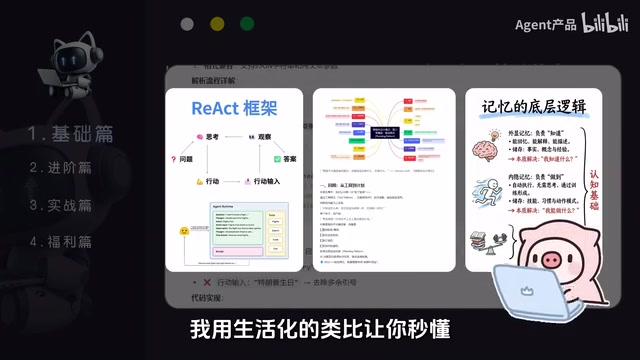
Hands-on experience of an agent doing work is more effective than simply reading theory. This "concept + hands-on" arrangement helps beginners quickly build positive feedback and avoid getting lost in abstract terminology.
ReAct framework (Reasoning + Acting) was proposed by Princeton University and Google in 2022. Its core idea is to have large language models alternate between "reasoning" and "acting": first output a Thought, then decide which tool to call (Action) and observe the result (Observation), looping until the task is complete. It solves the traditional model's "all talk, no action" problem, enabling agents to actively retrieve information and call APIs. Understanding ReAct is the starting point for mastering Agent workflows; most subsequent capabilities such as planning and tool calling are extensions built on it.
Memory mechanisms are usually divided into short-term and long-term memory: short-term memory stores the current conversation context and is limited by the model's context window length; long-term memory uses external storage such as vector databases to retain information across sessions. Working together, they allow the agent to maintain coherence across multi-turn interactions and accumulate knowledge.
Advanced: Framework Practice and Multi-Agent Collaboration
The Advanced section enters the "intensive" phase, covering hands-on with LangChain and AutoGen frameworks, multi-agent collaboration, Function Calling tool invocation, RAG+Agent hybrid architecture, and evaluation, debugging, and safety boundaries. This basically covers the mainstream tech stack of current Agent development: LangChain handles process orchestration, AutoGen focuses on multi-agent dialogue, Function Calling lets agents call external tools, and RAG addresses knowledge augmentation.
Notably, the course lists "evaluation, debugging, and safety boundaries" separately. In real development, agent behavior is often hard to predict; how to evaluate output quality and set safety guardrails is key to engineering deployment. Many tutorials only cover "how to build" but not "how to manage"; this course notices that gap. All accompanying code materials for each lesson are packaged together, so students don't need to worry about falling behind.
LangChain is an open-source orchestration framework for building large-model applications, providing modules such as chained calls, tool integration, memory management, and retrieval augmentation, helping developers organize scattered API calls into maintainable workflows. AutoGen, launched by Microsoft Research, focuses on multi-agent dialogue, allowing multiple role-based agents to collaborate through message passing—suitable for scenarios requiring division of labor and debate. The two have different positioning: LangChain emphasizes single-agent process orchestration, while AutoGen emphasizes multi-agent collaboration; in practice they are often used together.
Function Calling is the ability of a model to output structured parameters according to a predefined schema, with an external system executing and returning results—the standard interface for agents to call external tools. RAG (Retrieval-Augmented Generation) first retrieves from an external knowledge base and then injects relevant content into the prompt, alleviating hallucinations and outdated knowledge; combined with agents, the agent can autonomously decide when and what to retrieve, forming a more flexible hybrid architecture.
Real-World Projects: Enterprise-Level Projects and Resume Portfolio
The Real-World Projects section is the course's core selling point, including three project directions: an enterprise-level intelligent customer service Agent system (from intent recognition to automatic ticket routing), an automated data analysis Agent (upload Excel and automatically generate reports and charts), and a multi-agent collaboration production line (multiple agents dividing and collaborating like a team). These three projects correspond to common enterprise scenarios such as customer service, data analysis, and process automation, and can be showcased as resume portfolio pieces upon completion.
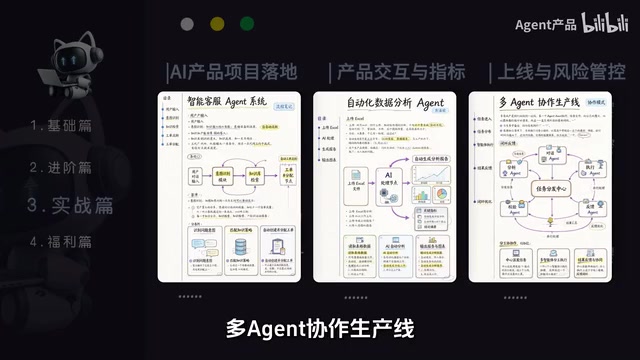
The design of the multi-agent collaboration production line is especially close to real business—in complex tasks, a single agent is often limited in capability, and having multiple specialized agents collaborate (e.g., one for retrieval, one for reasoning, one for review) can significantly improve overall results. This kind of project experience has practical value for job seekers.
Accompanying Resources and Learning Advice
The course promises to provide all materials including an Agent learning gift pack, project cases, and course notes.
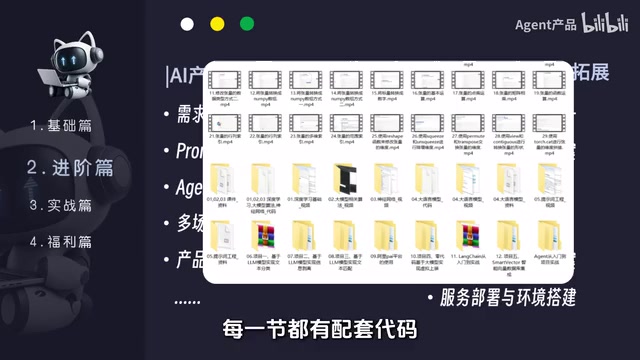
For self-learners, the completeness of accompanying resources directly affects learning continuity. However, it should be noted that 748 episodes means a long learning cycle; it is recommended to proceed in the order "Foundations → Advanced → Real-World Projects" and reproduce the code after each module to avoid only watching without practicing. In addition, technology iterates quickly, and the framework versions and best practices involved in the course may need to be updated in conjunction with official documentation.
Overall, this tutorial shows a certain level of sincerity in structural design and content coverage, and is especially suitable for learners with zero foundation who want a systematic introduction to Agent development. But the promotional phrase "the most complete and easiest to understand on the internet" still needs learners to judge based on their own foundation—if you already have programming experience, you can skip the Foundations section and go straight to framework practice; if you are a complete beginner, it is advisable to set aside sufficient time to digest the concepts. Ultimately, the value of the course depends on whether you can persist in following along, not on the number of episodes.
One-line Summary
Bilibili's 748-episode zero-foundation Agent course, divided into three parts covering concepts, frameworks, and enterprise-level practice.
Paragraph Summary
This article outlines the knowledge system of a Bilibili AI Agent zero-foundation tutorial billed as a "full 748 episodes." The course is divided into Foundations, Advanced, and Real-World Projects: Foundations uses everyday analogies to explain ReAct, planning and reasoning, and memory mechanisms, and walks students through their first Demo; Advanced covers LangChain, AutoGen, Function Calling, RAG+Agent hybrid architecture, and evaluation, debugging, and safety boundaries; Real-World Projects provides three enterprise-level projects—intelligent customer service, automated data analysis, and a multi-agent collaboration production line—that can serve as resume portfolio pieces. The course emphasizes accompanying code materials for each lesson, lowering the barrier to following along. The article considers its structure complete and content sincere, suitable for zero-foundation learners seeking a systematic introduction, but 748 episodes means a long cycle, and framework versions need to be updated in conjunction with official documentation; the ultimate value depends on whether you can persist in following along.
Related articles

LangGraph in Production: The Pain of Silent API Changes
Explores the challenge of silent external API changes affecting LangGraph agents in production, analyzes monitoring and testing limits, and proposes semantic validation and regression testing defenses.

Salesforce CRM Hands-On Test: Performance and Cost Deep Comparison of 5 AI Agents
Hands-on comparison of 5 AI agents in Salesforce CRM: Claude Opus leads at 87% accuracy, DeepSeek hits 82% at 1/75 the cost. Key findings on tool false positives, self-checking, and automatic field changes.

Conference Badge Turned Game Boy Color: A Gemini-Assisted Hardware Hack
The GitHub Universe conference badge was hacked into a device that runs Game Boy Color emulators. Steve Francia used Gemini to port NES and Game Boy emulators; this article analyzes AI's real role in hardware hacking and the evolution of conference badges.