Bilibili's Open-Source Index-Translate Tested: 150 Languages, Local Deployment, Enterprise-Grade Translation That Actually Works

Bilibili open-sources Index-Translate — enterprise-ready translation with stable JSON output and 9B quality beating Google Translate.
Bilibili's open-source Index-Translate is built to solve the "accurate but unusable" engineering problem that plagues enterprise AI translation projects. Post-trained on Qwen, it offers 2B, 9B, and 35B versions supporting 150 languages. Its key differentiators are native stable JSON output, flexible number and terminology handling, and semantic understanding of culturally loaded content. Benchmarks show the 9B version surpasses Google Translate, while the 35B A3B tops multiple domain rankings. Fully open-sourced on Hugging Face with vLLM deployment support, ASR, TTS, and real-time subtitles — with GGUF quantization for consumer hardware on the way.
The Real Pain Point in AI Translation: Accurate Output That's Still Unusable
After years in AI consulting, I keep running into the same pattern: clients complain about translation problems, but when you dig into it, the issue usually isn't translation quality — it's translation breaking down somewhere in the engineering pipeline. These problems are often harder to fix than outright mistranslations. At least with a wrong translation, you know where to look. "Looks completely correct, but can't be used in production" is a much harder problem to debug.
There are three common failure modes. First, the AI translation is accurate, but downstream systems can't parse the output format. Second, a term has multiple valid translations, and the client assumes the content was altered without authorization. Third, every subtitle line is correct individually, but they fall out of sync with the video — or translated reviews become unsearchable in the content management system. These are linguistically sound but operationally useless.
Bilibili's recently open-sourced Index-Translate model is specifically designed to address this kind of "engineering usability" problem.
Model Overview: Three Versions, Post-Trained on Qwen
Index-Translate is post-trained on the Qwen 3.5B base model and comes in three versions: 2B, 9B, and 35B. The 2B version prioritizes speed for latency-sensitive scenarios; the 9B version balances speed and capability and is the most general-purpose choice; the 35B version (35B A3B) delivers the best performance and tops multiple benchmarks.
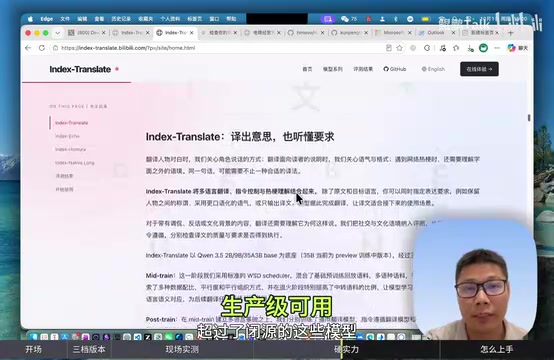
The model supports 150 languages, which is largely due to Qwen's multilingual foundation. Bilibili built on top of that with targeted training on low-resource languages, emphasizing broad generalization — the goal is a well-rounded "all-rounder" rather than a specialist that excels in one domain while falling short in others.
Key Differentiators: Built for Production Engineering
What truly sets this model apart from generic translation models are the features designed specifically for real-world deployment.
Stable JSON Output
Many large language models don't support structured JSON output at all, and even those that do are often inconsistent — sometimes correct, sometimes not. In enterprise workflows, translation results typically feed into downstream processing stages, and unstable JSON output directly causes pipeline failures. Index-Translate natively supports JSON output, eliminating significant engineering overhead around post-processing and error handling.
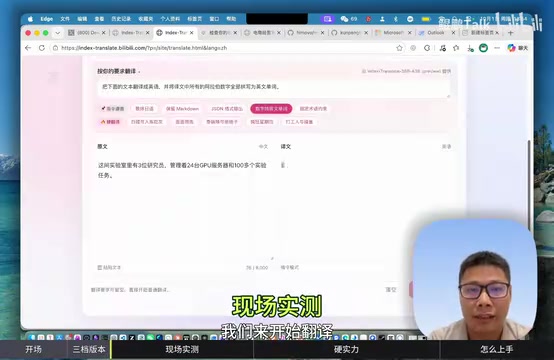
JSON (JavaScript Object Notation) is the most widely used data interchange format between enterprise systems. In a translation pipeline, the upstream system typically packages text into JSON before sending it to the translation service, and the response must also be returned as JSON so it can be directly consumed by content management systems, databases, or rendering engines. If the model's JSON output is inconsistent — stray comments, unclosed brackets, inconsistent key casing — the parser throws an exception and the entire pipeline breaks. This is why engineering teams often prefer a slightly lower-quality translation with reliable formatting over a better-quality model that requires manual output cleanup.
Number and Terminology Handling
The model can convert numbers to English words, preserve original numerals and English text when needed, and handle agreed-upon terminology. These details may seem minor, but they're exactly where traditional translation models tend to fail — and they represent the most common hard requirements in enterprise content standards.
Slang, Proverbs, and Classical Poetry
When handling slang, proverbs, idiomatic expressions, and even classical Chinese poetry, the model grasps the underlying meaning rather than producing a rigid literal translation. It also handles complex contextual rules like Japanese honorifics with solid performance.
Live Testing: Real-Time Translation and Simultaneous Interpretation
The demo environment includes a full feature set: text translation, speech translation, ASR (automatic speech recognition), and TTS (text-to-speech). In live testing, a Chinese audio clip was translated into English subtitles in real time — the output was natural and fluent: "I think this is really great, and I often post my videos on YouTube..." The sentence flow was notably smooth.
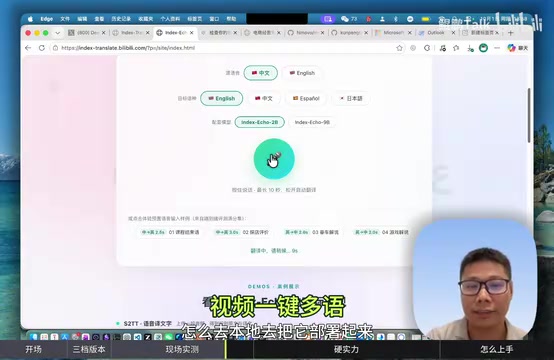
The online demo limits clips to 10 seconds due to cloud compute constraints, but there's no such restriction with local deployment. Combining the ASR and TTS models enables a full simultaneous interpretation workflow; paired with long-document translation, you can upload an entire document and translate it in one pass. For creators who regularly publish to YouTube, this means the ability to directly produce English-dubbed and subtitled versions.
Performance Benchmarks: 9B Beats Google Translate
The most surprising finding from the benchmark data: the 9B version surpasses Google Translate — long considered an almost untouchable baseline — on translation quality, while also comfortably outperforming Qwen's own ~100B-scale flash model. The 35B A3B version ranks first across multiple domains with no obvious weak spots.
In the author's assessment, this model has reached production-grade quality, fully deployable, and outperforms comparable closed-source models. That said, these conclusions are drawn from the author's own testing and official benchmark data — it's still recommended to validate against your specific use case.
Translation quality is typically measured using automatic metrics like BLEU and COMET. BLEU scores by calculating n-gram overlap between machine output and reference translations — it has a long history but captures semantics weakly. COMET uses a pretrained language model to score translations at the semantic level and correlates more closely with human judgments, making it the more widely accepted benchmark in recent translation research. The claim that "9B beats Google Translate" generally refers to a higher average score on COMET or similar semantic metrics, not that every individual sentence is better. Performance differences between models may vary across specific domains or language pairs, so targeted testing against your own business context remains essential.
Local Deployment and Format Support
All model versions are fully open-sourced on Hugging Face, with the GitHub repository also available. Thanks to the Qwen architecture, all core features can be reproduced locally, and Bilibili provides a vLLM-based inference deployment guide.
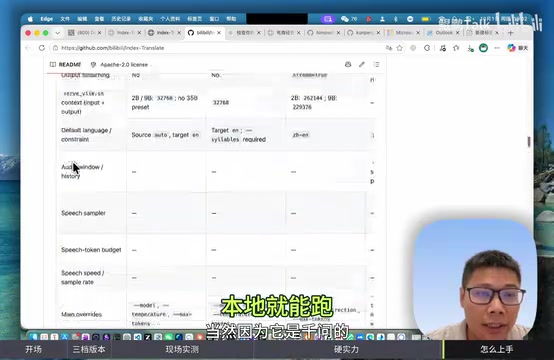
Since the base model is Qwen, the model file sizes will be familiar to anyone in that ecosystem. The community will quickly follow up with quantized formats like GGUF, enabling local runs on ordinary laptops with CPU inference also in progress. The official website offers an online demo with a Chinese-language interface, covering the full feature stack: text translation, speech translation, real-time subtitles, TTS, and more.
vLLM is currently the leading inference acceleration framework for large models, designed for high-concurrency inference on GPU clusters. Its core technology is PagedAttention — a KV cache management mechanism inspired by operating system memory paging — which significantly improves GPU memory utilization and throughput. GGUF is a quantization format targeting edge devices and consumer hardware, led by the llama.cpp project. It supports compressing model weights to 4-bit or lower precision, enabling models with billions of parameters to run on ordinary laptop CPUs or integrated GPUs. Together, these two deployment paths cover the full spectrum from cloud-scale high-concurrency services to local offline inference — which is especially important for enterprise users with data compliance requirements who cannot send content to external APIs.
Conclusion
The value of Index-Translate isn't simply in pushing benchmark scores higher — it's in making "engineering usability" the core objective: stable JSON output, number and terminology handling, 150-language coverage, and local deployability. These are precisely the areas where enterprise translation projects have repeatedly stumbled. For teams that need to truly integrate translation into production systems, this open-source model lowers the barrier to building your own stack. It's worth running a validation pass against your actual use case.
Related articles

Cursor AI Programming in Practice: Build a Student Management System from Scratch in 30 Minutes
A Bilibili creator demonstrates Cursor AI programming: generating a student management system in 30 minutes with natural language. Details on Agent mode, Claude selection, prompt techniques, and thresholds.

Top 20 AI Coding Tools Ranking: From Rock-Solid to Lackluster, a Scored Matrix
Bilibili creator releases top 20 AI coding tools ranking, tiered T0–T4 from rock-solid to lackluster, with Claude Code and Codex tied at T0. This article details the scoring dimensions (capability, reliability, robustness, durability, cost, domestic availability) and tool performances to help developers choose the right AI coding assistant.

Vibe Coding Systematic Tutorial: Master AI-Assisted Programming from Zero
A three-month Vibe Coding tutorial from a Bilibili creator covering Codex, ClaudeCode, and Cursor, from core logic to commercial project practice for beginners.