Bloomberg's Take: China's AI Is Closing In on the U.S. — But Low Prices and Open Source Create a Monetization Problem

China's AI is catching up fast on low costs and open source — but stuck in a price war with no clear path to profit.
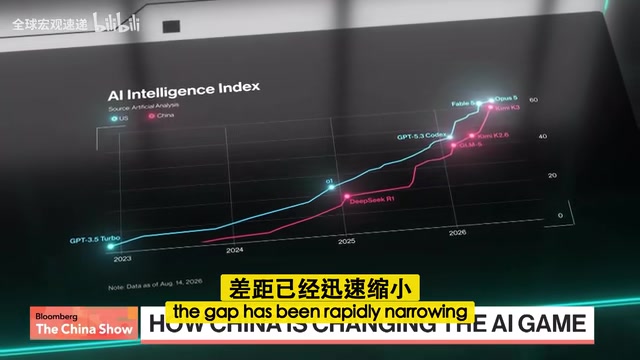
Bloomberg's feature report finds that China's AI industry — with giants like ByteDance and Alibaba alongside upstarts like DeepSeek — is rapidly closing the capability gap with U.S. frontier models, while leveraging cheap electricity, low-cost engineering talent, and open-weight models to build a significant price advantage. By 2026, the gap has narrowed dramatically, making "good enough and cheap" Chinese models attractive globally. Yet the same strategy has fueled a destructive race to the bottom: relentless price cuts combined with Chinese consumers' low willingness to pay for digital services have left the entire industry technically surging but commercially struggling — and the question of who solves monetization first may decide the next phase of the global AI race.
Bloomberg Originals recently published a feature focused on the rise of China's AI industry. The core conclusion is striking: the world's most powerful AI models may still come from the U.S., but over the past year, Chinese competitors have been capturing global attention with lower costs and rapidly closing capability gaps. At the same time, fierce price wars and an open-source approach have pushed the entire industry into an awkward bind — technology keeps getting stronger, but making money keeps getting harder.
China's AI Field: Tech Giants and Newcomers Competing Side by Side
Bloomberg notes that China's AI ecosystem is extraordinarily active. Nearly every major Chinese tech company you can name either has its own AI model or is actively training one. The report draws a direct comparison between the U.S. and China: where the U.S. has Google and Meta, China has ByteDance, Alibaba, and Tencent; where the U.S. has star startups like OpenAI and Anthropic, China has produced a wave of rising players including Moonshot, DeepSeek, Zhipu, and Minimax.
The report describes these Chinese companies as having "delivered genuinely breakthrough innovations" while pursuing highly aggressive market strategies. The sheer density of participants is itself a defining feature of China's AI industry — this isn't a race among a handful of oligarchs, but an all-out free-for-all involving both giants and startups.
Cost Has Become the Critical Variable in This Race
Bloomberg argues that cost has become an enormously important factor in the AI race — and on this dimension, Chinese products are "considerably more attractive right now." The report quotes a memorable line: "You don't need a 'God' to help you write an email."

That line cuts to the heart of how AI applications actually work today. For the vast majority of everyday tasks, what users really need is something "good enough and cheap" — not "best-in-class but expensive." So this race ultimately comes down to the balance between cost and capability. Chinese models have landed squarely on the right side of that equation: performance close enough to the frontier, at a dramatically lower price.
Looking at the timeline, after ChatGPT launched in late 2022, U.S. frontier model performance kept climbing while Chinese models lagged behind by what seemed like years. But the report is clear: as of 2026, that gap is closing fast. Converging capabilities combined with a price advantage is the underlying reason Chinese AI is "turning heads."
Where the Cheap Comes From: Electricity, Talent, and Open Source
Why can China build AI so quickly and cheaply? Bloomberg offers several layers of explanation.
On the surface, there are resource costs: China's electricity is cheaper, which lowers the compute and energy expenses required to train AI; China also has an abundance of engineering talent, whose salaries are a fraction of what top engineers command in the U.S. Cheap energy and cheap talent are undeniably accelerants.
But the report emphasizes that the real key lies elsewhere — Open Weight Models.

The value of the open-source approach is that it allows a large number of different researchers to examine the same technology simultaneously. This collaborative model — where everything happens under a multitude of watchful eyes — is seen as a major reason China has been able to close the gap. When model weights are made public, developers around the world can iterate, optimize, and identify issues on top of them, effectively creating a distributed R&D accelerator. This also explains why Chinese open-source models have seen their influence steadily rise in the global developer community in recent years.
Open Weight Models refer to models whose trained parameters (the "weights") are made available for public download after training is complete. Unlike fully closed API services (such as ChatGPT), open weights mean anyone can run, modify, and build on the model locally. Meta's LLaMA series and the DeepSeek series both fall into this category. It's worth noting that "open weight" is not the same as fully "open source" — the latter typically also requires releasing training data, training code, and the complete technical stack, whereas the former only releases the model weight files themselves. Even so, open weights are sufficient to allow developers worldwide to fine-tune, evaluate, and improve the model, creating the "distributed R&D accelerator" effect described in the report. This approach lets teams with relatively limited resources stand on the shoulders of giants and iterate quickly, without having to shoulder the pre-training costs that can run into hundreds of millions of dollars.
The Other Side of the Coin: Nobody Has Really Figured Out How to Make Money
Open source and low prices have accelerated the catch-up, but they've also planted a problem that remains unsolved: monetization. Bloomberg is blunt about it — "nobody has really figured out how to make money."
The report uses the phrase "race to the bottom" to describe the market dynamics of the past year or more — companies undercutting each other on price in a destructive cycle. Making things worse is the reality on the demand side: Chinese consumers simply aren't very willing to pay for AI services. Suppliers racing to cut prices, users unwilling to open their wallets — the combination makes the path to commercialization genuinely difficult.
This is the central contradiction at the heart of China's AI story: breathtaking technical progress on one side, an inability to generate sustainable revenue on the other. Open source can help win reputation and ecosystem share; price wars can help capture market share — but when the entire industry is caught in a spiral of slashed prices and freemium offerings, building a viable, profitable business model becomes the question hanging over everyone's head.
Race to the Bottom is a concept from economics describing a dynamic in which market participants continuously lower prices or standards to compete for share, ultimately leaving all participants collectively worse off. In the AI industry, this phenomenon was particularly pronounced in China's market through 2024: major players successively pushed API pricing down to near or below cost, with some services made entirely free. The short-term logic of this approach is to sacrifice margin for user scale and data accumulation, betting that ecosystem lock-in or value-added services will eventually generate returns. But when competitors follow suit in lockstep, everyone is burning cash and no one can build a genuine moat. Meanwhile, Chinese consumers already carry a "free habit" ingrained by years of digital services at no cost, further compressing the space for direct consumer-facing revenue — leaving the industry's path to commercialization deeply unclear.
Closing Thoughts: After Catching Up Comes the Harder Lesson
The picture Bloomberg's report paints is quite clear: China's AI is closing in fast on U.S. capabilities, already holds a meaningful advantage on cost, and has the open-source ecosystem as its unique weapon for accelerating the chase. But the price of this approach is a price war with no end in sight and a monetization problem that remains unresolved.
For anyone watching the global AI landscape, this raises a deeper question — when the technology gap is no longer the primary bottleneck, whoever figures out how to "make money" first may well determine who wins the next phase of the race.
Related articles
Can Multi-LLM Dialogue Really Improve Task Performance? Lessons from a Rigorous Experimental Design
A researcher designed rigorous controlled experiments to isolate whether multi-LLM back-and-forth dialogue genuinely outperforms simpler baselines like self-refinement and one-way sharing.

Which $10 AI Coding Plan Should You Choose? Go vs. Code Credit Breakdown
After DeepSeek's price hike, should you pick Go or Code for your $10 AI coding plan? We break down credit allocations for Mimo, Qwen, DeepSeek V4, Kimi, and more.
Laya Open-Source Decision Model: How 421M Parameters Beat Jev Benchmarks
Laya is an open-source 421M-parameter non-autoregressive decision model built on the Jev architecture, trained with RLCD on 25,000 human-annotated samples using a single GPU, running in ~35ms on low-end PCs.