Blueberry: An AI Assistant That Auto-Replies to iMessages in Your Voice

Blueberry is a macOS AI tool that drafts iMessage replies in your voice to help you stop ghosting people.
Blueberry is a lightweight macOS menu bar app that uses AI to draft iMessage replies mimicking your personal tone and style. Designed for chronic ghosters and socially anxious users, it employs a human-in-the-loop approach where nothing sends without your approval. The app aims to lower the psychological barrier of replying while keeping authentic communication intact.
When Social Anxiety Meets AI: What Problem Is Blueberry Trying to Solve?
We all probably know someone like this: they don't dislike you, they just see messages and perpetually forget to reply, until it evolves into the awkward phenomenon of "left on read." In English, this behavior is called "ghosting." A recently launched Mac app on Product Hunt called Blueberry is targeting exactly this pain point.
The term "ghosting" first gained popularity in the mid-2010s alongside the rise of dating apps, originally referring specifically to suddenly cutting off contact in romantic relationships. But as digital communication became ubiquitous, the word's meaning expanded to cover "left on read" behavior across all interpersonal relationships. According to psychological research, the motivation behind ghosting is usually not malicious — it's more often caused by decision fatigue, social battery depletion, or behavioral paralysis from overthinking "how should I respond." This phenomenon is particularly prevalent among people with ADHD (Attention Deficit Hyperactivity Disorder), who may formulate a reply the instant they see a message but completely forget to actually send it after their attention shifts.
Blueberry's tagline is refreshingly direct — "Stop Ghosting People You Actually Like." It's a lightweight app that lives in the macOS menu bar, with the core capability of automatically drafting iMessage replies that mimic your personal tone and expression habits.
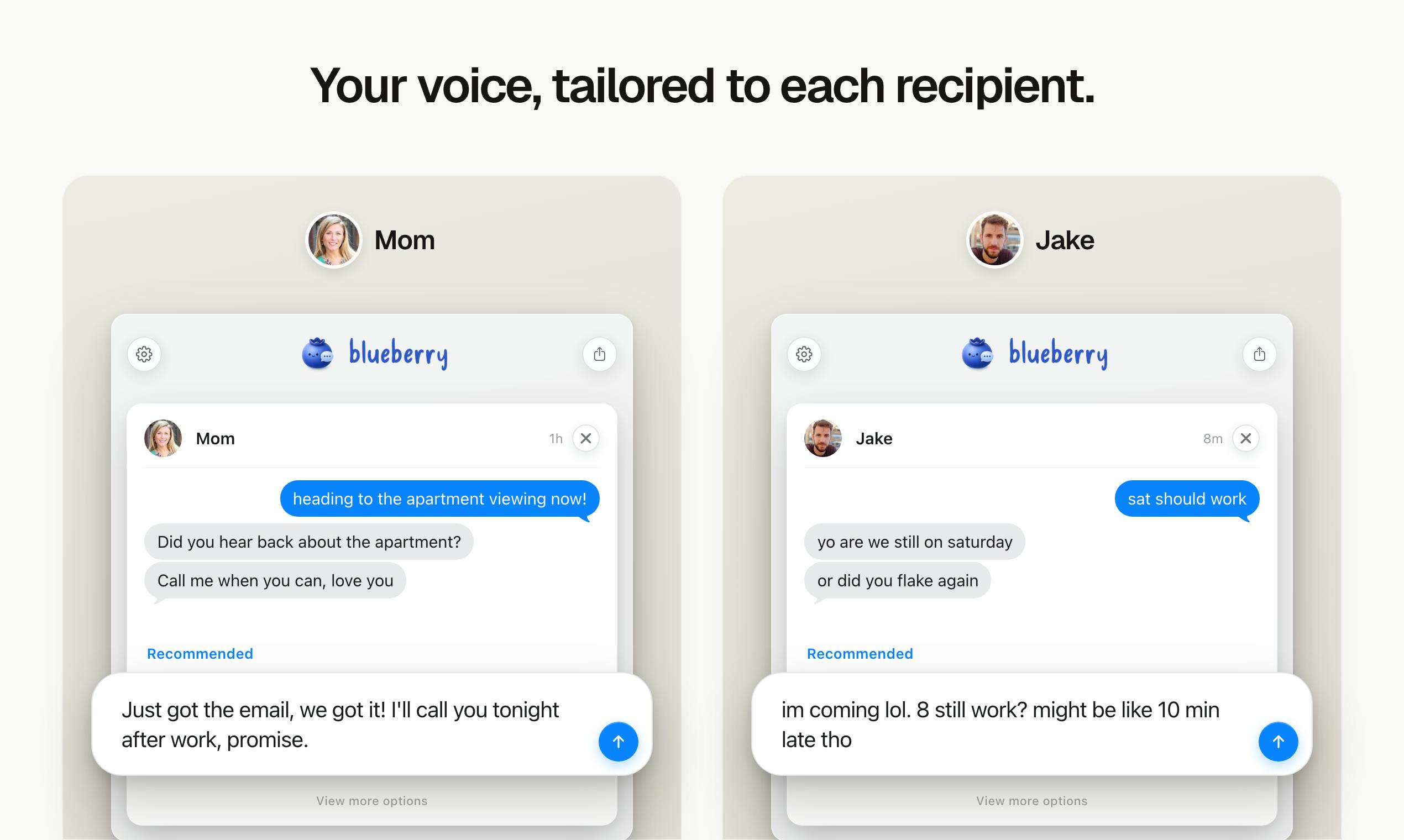
Currently, the product has received 71 votes on Product Hunt, ranking 19th, and is categorized under Artificial Intelligence, Menu Bar Apps, and iMessage Apps. While the numbers aren't exactly viral, the scenario it addresses and its product philosophy are worth a deeper look.
Blueberry's Core Mechanism: AI Drafts, Humans Approve
Blueberry's most critical design principle is — nothing is actually sent until you click send. This is explicitly emphasized in the product description.
Why the "No Auto-Send" Design Is Crucial
Many people instinctively feel wary about the concept of "AI auto-replying to messages," and the reason isn't hard to understand: private conversations are extremely personalized and context-dependent. If the AI misreads the context and sends something automatically, the consequences range from embarrassing to relationship-damaging. Blueberry chose the middle ground of "AI drafts + human confirmation," keeping the final decision firmly in the user's hands.
This design reflects a maturing trend in AI assistant products: retreating from "full automation" to "human-machine collaboration" (human-in-the-loop). The AI is responsible for lowering the activation barrier — helping you write out that reply you "didn't know how to phrase" — while humans handle the final judgment and emotional calibration. For people who struggle with messaging, the hardest part is often not the act of sending itself, but the step of "organizing language from scratch."
Human-in-the-loop (HITL) is a classic paradigm in AI system design, referring to the preservation of human review and intervention within an AI's decision-making or output pipeline. This concept originally came from industrial automation and military command systems, emphasizing that high-stakes decisions cannot rely entirely on machines. In the era of large language models, HITL is widely applied in content generation, code writing, and customer service scenarios. GitHub Copilot (code suggestions are only inserted after developer confirmation) and Notion AI (text is only retained after user review) are both representatives of this paradigm. Compared to full automation, HITL has significant advantages in accuracy and user trust, but the trade-off is sacrificing some efficiency, requiring users to expend cognitive effort reviewing AI output.
Mimicking User Voice: Blueberry's Key Selling Point
Blueberry claims to draft replies "in your voice." This means it needs to learn your past expression style — word choice habits, tonal intensity, emoji usage, and more. Compared to rigid generic template replies, personalized voice mimicry is the prerequisite for making AI drafts truly usable. Otherwise, recipients can immediately tell "this isn't something you would say," making things even more awkward.
From a technical implementation perspective, there are typically several approaches to making AI mimic a specific user's voice. The first is few-shot prompting, which embeds the user's historical messages as examples in the prompt each time the LLM is called, guiding the model to imitate their style. The second is fine-tuning, which performs secondary training on a base model using the user's conversation data to internalize specific expression patterns. The third is RAG (Retrieval-Augmented Generation), which retrieves the user's past expressions in similar contexts as reference during reply generation. For a lightweight app like Blueberry, the first or third approach is most likely, since fine-tuning has higher requirements for data volume and computational resources. Voice characteristic dimensions include but are not limited to: sentence length preference, punctuation usage habits, slang and abbreviation frequency, emoji density, and reply detail level.
Blueberry's Product Positioning and Use Case Analysis
Target User Profile: Chronic Ghosters and Socially Anxious People
The product explicitly names two groups: "chronic ghosters" and "terrible texters." This is a remarkably focused positioning. It doesn't try to be an all-purpose communication assistant, but rather solves a specific social anxiety problem — unintentionally neglecting important relationships due to procrastination or poor expression skills.
This precise positioning is a common strategy for small independent apps. Rather than competing head-on with big tech's general-purpose AI assistants, it's better to go deep and thorough in a niche scenario.
The Choice of macOS Menu Bar App Format
Choosing a menu bar app over a standalone window indicates that Blueberry pursues a lightweight "always accessible, never intrusive" experience. iMessage itself is deeply tied to the Apple ecosystem with a native client on Mac, so building a companion tool within the same system is relatively smooth in terms of both technical integration and usage context.
macOS menu bar apps are a unique application format in Apple's desktop ecosystem. They don't occupy Dock space, displaying only a small icon in the top menu bar that expands into an interface when clicked. This format is particularly suited for utility apps that need to run in the background with occasional interaction. Well-known menu bar apps include Bartender (menu bar management), CleanShot (screenshot tool), and iStatMenus (system monitoring). For Blueberry, the menu bar format means it can continuously monitor new messages in the background and alert users to unreplied messages through notifications or icon changes, without disrupting their primary workflow. From a technical perspective, iMessage on macOS can be accessed through Apple's Messages framework or by reading the local SQLite database, providing possibilities for third-party tool integration.
However, this also means its applicability is limited to Apple users — covering only iMessage, unable to serve users of WeChat, WhatsApp, Telegram, and other mainstream messaging platforms.
AI Reading Private Messages: Privacy and Ethical Concerns Cannot Be Ignored
An app that reads your private messages and learns how you talk naturally raises privacy concerns. To mimic user voice, Blueberry must access historical conversation data; to generate replies, it likely involves transmitting content to a large language model for processing. Is this data processed locally or in the cloud? Will it be used for model training? These questions aren't detailed in the product description, yet they're what potential users should care about most.
There's also a more subtle ethical topic: when you use AI to ghostwrite replies to friends, is it still "you" communicating? Blueberry's "click to send" mechanism alleviates this to some extent — you've at least read and approved every message. But in the longer term, if people increasingly rely on AI to maintain interpersonal relationships, whether genuine communication itself gets diluted is a question no tool of this kind can avoid.
The identity and authenticity issues raised by AI ghostwriting can be traced philosophically to the "Ship of Theseus" paradox — if every one of your messages is drafted by AI and you only click send, is the "you" in communication still fully you? Philosopher Harry Frankfurt, in his discussions of authenticity, argues that sincerity isn't just about the truthfulness of content, but whether the act of expression itself originates from one's own will. From this perspective, Blueberry's "human confirmation" mechanism offers a compromise: the right to confirm intent still rests with the user, and AI merely reduces the cognitive cost of language organization. Similar ethical discussions also appear in AI-assisted writing (such as papers and love letters) and AI-generated art, with the core controversy always centering on the boundary between "tool assistance" and "creative replacement."
Conclusion: The Product Philosophy of AI Doing Less Is Worth Learning From
Blueberry is a precisely positioned, philosophically restrained AI-assisted tool. It doesn't exaggerate AI's capabilities, but smartly places AI in the role of "drafting assistant," winning user trust through the safeguard of human confirmation. For those genuinely troubled by procrastination and expression barriers in their social lives, it offers a practical solution for lowering the reply threshold.
As an early-stage product, it still needs to be evaluated on privacy transparency, cross-platform support, and other aspects. But the product thinking it reflects — AI doing less rather than taking full control — is worth emulating by similar tools. In an era where everyone wants to automate everything, knowing how to "leave the last step to humans" is actually a sign of maturity.
Related articles

Risklytics: An Insurance Brokerage Platform Built for Frontier Tech Companies in AI, Nuclear Fusion, and Beyond
YC S26 startup Risklytics provides specialized insurance brokerage for AI, nuclear fusion, and autonomous driving companies, solving the gap where traditional insurance fails to cover emerging tech risks.

Coze 3.0 Workflow in Practice: Build an Automated AI Agent in Three Steps
Learn to build AI Agents on Coze 3.0 in three steps: prompt engineering & API calls, RAG knowledge base construction, and multi-agent autonomous decision-making for low-code AI app development.
Gemini 3.5 Transcribe Explained: From Dictation to Intelligent Speech-to-Text
An in-depth look at Google Gemini 3.5 Transcribe's intelligent speech-to-text capabilities, covering contextual correction, terminology recognition, and real-world applications.