Bolnee-Chat: A Self-Hosted Chatbot Solution for Enterprise Websites

Bolnee-Chat offers a self-hosted chatbot solution for enterprises prioritizing data sovereignty and cost control.
Bolnee-Chat is a self-hosted chatbot integration tool for enterprise websites, enabling private deployment with full control over conversation data. It addresses growing concerns around data sovereignty, regulatory compliance (GDPR, HIPAA), and long-term cost management. While still at an early stage with limited community feedback, it represents a broader market trend toward localizing AI capabilities using open-source models and self-hosted infrastructure.
Why Enterprises Need Self-Hosted Chatbots
Website chatbots have become one of the core channels for businesses to communicate with visitors. However, mainstream SaaS chatbot services have notable shortcomings: conversation data is stored on third-party clouds, long-term subscription costs are significant, and they struggle to meet strict compliance requirements. Under the SaaS (Software as a Service) model, the chatbot service runs on the vendor's cloud infrastructure, with all conversation logs, user behavior data, and customer information stored on third-party servers—leaving enterprises with limited direct control over data location, access permissions, and lifecycle management. In recent years, as data breaches have become more frequent globally and data protection regulations have tightened, the concept of "Data Sovereignty" has gained increasing attention—emphasizing that data should be subject to the laws of the jurisdiction where it resides and that data owners should have complete control over it. For enterprises that prioritize data sovereignty, face compliance constraints, or want to control long-term costs, self-hosted solutions are becoming the more pragmatic choice.
Bolnee-Chat recently appeared on Hacker News' Show HN section, positioning itself as a "Self-Hosted" solution that provides a chatbot integration kit for enterprise websites, giving businesses full control over conversation data and deployment environments. Hacker News is a tech community operated by Y Combinator, and its Show HN section is specifically designed for developers to showcase projects they're building—serving as an important channel for indie developers and startup teams to gather early user feedback.
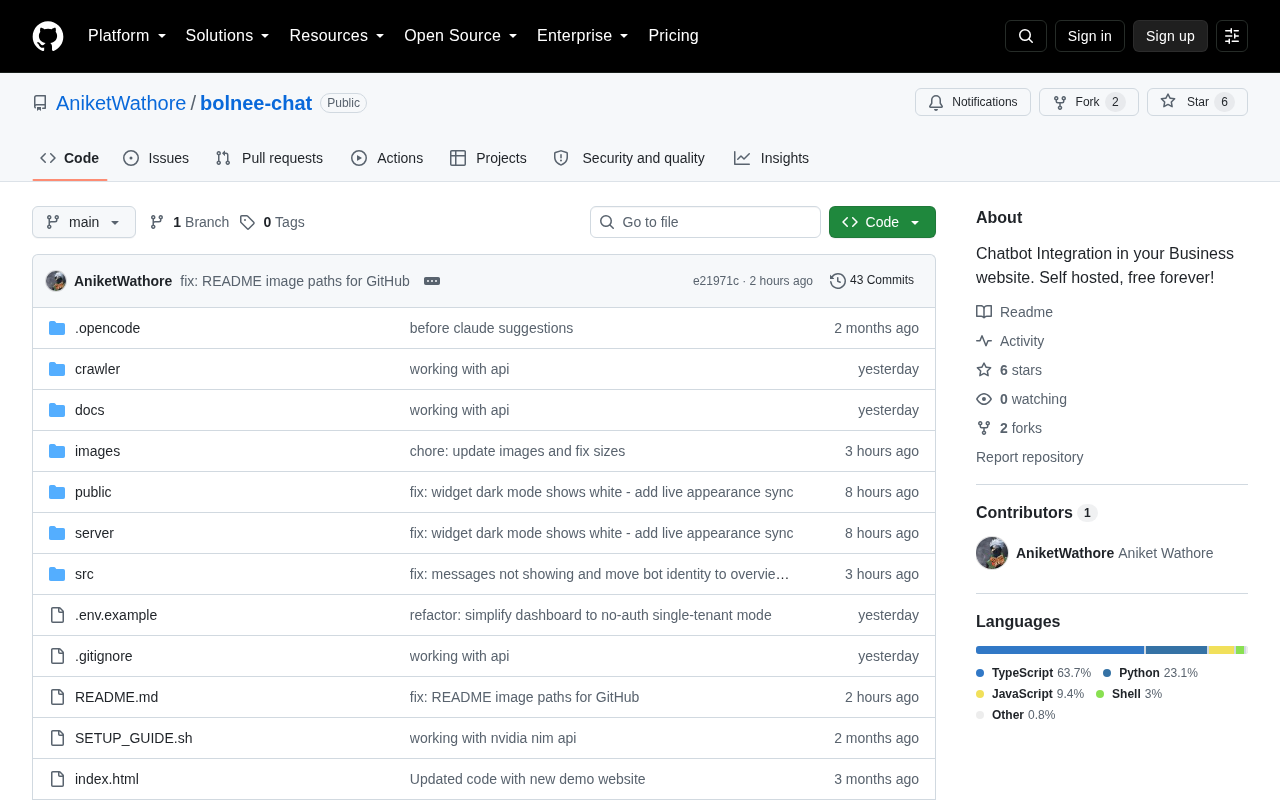
What Is Bolnee-Chat
Bolnee-Chat is a self-hosted chatbot integration tool designed for enterprise websites. Unlike commercial products that rely on cloud services, it allows developers to deploy the entire system on their own servers for fully private operation.
The Core Value of Self-Hosted Chatbots
Self-hosting means running the chatbot service on your own infrastructure without handing data over to external service providers. The key advantages of this model include:
- Data Sovereignty Assurance: All user conversations and visitor information remain on the enterprise's own servers, eliminating the risk of sensitive data leakage at the source.
- Compliance-Friendly by Design: Industries subject to GDPR, HIPAA, and similar regulations have hard requirements around data residency and auditability—self-hosted solutions are purpose-built for these needs. GDPR (General Data Protection Regulation) is the EU's data protection regulation that took effect in 2018, requiring organizations that process EU citizens' personal data to ensure lawful and transparent data processing, while granting users rights to access, modify, and delete their data—with penalties for non-compliance reaching up to 4% of global annual revenue. HIPAA (Health Insurance Portability and Accountability Act) is the U.S. privacy protection regulation for healthcare information, requiring that protected health information meets strict security standards during storage, transmission, and access. Self-hosted solutions allow enterprises to keep data entirely within their own infrastructure, making data flows transparent and controllable, audit trails clear and traceable, and significantly simplifying the compliance certification process.
- Controllable Long-Term Costs: After a one-time deployment, there are no ongoing charges based on conversation volume or agent seats—the total cost of ownership decreases over time.
- Deep Customization Freedom: With control over the deployment environment, enterprises can flexibly adjust features, interfaces, and even underlying logic to suit their specific business needs.
How to Integrate a Chatbot into an Enterprise Website
Bolnee-Chat emphasizes seamless integration with enterprise websites, typically achieved through an embeddable script or component—businesses simply include the corresponding code in their web pages to display a chat entry point.
Typical Use Cases
Embedded chatbots can cover a variety of business needs:
- Pre-Sales Consultation: Visitors can ask questions anytime while browsing products or services, effectively improving conversion rates.
- Customer Self-Service Support: Handling FAQs and guiding users through self-service resolution reduces the burden on human support agents.
- Lead Generation: Capturing visitor contact information and intent during conversations accumulates high-quality leads for the sales team.
For small and medium-sized businesses, a chatbot that's simple to deploy and fully under their control often offers better value than heavyweight commercial customer service systems.
A Realistic Assessment of an Early-Stage Project
Based on feedback from Hacker News, Bolnee-Chat is still at a very early stage. The Show HN post received 12 upvotes but no comments with further discussion. In the Hacker News ecosystem, projects that truly gain widespread attention typically accumulate dozens of comments and hundreds of upvotes within hours, so this state of "some initial attention but limited community feedback" suggests the project has caught preliminary interest but hasn't yet sparked in-depth technical discussion.
When considering this type of emerging self-hosted solution, several key dimensions deserve careful evaluation:
- Project Maturity: Early-stage projects typically have significant room for improvement in stability, documentation quality, and community support.
- AI Conversation Capabilities: The practical value of modern chatbots largely depends on conversation quality—whether they connect to large language models, which models they support, and whether local inference is possible are all critical questions to confirm. Current chatbot conversation capabilities have evolved from traditional keyword matching and decision tree logic to natural language understanding and generation based on Large Language Models (LLMs). Models like the GPT series, LLaMA, and Mistral, trained on massive text datasets, can understand context, handle complex queries, and generate coherent responses. In self-hosted scenarios, enterprises face a key choice: call cloud-based LLMs via API (such as the OpenAI API), or deploy open-source models locally for inference. The former is simpler to implement but still requires sending data externally, while the latter achieves true data isolation but demands significant local computing power (especially GPU resources). With the maturation of local inference frameworks like llama.cpp and Ollama, along with advances in quantization techniques (such as GGUF and AWQ), running models with 7B-13B parameters on consumer-grade hardware has become feasible—providing a viable technical foundation for local inference in self-hosted AI chatbots.
- Operational Costs: Self-hosting eliminates subscription fees, but the responsibilities of server maintenance, security updates, and scaling shift to the enterprise itself, requiring a capable technical team. Specifically, these responsibilities include server procurement or leasing and daily maintenance, security patching for operating systems and middleware, database backup and disaster recovery strategies, SSL certificate management and network security, and horizontal or vertical scaling to handle traffic growth. A common industry practice is leveraging containerization technologies (such as Docker and Kubernetes) to reduce deployment and operational complexity—by packaging applications and their dependencies into standardized container images, enabling one-click deployment, version rollback, and auto-scaling. Many self-hosted projects therefore provide Docker Compose configuration files as the recommended deployment method.
Market Trends for Self-Hosted AI Tools
Setting aside the maturity of any individual project, the direction Bolnee-Chat represents is worth watching. As open-source LLMs iterate rapidly, more and more enterprises are bringing AI capabilities "back in-house"—driven both by data privacy concerns and the desire to reduce dependency on a handful of cloud providers.
Against this backdrop, self-hosted chatbots, knowledge base Q&A systems, and internal AI assistants are forming an emerging market segment. This is not an isolated phenomenon but part of a broader "open-source infrastructure localization" trend. In the chatbot and AI assistant space, several open-source projects have already established a competitive landscape: Rasa offers a mature conversational AI framework supporting local training and deployment; Botpress positions itself as an open-source conversational platform with a visual flow editor; and Chatwoot focuses on open-source customer communication platforms with multi-channel messaging integration. In the broader self-hosted AI ecosystem, knowledge base Q&A includes projects like PrivateGPT and LocalAI, while enterprise internal AI assistants include LibreChat and Open WebUI. Together, these projects form a rapidly growing ecosystem whose core philosophy is enabling enterprises to leverage AI capabilities without surrendering data control to cloud providers.
Building products around "open-source + self-hosted + easy integration" has become a clear path for developers to achieve competitive differentiation. Bolnee-Chat needs to find its unique value proposition within this existing landscape.
Conclusion
Bolnee-Chat takes self-hosting as its entry point, offering enterprise websites a chatbot solution with data control and deployment autonomy—addressing the growing market pain points of data sovereignty awareness and cost control. Although the project is still in its early stages and its feature completeness and stability remain to be validated, the trend toward "localizing AI capabilities" is already very clear. For technical teams with relevant needs, we recommend following the project's progress and conducting a deeper evaluation and selection decision once the documentation and community have further matured.
Key Takeaways
Related articles

Uber Deploys ChatGPT Work Company-Wide: AI in the Workplace Enters the Scaled Implementation Phase
Uber deploys ChatGPT Work to 30,000+ employees, extending it from engineering to all roles. We analyze its expert-engineer pairing, end-to-end automation, and questions of AI control and power concentration—insights for scaling AI in the workplace.

Shift at Midnight Hands-On: When "ID Verification" Becomes Alien Hunting
Shift at Midnight blends ID verification with horror survival in a four-player co-op game. We break down its inspection mechanics and chaotic humor.

Zelensky Recounts the Outbreak of War: I Need Ammunition, Not a Ride
Zelensky recalls the first day of war in a YouTube interview: farewell to family, rejecting Biden's evacuation offer with "I need ammunition, not a ride," and how Bucha shaped his stance on compromise and peace talks.