Bonbon Foundation Model: Emergent Biological Capabilities in Molecular Interactions
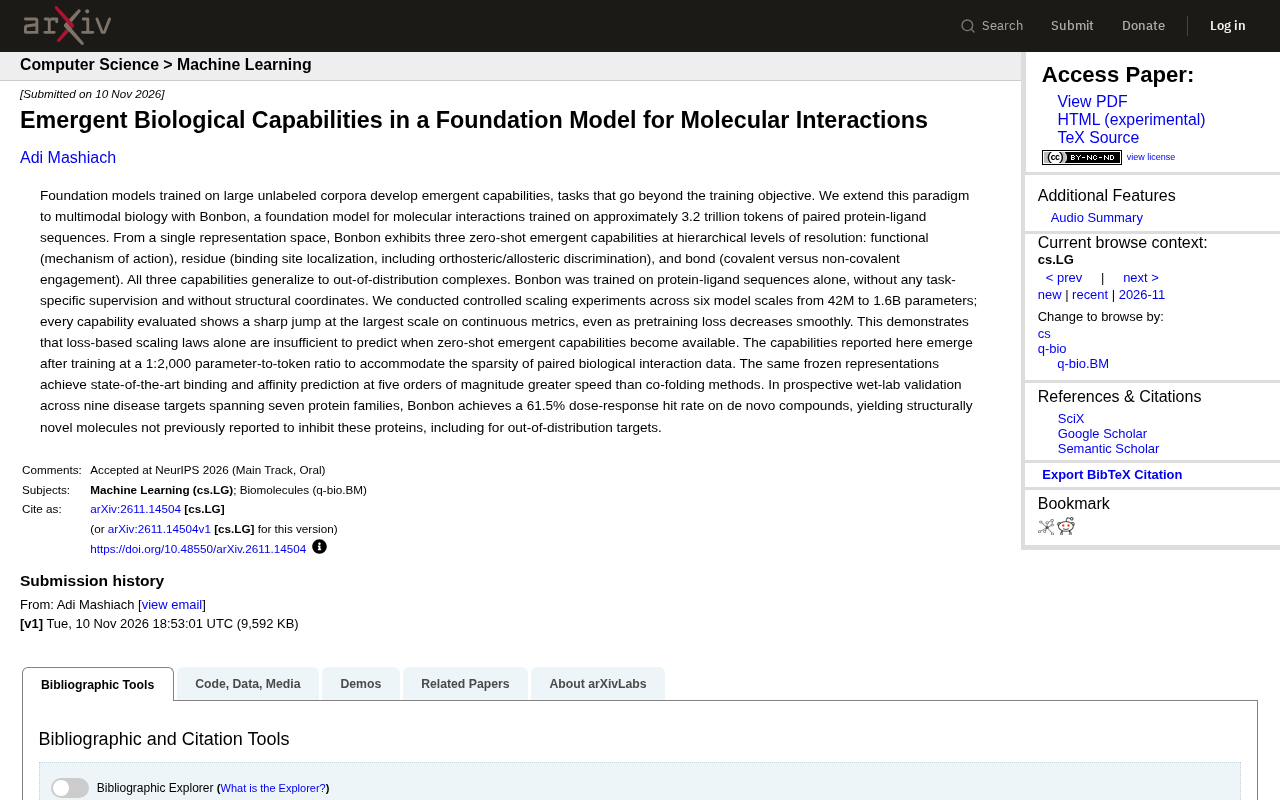
Bonbon foundation model trained on protein-ligand sequences exhibits multi-level zero-shot capabilities validated by wet-lab experiments.
Bonbon is a foundation model for molecular interactions trained on ~3.2T protein-ligand sequence tokens without task supervision or structural coordinates. It shows three zero-shot emergent capabilities—mechanism of action prediction, binding site localization with orthosteric/allosteric discrimination, and covalent/non-covalent determination—generalizing to out-of-distribution complexes. Scaling experiments across 42M to 1.6B parameters reveal sharp capability jumps at the largest scale despite smooth loss decline, showing loss laws cannot predict emergence. Frozen representations achieve SOTA on binding/affinity prediction, five orders of magnitude faster than co-folding methods. Wet-lab validation achieved 61.5% dose-response hit rate across nine disease targets, yielding structurally novel inhibitors. The work offers reusable scaling lessons for biological foundation model design.
Foundation models trained on massive unlabeled corpora often exhibit emergent capabilities that go beyond their training objectives. This paradigm is now being extended to multimodal biology. A foundation model called Bonbon focuses on molecular interactions and was trained on approximately 3.2 trillion paired protein-ligand sequence tokens. Surprisingly, with a single representation space, Bonbon demonstrates three zero-shot emergent capabilities corresponding to three levels of resolution: function, residue, and bond.
Three Zero-Shot Emergent Capabilities
Bonbon's emergent capabilities cover key aspects of molecular recognition. At the functional level, the model can predict mechanism of action; at the residue level, it can localize binding sites and even distinguish orthosteric from allosteric binding; at the bond level, the model can determine covalent versus non-covalent binding. All of these capabilities have been validated to generalize on out-of-distribution complexes.
Importantly, Bonbon's training data consists solely of protein-ligand sequences, with no task-specific supervision signals and no structural coordinates. This means the model autonomously learned deep patterns underlying molecular interactions purely from sequence co-occurrence patterns.
Zero-shot emergent abilities refer to capabilities that a model acquires solely through pretraining—without fine-tuning for specific tasks or providing supervision signals—that enable it to directly perform new tasks. In natural language processing, such abilities often appear abruptly as model scale increases, a phenomenon known as "emergence." What makes Bonbon special is that its pretraining data consists only of protein-ligand sequence pairs, containing no structural coordinates or functional labels, yet the model exhibits zero-shot recognition capabilities at three levels: function (mechanism of action prediction), residue (binding site localization, orthosteric/allosteric discrimination), and bond (covalent/non-covalent determination). This indicates that the model spontaneously learned deep patterns of molecular interactions from sequence co-occurrence patterns rather than relying on task-specific supervision.
Scaling and Emergence Thresholds
The research team conducted controlled scaling experiments covering six model sizes from 42 million to 1.6 billion parameters. On continuous metrics, every evaluated capability exhibited a sharp jump at the largest scale, while pretraining loss decreased smoothly. This phenomenon directly demonstrates that loss-based scaling laws alone are insufficient to predict when zero-shot emergent capabilities will appear.
To accommodate the sparsity of paired biological interaction data, these capabilities emerged under training conditions with a parameters-to-tokens ratio of 1:2000. This ratio is far higher than conventional language model training configurations, suggesting that the unique challenges of biological interaction data require different scaling strategies.
Loss-based scaling laws typically describe how model pretraining loss decreases smoothly with parameter scale, data volume, and compute. However, Bonbon's research found that on continuous metrics, zero-shot capabilities exhibit sharp jumps at the largest scale while pretraining loss decreases smoothly. This shows that loss curves alone cannot predict the threshold for capability emergence. The parameters-to-tokens ratio is another key factor: conventional language model training uses lower ratios (e.g., 1:10 to 1:100), whereas Bonbon adopted a high ratio of 1:2000 to accommodate the sparsity of paired biological interaction data. This adjustment suggests that the unique challenges of biological interaction data require different scaling strategies and cannot simply replicate the scaling experience of language models.
Performance and Wet-Lab Validation
The same frozen representations achieved state-of-the-art performance on binding and affinity prediction tasks, at a speed five orders of magnitude faster than co-folding methods. Even more compelling is the prospective wet-lab validation: across nine disease targets spanning seven protein families, Bonbon achieved a 61.5% dose-response hit rate for de novo designed compounds, producing structurally novel molecules that had not previously been reported to inhibit these proteins, including out-of-distribution targets.
Co-folding methods are a class of techniques that predict three-dimensional structures of protein-ligand complexes via deep learning, such as the AlphaFold series. These methods typically require generating structural coordinates, making them computationally expensive and slow. Bonbon's frozen representations achieve state-of-the-art performance on binding and affinity prediction tasks while being five orders of magnitude faster than co-folding methods, meaning it can efficiently perform molecular recognition tasks without explicit structure prediction. Prospective wet-lab validation refers to validating predicted compound activity through actual experiments (e.g., dose-response assays) after model prediction. Bonbon achieved a 61.5% dose-response hit rate across nine disease targets and discovered structurally novel inhibitors, including for out-of-distribution targets, strongly demonstrating the model's generalization ability and practical value.
Implications for Foundation Model Research
Bonbon's work reveals several key insights. First, emergent capabilities are not exclusive to language models—they also exist in multimodal biological sequences and follow similar scale-threshold patterns. Second, a smooth loss curve does not mean smooth capability development; researchers need more granular evaluation metrics to capture capability transitions. Third, the parameters-to-tokens ratio needs to be flexibly adjusted based on data sparsity—the sparsity of biological interaction data demands higher parameter ratios.
This research provides reusable scaling lessons for the design of biological foundation models and reminds us that while pursuing larger scale, we must pay attention to how domain-specific data characteristics affect training dynamics.
One-line Summary
Bonbon, a foundation model trained on protein-ligand sequences, exhibits multi-level zero-shot capabilities validated by wet-lab experiments.
Paragraph Summary
Bonbon is a foundation model focused on molecular interactions, trained on approximately 3.2 trillion protein-ligand sequence tokens without task supervision or structural coordinates. It exhibits three zero-shot emergent capabilities: predicting mechanism of action at the functional level, localizing binding sites and distinguishing orthosteric/allosteric binding at the residue level, and determining covalent/non-covalent binding at the bond level—all generalizing to out-of-distribution complexes. Scaling experiments across six model sizes from 42M to 1.6B parameters found that capabilities jump sharply at the largest scale while pretraining loss decreases smoothly, indicating that loss laws are insufficient to predict emergence. Frozen representations achieve SOTA on binding and affinity prediction, five orders of magnitude faster than co-folding methods. Wet-lab validation achieved a 61.5% dose-response hit rate across nine disease targets, yielding structurally novel inhibitors. The research provides reusable scaling lessons for biological foundation model design.
Related articles
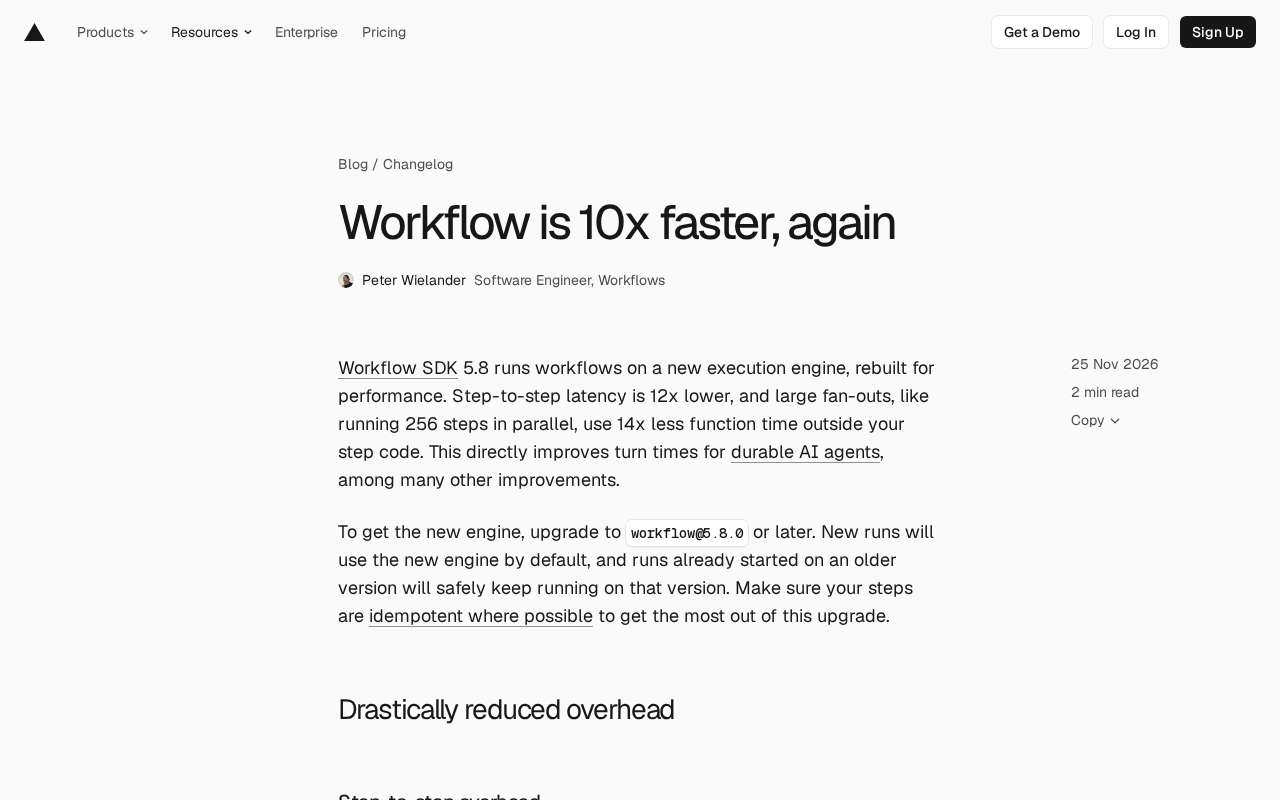
Workflow SDK 5.8 Performance Benchmark: Step Latency Reduced 12x
Workflow SDK 5.8 rebuilds its execution engine, cutting p75 inter-step latency from 85ms to 7ms and 256-way parallel fan-out overhead by 14x, improving durable AI agent turnaround.

David Fincher's New Film Accused of Being AI-Generated? The Truth Behind the Controversy
David Fincher's new film *The Further Misadventures of Cliff Booth* is accused of using AI, with a carriage shot in the trailer sparking controversy. Netflix's acquisition of Ben Affleck's AI company and Fincher's own openness to AI keep suspicions alive. This article sorts out the controversy and the views of all sides.

FCC Clears SpaceX's Space-Based AI Data Centers: A Debate Over Regulatory Boundaries
The FCC approved SpaceX's plan to deploy AI data centers in space but dismissed opponents' key concerns about scientific research impacts as beyond its regulatory authority. This article analyzes the regulatory boundary issues behind the decision, the deeper tensions of space-based AI infrastructure, and its implications for the industry.