Workflow SDK 5.8 Performance Benchmark: Step Latency Reduced 12x
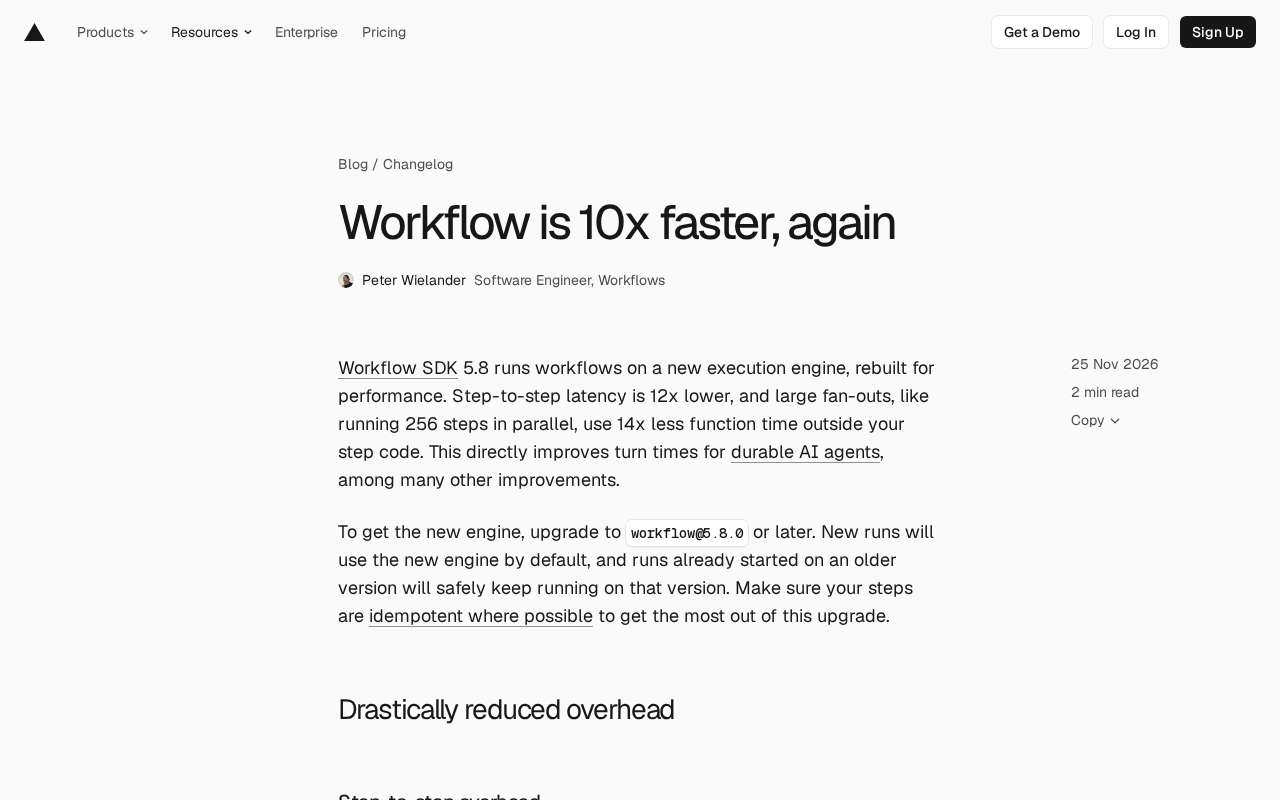
Workflow SDK 5.8's new engine cuts inter-step latency 12x and parallel overhead 14x, but needs idempotent steps and World spec v9.
Workflow SDK 5.8 introduces a new execution engine that boosts durable AI agent performance. Benchmarks show p75 inter-step overhead dropping from 85ms to 7ms (about 12x), and median total run time from 3.0 minutes to 111 seconds. In 256-step parallel fan-out, overhead falls from 13.5s to 2.5s, with out-of-step function time down 14x. Gains rely on speculative execution, safe only for idempotent steps.
Workflow SDK 5.8 introduces a brand-new execution engine that reduces inter-step latency by 12x and function overhead in large-scale parallel scenarios by 14x. For developers building durable AI agents, this means faster multi-turn conversation turnaround times and lower infrastructure costs.
What the New Execution Engine Brings
The core change in Workflow SDK 5.8 is the rebuild of the underlying execution engine. According to official benchmarks, p75 inter-step overhead dropped from 85 milliseconds to 7 milliseconds—roughly a 12x reduction. A median run containing 102 seconds of step work had its total duration cut from 3.0 minutes to 111 seconds—meaning the overhead from non-step code has been compressed to nearly negligible levels.
For large-scale fan-out scenarios with 256 steps executing in parallel, added overhead fell from 13.5 seconds to 2.5 seconds, a 5.5x reduction. Function time spent outside the steps' own work in median runs dropped from 1,446 seconds to 105 seconds—a 14x reduction. This number is worth noting: it shows that in the past, a large amount of time was consumed by the orchestration layer itself rather than business logic.
For a five-round agent loop (streaming tokens durably and calling tools), overhead fell from 3.0 seconds to 0.9 seconds, a 3.3x reduction. On the resume-wait front, resume time after 1 second of idleness dropped from 425 milliseconds to 184 milliseconds—a 2.3x speedup; resumes after more than 5 seconds of idleness may incur slightly higher overhead. Developers can choose to keep functions warm for longer periods in exchange for better resume times, at the cost of additional compute time.
Speculative Execution: The Key Mechanism Behind the Performance Gains
These gains rely heavily on speculative execution of steps. Under certain conditions, the engine executes steps ahead of time, thereby hiding orchestration latency. But this comes with a precondition: only idempotent steps can run this way.
The official guidance offers two approaches. If a step passes stepId as an idempotency key—such as in a Stripe charge scenario—then it maintains the same stepId across retries and speculative reruns, and Stripe will only create a single charge, with no changes needed. If the step itself is sensitive and cannot be safely retried—such as sending a receipt email via SMTP, where a second attempt would send a second email—then it should be marked maxRetries = 0 to ensure the step executes at most once.
This effectively reinforces an engineering practice: make steps idempotent whenever possible, or explicitly opt out of speculation and retries when idempotency isn't achievable. After upgrading to 5.8, new runs use the new engine by default, while already-started runs on the old version safely continue executing on the old engine.
Idempotency means that performing an operation multiple times produces the same result as performing it once. In distributed systems, network failures or timeouts may leave clients unsure whether a request was processed, leading them to retry. If the operation is idempotent, retries cause no side effects (such as duplicate charges or sending multiple emails). Common approaches to achieving idempotency include using a unique idempotency key (such as stepId), with the server recording the result for that key and returning the same result directly on duplicate requests. For Workflow SDK's speculative execution, idempotency is a safety precondition: the engine may execute a step before it is formally scheduled, and if the step is not idempotent, this could lead to duplicate business operations. Therefore, developers should ensure step logic is idempotent, or disable retries (maxRetries = 0) when idempotency isn't achievable to opt out of speculative execution.
Upgrade Considerations and Ecosystem Compatibility
Upgrading only requires installing workflow@5.8.0 or higher. If you want new runs to continue using the old engine after upgrading, you can set the environment variable WORKFLOW_SPEC_VERSION=8. Users upgrading from 4.x should first consult the upgrade guide, as v5 is a major version.
Third-party World compatibility is an easily overlooked detail. The World maintained by Vercel already supports the new engine, but third-party Worlds need to support World spec version 9; otherwise, upgrading will yield no performance improvements—new runs will continue using the previous engine.
For teams whose core scenario is durable AI agents, the value of this upgrade isn't just the numerical latency reduction. The turnaround time of multi-round agent loops is directly affected by orchestration overhead; when per-round overhead is compressed from seconds to sub-second levels, both the response speed users perceive and the concurrency that a given unit of compute can support will change. The official description of this upgrade as "10x faster again" holds up on the latency dimension based on the benchmark data—but only if steps are idempotent and the World in use has been adapted to the new spec.
World spec is the specification in Workflow SDK that defines the interface for durable execution environments. The World abstracts the underlying infrastructure (such as storage, queues, timers, etc.), enabling the SDK to run on different platforms (such as Vercel, self-hosted environments, or third-party services). Each World implementation must conform to a specific version of the spec to ensure compatibility with the SDK engine. World spec version 9 introduces the interfaces and semantics required by the new execution engine, such as more efficient state management and scheduling primitives. If a third-party World only supports an older spec version (such as version 8), SDK 5.8 cannot leverage the new engine's features, and new runs will fall back to the old engine. Therefore, before upgrading, confirm the spec version of the World in use, or contact the World maintainer to adapt it.
One-line Summary
Workflow SDK 5.8's new execution engine reduces inter-step latency by 12x and parallel overhead by 14x, but relies on idempotent steps and World spec v9.
Paragraph Summary
Workflow SDK 5.8 introduces a brand-new execution engine that significantly improves the performance of durable AI agents. Benchmarks show p75 inter-step overhead dropping from 85 milliseconds to 7 milliseconds (about a 12x improvement), with median total run duration cut from 3.0 minutes to 111 seconds. In large-scale fan-out scenarios with 256 parallel steps, added overhead fell from 13.5 seconds to 2.5 seconds, and out-of-step function time dropped 14x. Overhead for a five-round agent loop fell from 3.0 seconds to 0.9 seconds, and resume time after 1 second of idleness dropped from 425 milliseconds to 184 milliseconds. These gains rely heavily on speculative execution, but only idempotent steps can safely benefit; steps that cannot be retried should be marked maxRetries = 0. Upgrading only requires installing workflow@5.8.0, but third-party Worlds must support World spec version 9 to gain the performance improvements.
Related articles

David Fincher's New Film Accused of Being AI-Generated? The Truth Behind the Controversy
David Fincher's new film *The Further Misadventures of Cliff Booth* is accused of using AI, with a carriage shot in the trailer sparking controversy. Netflix's acquisition of Ben Affleck's AI company and Fincher's own openness to AI keep suspicions alive. This article sorts out the controversy and the views of all sides.
FCC Clears SpaceX's Space-Based AI Data Centers: A Debate Over Regulatory Boundaries
The FCC approved SpaceX's plan to deploy AI data centers in space but dismissed opponents' key concerns about scientific research impacts as beyond its regulatory authority. This article analyzes the regulatory boundary issues behind the decision, the deeper tensions of space-based AI infrastructure, and its implications for the industry.

Why Are Latinos Nearly Half of the U.S. Border Patrol?
Latinos hold nearly half of the U.S. Border Patrol and about 30% of ICE. Vox's Khalil Green explores their motivations, identity tensions, and why enforcement work ≠ MAGA.