Bounded Autonomy and Verifiable Safety: The BRaVeS Governance Framework for Agentic AI in High-Stakes Scenarios
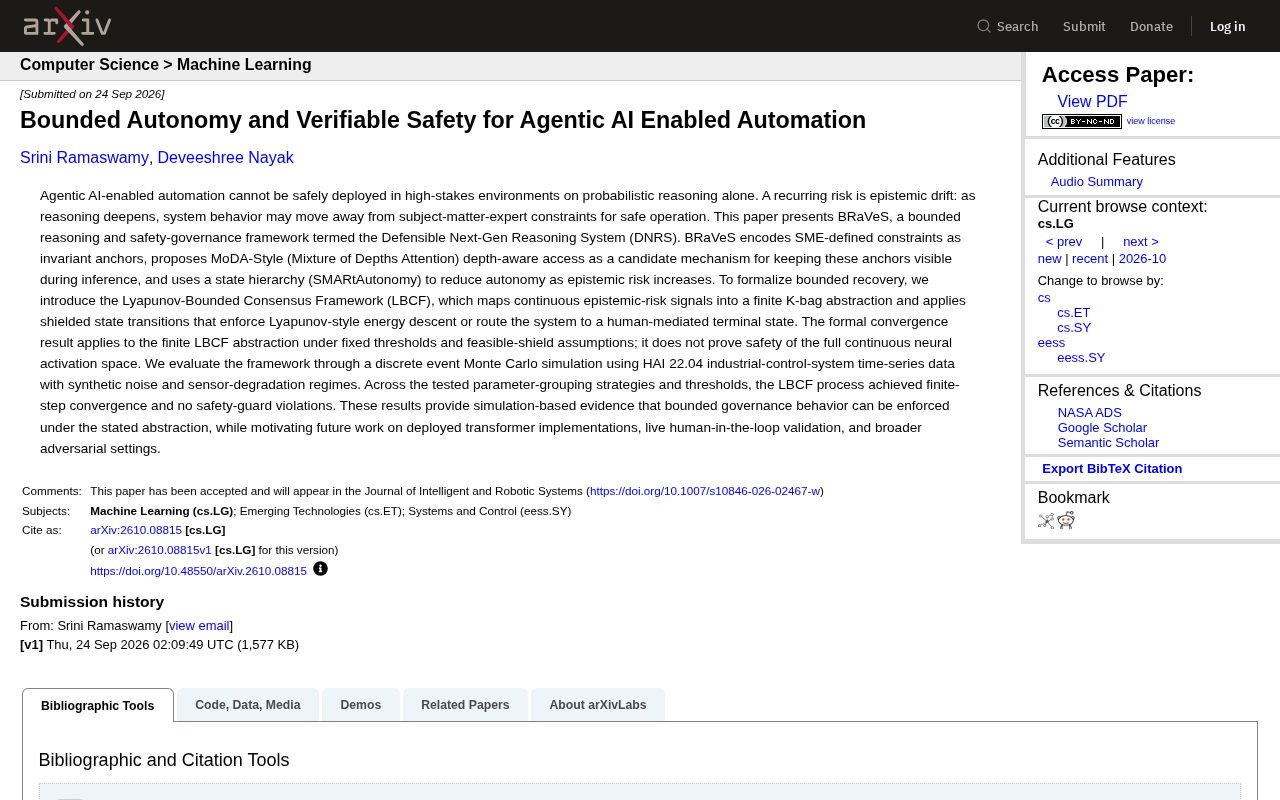
BRaVeS governs agentic AI safety in high-risk settings through bounded reasoning and Lyapunov-verified constraints.
This article examines the BRaVeS (Bounded Reasoning and Safety-governance) framework proposed in an arXiv paper, designed to counter epistemic drift — the risk that deeper AI reasoning increasingly deviates from expert-defined safety constraints. BRaVeS combines three layers: invariant anchors that keep SME constraints visible throughout reasoning, a MoDA-inspired depth-aware attention mechanism, and SMARtAutonomy tiering that reduces system autonomy as risk rises. Theoretically, a Lyapunov-Bounded Consensus Framework (LBCF) provides formal convergence guarantees — though only for a finite discrete abstraction, not the full neural activation space. Monte Carlo simulation on HAI 22.04 industrial control data confirms finite-step convergence with zero safety violations under the given abstraction.
When Deep Reasoning Becomes a Safety Hazard
As Agentic AI is increasingly counted on to deliver automation at scale, a sharp question emerges: can systems that rely solely on probabilistic reasoning be safely deployed in high-risk environments? A recent arXiv paper offers a definitive "no" — and points to a technical hazard worth taking seriously: epistemic drift.
Epistemic drift refers to the phenomenon where, as an AI system's reasoning chain grows deeper, its behavior may gradually deviate from the safety constraints set by domain Subject-Matter Experts (SMEs). In other words, the more a model "thinks deeply," the more likely it is to veer into dangerous territory. This runs counter to the intuition that more thorough reasoning produces more reliable outcomes — and it is precisely the core concern preventing industrial control, healthcare, and energy sectors from embracing autonomous agents.
The paper's proposed solution is called BRaVeS (Bounded Reasoning and Safety-governance), also named by the authors as a "Defensible Next-Gen Reasoning System" (DNRS). Its central insight is not to pursue unbounded intelligence, but to establish verifiable boundaries around it.
The Three-Layer Design of BRaVeS
BRaVeS is not a single mechanism but a governance system composed of multiple complementary components. Understanding it requires grasping the dynamic balance between "constraint" and "autonomy."
Invariant Anchors: Embedding Expert Constraints into the Reasoning Process
The first layer encodes SME-defined constraints as invariant anchors — representing the safety baselines that domain experts consider non-negotiable. These anchors must remain visible and inviolable throughout the entire reasoning process. This addresses a common pain point: traditional large models tend to "forget" initial constraints during long-chain reasoning. The anchor mechanism aims to keep safety rules present from start to finish.
MoDA-Style Depth-Aware Access
To ensure these anchors remain active throughout reasoning, the paper proposes borrowing from MoDA (Mixture of Depths Attention) — a depth-aware access mechanism offered as a candidate approach. Its goal is to ensure that no matter how deeply reasoning proceeds, safety anchors never fall out of the model's "field of view." This is a direct technical response to epistemic drift: building a persistent bridge between deep reasoning and safety constraints.
MoDA (Mixture of Depths Attention) is an attention mechanism in Transformer architectures that dynamically allocates computational resources. Unlike traditional Transformers, which treat all tokens equally at every layer, MoDA allows the model to decide — based on content importance — which tokens should continue participating in attention at deeper layers and which can bypass certain layers. This "compute on demand" design was originally conceived to improve inference efficiency. BRaVeS borrows its core idea of "depth awareness": assigning different information different "penetration depths." In the BRaVeS context, safety anchors are treated as high-priority information that must traverse all reasoning depths, staying present in the attention context to prevent the model from gradually ignoring safety constraints through attention dilution during long-chain reasoning. It is worth noting that the paper presents this as a candidate approach rather than a realized hardware implementation; its feasibility in real Transformer deployments remains to be validated.
SMARtAutonomy: The Higher the Risk, the Lower the Autonomy
The third layer is a state-tiering mechanism called SMARtAutonomy, built on a simple but powerful design philosophy: as epistemic risk rises, the system's autonomous authority decreases accordingly. When the system judges itself to be in a state of high uncertainty or potential danger, it proactively narrows its decision scope and returns greater control to humans or more conservative policies. This "knowing when to step back" design is precisely the safety valve that high-risk scenarios demand.
Lyapunov-Bounded Consensus: A Mathematical Proof of Safety
The paper's most theoretically substantial contribution is the introduction of the Lyapunov-Bounded Consensus Framework (LBCF), used to formalize the concept of "bounded recovery."
The mechanism works as follows: the system maps continuous epistemic risk signals into a finite "K-bag" abstract state space, then enforces shielded state transitions. These transitions either force Lyapunov-style energy descent (i.e., risk continuously converges) or direct the system toward a human-intervention terminal state. By drawing on the mature Lyapunov stability theory from control engineering, the paper provides provable convergence guarantees for safe agent behavior.
However, the authors display commendable academic honesty here: this formal convergence result applies only to the finite LBCF abstraction under fixed thresholds and feasible shielding assumptions — it does not prove safety for the full continuous neural activation space. In other words, the framework proves boundedness at the governance layer, not absolute safety in the underlying neural network. This careful delineation reflects the realistic state of verifiable AI safety research today.
Lyapunov stability theory originates from the 19th-century Russian mathematician Alexander Lyapunov's work on dynamical systems, and is one of the cornerstones of modern control theory. Its core idea: if you can find a "Lyapunov function" for a system (analogous to "energy" in a physical system) that monotonically decreases along the system's trajectory and equals zero at the equilibrium point, you can rigorously prove that the system will eventually converge to equilibrium — without needing to solve complex differential equations directly. This approach is widely used in robotics, aerospace, and power systems to prove safety bounds. The challenge in applying it to AI safety is that neural network state spaces are continuous and high-dimensional, making it difficult to construct effective Lyapunov functions directly. BRaVeS addresses this by discretizing the continuous space into a finite K-bag abstraction, constructing feasible proofs within this reduced state space — at the cost of forgoing complete coverage of the underlying neural activations.
Simulation Validation on Industrial Data
Beyond theory, the paper evaluates the framework using discrete-event Monte Carlo simulation. Experiments use HAI 22.04 industrial control system time-series data, with synthetic noise and sensor degradation scenarios injected to simulate real-world industrial anomalies.
Results show that across the tested parameter grouping strategies and threshold configurations, LBCF processes achieved finite-step convergence with zero safety shield violations. This provides simulation-based evidence that "bounded governance behavior can be enforced under the given abstraction."
A clear-eyed reading is warranted: these conclusions rest on a simulated environment and specific abstractions. The paper explicitly identifies future work directions: real Transformer implementations for actual deployment, online human-in-the-loop verification, and broader adversarial scenario testing. The gap between simulation and real-world deployment remains substantial.
HAI 22.04 (Hardware-in-the-Loop Anomaly Injection 2022 Version 4) is a publicly available time-series dataset for industrial control system security research. It contains sensor readings from real industrial equipment (such as water treatment and power generation scenarios), along with annotated anomaly events and attack injection records. The dataset is commonly used to evaluate anomaly detection algorithms in Cyber-Physical Systems (CPS). Its key characteristics — strong physical constraints on signals (temperatures and pressures cannot change abruptly) and anomalies that tend to drift gradually rather than spike suddenly — make it highly suited for simulating epistemic drift. Monte Carlo simulation, meanwhile, uses large-scale random sampling to estimate a system's statistical behavior under uncertainty, and is a standard engineering method for assessing complex system reliability when closed-form solutions are unavailable. Together, they give the experiments a degree of industrial representativeness while keeping conditions controlled.
Implications for Agentic AI Safety Research
The value of this paper lies not in delivering a plug-and-play product, but in proposing a pragmatic safety governance paradigm. At a time when the industry broadly pursues ever-stronger reasoning capabilities, BRaVeS takes the opposite approach — emphasizing verifiable boundaries as the price of deployable safety.
Several ideas are particularly worth noting: treating safety as an "anchor" that must be actively kept visible rather than a one-time prompt; replacing the binary choice of "fully autonomous or fully human-controlled" with risk-linked autonomy tiering; and using control theory to provide formal proofs for AI safety. These explorations point toward a more mature future for agent deployment — not unbounded intelligence, but bounded, defensible, and human-interruptible intelligence.
For teams considering deploying Agentic AI in high-risk operations, this paper offers an important reminder: true safety does not come from deeper reasoning, but from explicit governance of reasoning boundaries.
Related articles

M&M's Spent Millions Replacing Artificial Blue Dye — Why Is It So Hard?
Mars spent millions trying to replace artificial blue dye in M&M's with spirulina, but thick material clogs pipes and residue risks mold, forcing a full production-line rebuild. Here's the engineering behind the reformulation.

Teammate Wanted for Meta Global AI Developer Hackathon: Computer Vision & Medical AI
A Reddit developer seeks teammates for the Meta Global AI Developer Hackathon, focusing on computer vision and medical AI. This article analyzes the track logic, skills-complementarity needs, and topic selection strategy behind this teaming signal.
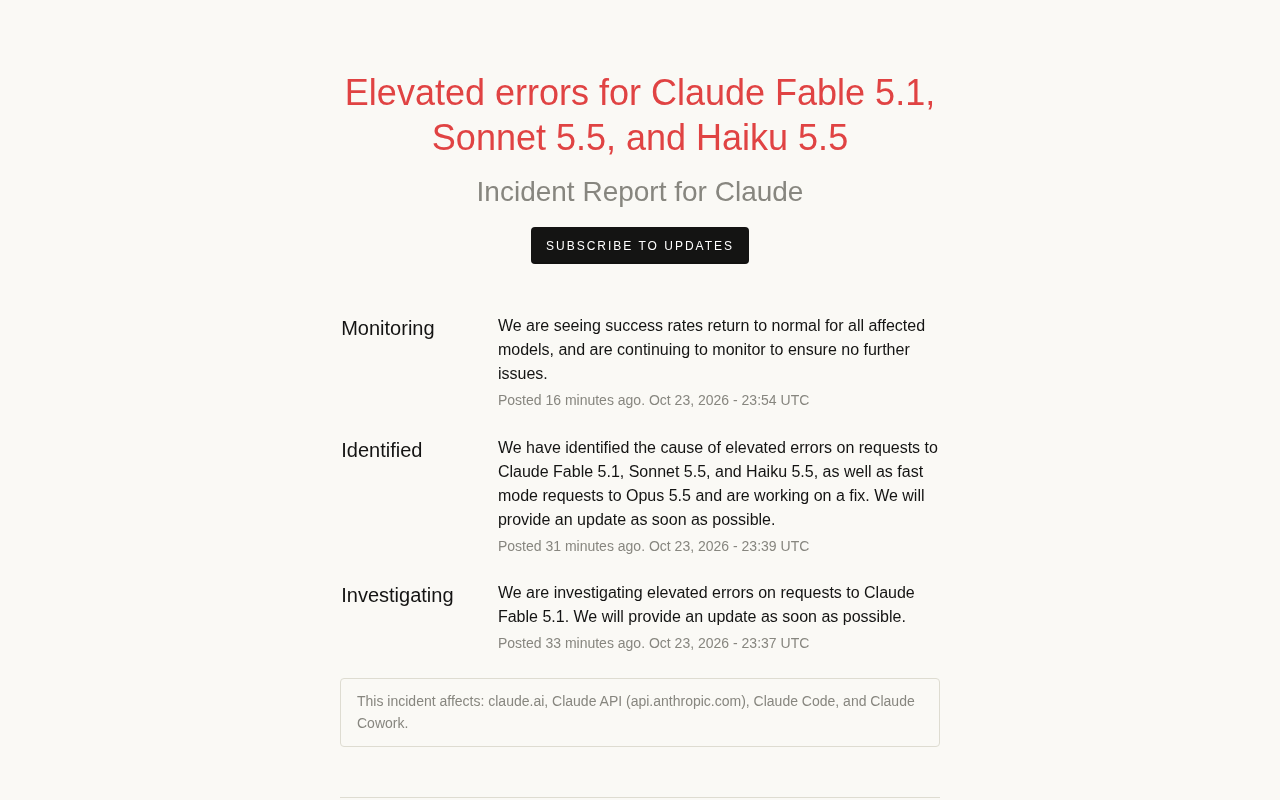
Multiple Claude Models Hit by Errors: A Postmortem of Fable 5.1, Sonnet 5.5, and Haiku 5.5
Claude Fable 5.1, Sonnet 5.5, Haiku 5.5, and Opus 5.5 fast mode saw elevated errors; Anthropic identified and resolved the issue in 17 minutes. This postmortem covers the timeline, the technical reasons for the multi-model cascading failure, and practical lessons for retry and degradation strategies.