Breaking Into LLM Development From Zero: A Four-Stage Learning Roadmap

Breaking down a 748-episode LLM course's four-stage roadmap and the learning order for switching careers from zero.
The article unpacks a Bilibili LLM course billed as 748 episodes, focusing on its learning-path design rather than its content list. It targets zero-background career switchers, traditional developers wanting an AI label, and demo players lacking engineering methodology. The four stages are: job-role awareness and model boundaries; Prompt engineering, RAG, and Agent with hands-on projects; engineering from demo to launch (interface wrapping, streaming, cost monitoring, bad-case collection, framework selection); and resume rewriting plus interview prep. It argues the order should be framework first, papers later, and that engineering delivery is the real job focus.
Title
Breaking Into LLM Development From Zero: A Four-Stage Learning Roadmap
Meta Description
Breaking down a four-stage LLM systems course from Bilibili: from job-role awareness and core Prompt/RAG/Agent skills to engineering delivery and job-hunting, and how a beginner should plan a path into LLM development.
Article Content
Online learning resources for large models are dazzlingly abundant, but people who truly want to switch careers from zero often get stuck at the very first step: they don't know where to start. A systematic course on Bilibili billed as "all 748 episodes" tries to answer this question, and its course-design logic is worth unpacking—not because it covers everything, but because it builds a fairly clear chain between "what to learn" and "why learn it."
Who This Course Is Really For
The course opens by defining three target groups: people with zero background who want to switch careers but are drowning in fragmented information; people who have done traditional development for two or three years and want to add an AI label to their resume, yet get stumped by RAG and Agent questions in interviews; and people who can get a model demo running but lack a methodology for engineering delivery.
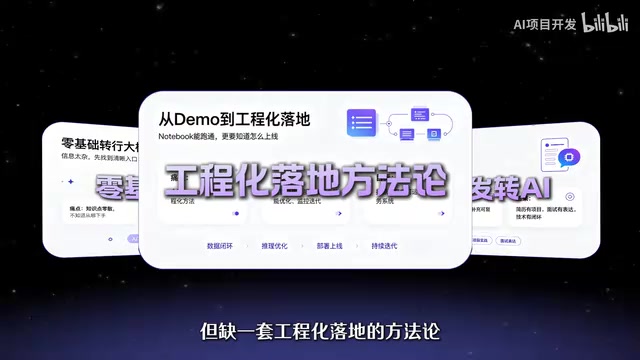
This positioning itself reveals a reality: the barrier to LLM application development is not "whether you can call a model," but whether you can assemble model capabilities into a deliverable system. Many courses on the market are either theory-heavy—after covering model principles and mathematical derivations, you still can't write an application—or they stay at the level of trends and buzzwords, with the implementation part left entirely up in the air. This course chooses to sit in the middle: enough model understanding to hold your own in interviews, and enough engineering skill to actually get work done.
The Four-Stage Roadmap: From Awareness to Job Hunting
Stage One: Establish Job-Role Awareness First
The first step is not writing code, but getting clear on the essential differences between LLM application development and traditional backend development, and where the model's capability boundaries lie—what it can do and what it can't. Specific content includes the role of tokens and context windows, how the temperature parameter affects output, API calling and billing logic, what each mainstream model is good at, and a line-by-line breakdown of job JDs.
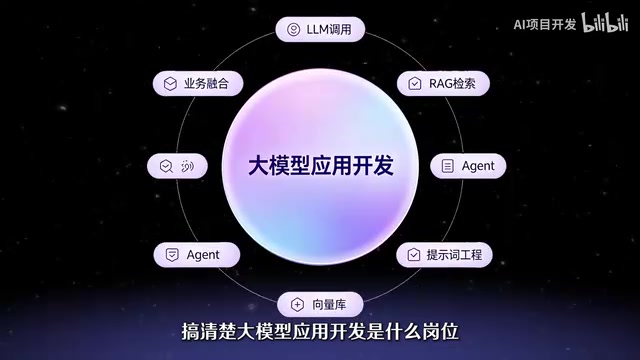
This step may seem abstract, but it actually determines the sense of direction for all subsequent learning. Without clear job-role awareness, the systems you build are castles in the air, and you'll be exposed the moment an interviewer asks a question.
Token is the basic unit of text that large models process; models bill by token and limit input length. The context window refers to the maximum number of tokens a model can process in a single pass; exceeding it causes truncation or an error. The temperature parameter controls output randomness—the lower the value, the more deterministic the output; the higher the value, the more divergent. Understanding these parameters helps you judge a model's capability boundaries in specific scenarios, and they are also basic points frequently probed in interviews.
A job JD (Job Description) is a formal description of a position's responsibilities and requirements from the recruiter. Breaking down JDs line by line helps learners identify the skill combinations the market actually needs, rather than studying blindly based on personal interest—which is why the course places it in the first stage.
Stage Two: Three Core Hard Skills
This stage focuses on three areas. Prompt engineering moves from "being able to write" to "writing reliably," covering role setting, few-shot examples, and structured output. RAG goes from principles to implementation, involving embeddings, vector databases, chunking strategies, and how to tune when retrieval accuracy won't improve. Agent architecture design deals with multi-step task orchestration, tool integration via Function Call and MCP, and fallback strategies when tool calls fail.
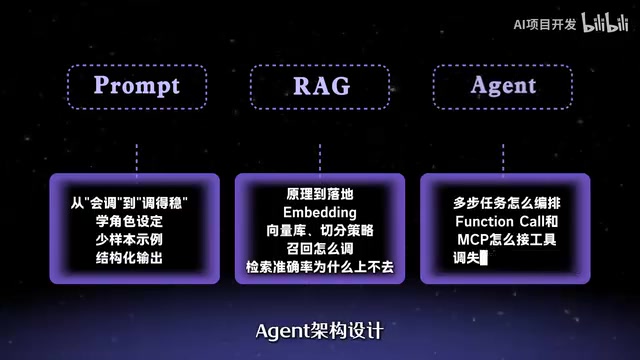
The author pairs each skill area with a hands-on project: a document Q&A system for RAG, and an automated workflow for Agent. These two are both core interview topics and basic daily-work skills; the purpose of the hands-on projects is to solidify knowledge points into demonstrable output.
Embedding is the technique of mapping text into high-dimensional vectors; texts with similar semantics are closer in vector space, and the retrieval step of RAG relies precisely on this property. Vector databases (such as FAISS, Milvus, Chroma) store and efficiently retrieve these vectors. Chunking strategy refers to splitting long documents into fragments suitable for retrieval and for fitting into the context window; the granularity of chunking directly affects recall quality.
Function Call is a mechanism in which the model outputs structured parameters based on user intent, and an external program executes the actual function call; MCP (Model Context Protocol) is an open protocol proposed by Anthropic to standardize how models connect to external tools and data sources, so that tool integration no longer depends on each framework's proprietary implementation.
Stage Three: Turn Demos Into Systems That Can Go Live
This stage addresses the gap from "it runs" to "it ships": wrapping interfaces with FastAPI, how to do streaming output, how to manage session state, how to add logging and instrumentation, how to write test cases covering scenarios where model output is unstable, how to control token costs, how to track online performance, and how to collect bad cases. The course also specifically discusses framework selection—when to use LangChain, and when writing it bare is more appropriate.
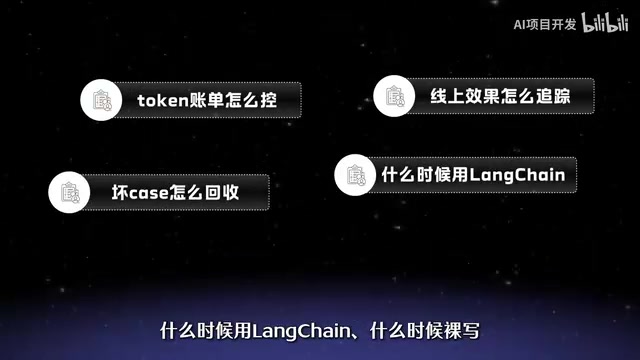
The question of framework selection is often underestimated in real projects. Tools like LangChain can accelerate prototyping, but the abstraction layers they introduce can become a burden during debugging and customization; understanding when "bare writing" applies is one mark of engineering maturity.
Streaming refers to the model returning tokens as it generates them, with the frontend displaying them character by character; it can significantly improve the waiting experience in long-answer scenarios, but requires handling connection interruptions and incremental concatenation. Session state management refers to maintaining historical context across multi-turn conversations; common approaches include storing sessions server-side and truncating history by window to control token consumption. Logging and instrumentation means recording each request's input, output, latency, and token usage—it is the data foundation for cost accounting and bad-case collection.
Stage Four: Job-Hunting in Practice
The final stage targets job hunting directly: rewrite each experience on your resume according to "what problem was solved, what solution was used, what the result data was"; prepare in advance for high-frequency interview questions, including how to treat RAG hallucinations, how to break Agent infinite loops, and how to reduce costs; deploy your portfolio online and provide a link people can click. From preparation to receiving an offer, it forms a closed loop.
Lessons From This Learning-Path Design
The most worth learning from this course is not its content list, but its order of progression: first build the framework and know what capabilities the job requires, then fill in skill points one by one, with every step making clear what you're learning, why you're learning it, and what you can do after learning it.
This order happens to be the opposite of many people's intuition. A common failure mode is to start by grinding through papers and memorizing architecture diagrams, only to find after two weeks that you've learned nothing, and then give up. Papers and architecture diagrams are not unimportant, but they should be studied in depth only after you have an application framework; otherwise, knowledge has nothing to hook onto and is quickly forgotten.
Another noteworthy point is the course's weighting of "engineering delivery." A large number of AI tutorials stop at the demo, while the real evaluation points of actual jobs lie precisely after the demo: cost, monitoring, testing, and bad-case handling. This content isn't sexy, but it determines whether what you write is a toy or a system.
It should be noted that the actual teaching quality of this course cannot be judged from its outline, and the 748-episode volume also means the learning period is far longer than the "one week" claimed in the title. But as a career-switching roadmap, its stage division and content trade-offs provide a frame of reference—especially for those spinning in fragmented information who need a global map.
One-line Summary
Breaking down the four-stage roadmap of a 748-episode LLM systems course, extracting the learning order and engineering-delivery essentials for switching careers from zero.
Paragraph Summary
The article unpacks a Bilibili LLM course billed as 748 episodes, focusing not on the content list but on the design logic of its learning path. The course targets three groups: zero-background career switchers, traditional developers wanting an AI label, and demo players lacking engineering methodology. The path has four stages: first build job-role awareness and model capability boundaries; then tackle the three core skills of Prompt engineering, RAG, and Agent with hands-on projects; then solve the engineering problems from demo to launch (interface wrapping, streaming, cost monitoring, bad-case collection, framework selection); and finally move to resume rewriting and interview prep. The article notes that its progression order is the opposite of the common failure mode: build an application framework first, then go deep into paper principles, and emphasizes that engineering delivery is the real focus of actual jobs.
Related articles

Gemini 4 Argon Hands-On: Aggressive Pricing, 3D Capabilities Need Coaching
Gemini 4 Argon hands-on: limited-time $2/$10 pricing, million-token output, strong 3D and reverse-engineering work, but weak front-end aesthetics and zero-shot ability need coaching.

Build Your Own ChatGPT with Flutter and Gemini API: Streaming Chat in 200 Lines of Code
Learn to build a ChatGPT-like AI chat app with Flutter and the Gemini API: secure API keys via Firebase AI Logic, stream replies with sendMessageStream, maintain memory with chat sessions—all in under 200 lines of code.

A Practical Guide to Pairing a Wear OS Phone with a Virtual Watch
Based on a YouTube walkthrough, this guide details creating a Wear OS project in Android Studio, configuring phone and watch emulators, and completing pairing, with troubleshooting for five common failure scenarios and three verification criteria.