Breaking Into Tech Isn't Rocket Science: In the AI Era, You Only Need to Master Infrastructure Judgment

In the AI era, the key to breaking into tech has shifted from writing code to making infrastructure decisions.
The article argues that the barrier to entering tech has changed: what used to be a contest of "who writes better code" is now about "who makes better infrastructure decisions"—deciding what software should do and how. Two paths exist: the deep dive path, suited for job seekers, requires long-term learning of systems, design, and architecture; the vibe coding path, suited for those who just want to ship fast, uses AI to build websites in 30 minutes, but risks producing fragile "slop." Avoiding slop means learning fundamentals like front end, back end, and databases—gaining the upper hand over AI. Done well, both paths count as software engineering; the real ticket in is understanding systems, not writing code.
Many people who want to break into the tech industry are held back by one belief: coding is too hard, and only smart people can do it. A classmate says they built a neural network in C back in high school, and you immediately feel like you have no chance.
But things changed a long time ago. What used to be a contest of "who writes better code" has now become a question of "who makes better infrastructure decisions." Infrastructure decisions are about "what this software should do and how it should do it." This is already the developer baseline for 2026 and beyond.
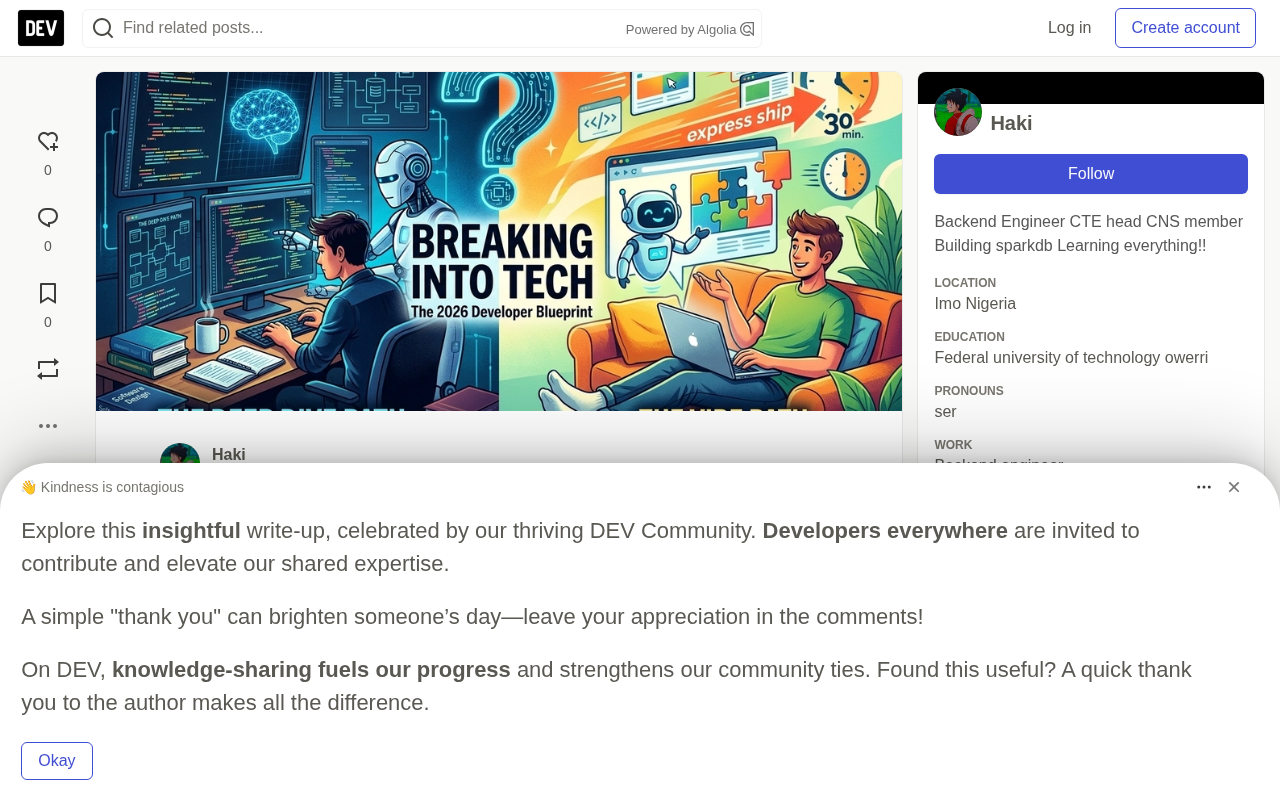
Two Paths: Deep Dive vs. Vibe Coding
If you're interested in breaking into tech, there are two paths you can take, each with its own appeal.
The Deep Dive Path
If you have the time and the courage, you can watch tutorials, learn what you need to learn, then start building on your own, using AI as a partner (tool). This path requires a great deal of persistence and patience.
- Start with a high-level overview
- Then maybe follow a tutorial
- Branch out from the tutorial into hands-on projects
- Keep learning
- Build more things on your own
- Explore the AI toolchain
This path is especially suited for people who want to land a job at a software company. You need to understand software systems, design, architecture, and so on—essentially, you're learning software engineering itself.
The Vibe Coding Path
In the other scenario, you don't really care about coding, programming, or how the system works underneath. You just want the system itself.
This path appeals to most people because you can build a complete website in 30 minutes, whereas the deep path might take a week or even several weeks. The main advantage is fast delivery—and the main disadvantage is also fast delivery. And what you deliver is mostly garbage (we call it "slop").
Maybe you're a business owner who doesn't want to pay $700 for a developer to build a simple inventory system, and you figure you can handle it yourself. Sure you can.
"Vibe Coding" is the term used to describe a kind of aggressive agentic development—where the developer doesn't understand code, or at least isn't interested in it.
But here's the problem: building a system is one thing. Building a reliable, excellent system is something else entirely—and most of the time, it's extremely hard.
Vibe Coding was coined by AI researcher Andrej Karpathy in early 2025 to describe a brand-new way of programming: developers no longer hand-write code line by line, but describe their intent to a large language model in natural language, letting the model generate the code. Developers can even skip reading the generated code entirely, deciding whether to accept it based purely on whether it runs. Its emergence relies on the maturity of agentic tools like Cursor, Claude Code, Lovable, and v0.dev—tools that don't just autocomplete code, but can also read files, run commands, and call APIs to autonomously complete multi-step tasks.
Vibe Coding's value lies in compressing the path from "idea to product" into a matter of minutes, making it especially well-suited for prototype validation, internal tools, and solo entrepreneurs. But it also has clear weaknesses: the security, performance, and maintainability of generated output are all unguaranteed; as the system grows, the model's understanding of context degrades, and bugs accumulate in ways that are hard to pin down. That's why the industry widely believes that only people who grasp "foundational concepts + key decisions" can turn Vibe Coding from a toy into a productivity tool—otherwise, it's just a fast way to manufacture technical debt.
How to Avoid Producing "Slop"
So how can you vibe code without producing AI garbage (the kind that crashes easily)?
Simple: just learn the fundamentals.
Want to build a website? Learn an overview of how websites are put together: front end, back end, database. That way, you can tell AI what to use and what to do—instead of being commanded by AI.
You're not learning programming. You're learning infrastructure.
"Slop" originally was English internet slang referring to low-quality AI-generated content (like articles or images), later extended into software to describe AI-generated code that runs but is fragile, that no one dares to modify, and that crashes at any moment. Its typical traits include: no error handling, hardcoded secrets, chaotic dependency versions, lack of tests, arbitrary naming, and hidden gaps between logic and requirements.
Slop is dangerous because it looks perfectly fine during a demo, and problems often only surface after launch—when user volume rises, edge cases appear, or dependencies get upgraded. The key to avoiding slop isn't banning AI from writing code, but establishing "acceptance criteria": clarifying data flow, defining interface contracts, requiring tests on critical paths, and regularly auditing dependencies and permissions. A person who understands the skeleton of a system can quickly judge "can this piece be used?" after AI delivers it—which is exactly the point of this article: in the AI era, what's truly scarce isn't the hand that writes code, but the brain that judges whether the code is correct.
The Key Turn: Both Paths Are Software Engineering
These two paths are obviously quite different, but the twist is this: done well, both are software engineering.
So what are you waiting for? After reading this article, you're perfectly capable of creating your first website. No laptop? Search for Lovable or v0.dev. Go online and find learning materials.
The author left contact information in the original post, offering free help and encouraging readers to go build something right away.
Whichever path you choose, the core skill has shifted from "writing code" to "making decisions." Understanding the skeleton of a software system matters more than memorizing syntax. You don't have to know how to program, but you must understand what you're building and why you're building it that way. That's the real ticket into the AI era.
One-line Summary
In the AI era, the key to breaking into tech has shifted from writing code to making infrastructure decisions.
Paragraph Summary
The article points out that the barrier to entering the tech industry has changed: what used to be a contest of "who writes better code" is now about "who makes better infrastructure decisions"—deciding what software should do and how. The author offers two paths: the deep dive path, suited for those aiming for employment, requires long-term learning of systems, design, and architecture; the vibe coding path, suited for those who just want to ship a system fast, uses AI to build a website in 30 minutes, but risks producing fragile "slop." The way to avoid slop isn't mastering syntax, but learning the fundamentals like front end, back end, and databases—gaining the upper hand over AI. Done well, both paths count as software engineering, and the real ticket in is understanding systems, not writing code.
Related articles

GPT-Next Leak, Gemini 4 Argon Imminent: AI News Roundup
GPT-Next leak suggests extreme efficiency; OpenAI's 28-day shipping pledge boosts speed 50%; Gemini 4 Argon nears release; Anthropic subscription value report sparks debate.

GPT-Next Leaked, Gemini 4 Argon Speeds Up, Fable 5.5 May Launch Today
OpenAI's GPT-Next model leaks, expected to be extremely low-cost and possibly part of the 28-day release plan; Gemini 4 Argon internal testing accelerates, NanoBanana 2.1 is live; Semi Analysis tests show Claude Max's equivalent API value is about 5 times that of ChatGPT Pro; Fable 5.5 may launch today.

Gemini 4 Argon Launches Globally: Key Highlights from the AI Daily Brief
Google opens Gemini 4 Argon globally across Pro and Ultra subscriptions and the API, and demonstrates robot control. This article rounds up open-source models, Agent infrastructure, cost transparency, and safety governance updates.