Breaking Strong Convexity Limits: New Advances in Newton-Type Bilevel Optimization

Newton GALET, Newton BAMM, and unified GNBO break lower-level strong convexity limits in bilevel optimization.
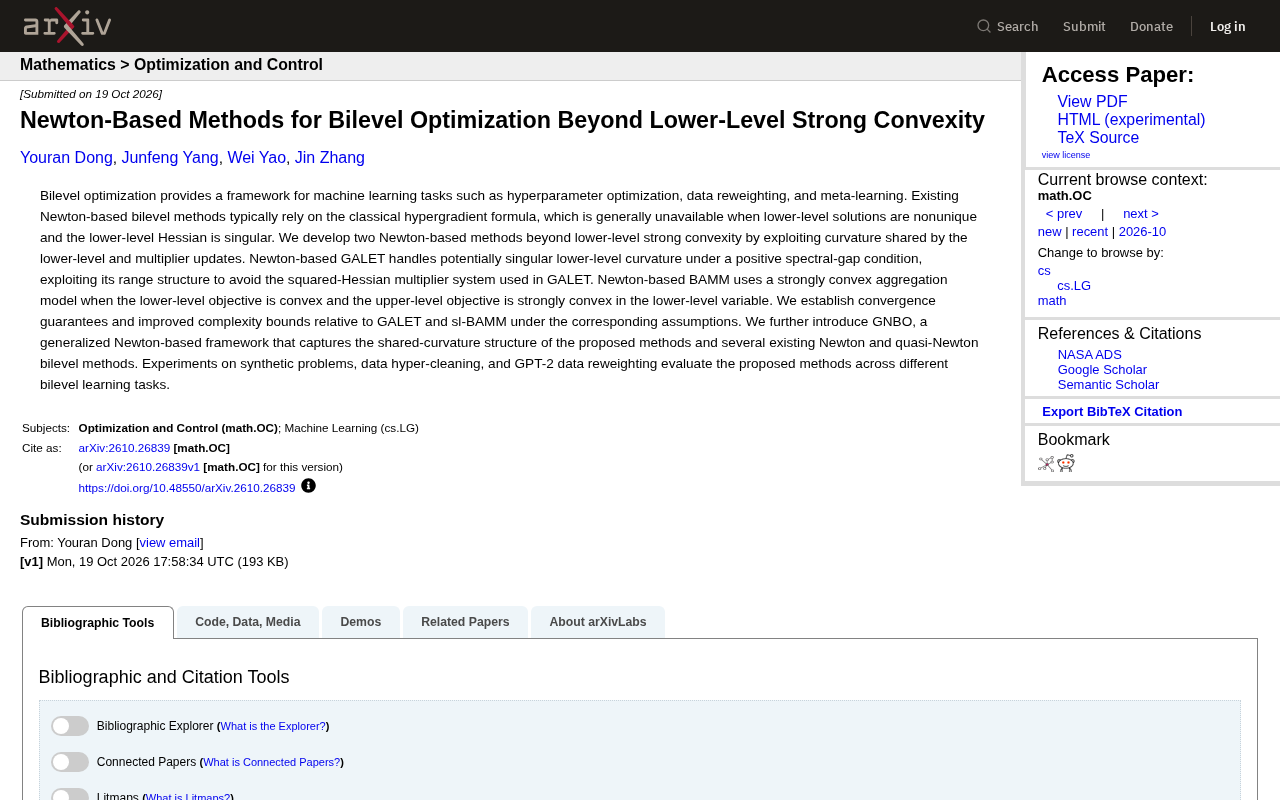
The article reviews new Newton-type bilevel optimization methods that go beyond lower-level strong convexity. Newton GALET handles singular curvature under a positive spectral gap, while Newton BAMM uses a strongly convex aggregated model with better complexity than sl-BAMM. A unified GNBO framework captures shared curvature structure, with convergence guarantees and experiments on data overcleaning and GPT-2 reweighting.
Bilevel optimization is an important framework in machine learning for tasks such as hyperparameter optimization, data reweighting, and meta-learning. Traditional Newton-type bilevel methods rely on the classical hypergradient formula, but this formula often fails when the lower-level problem's solution is non-unique or when the lower-level Hessian is singular. A recent paper proposes two Newton-type methods that go beyond lower-level strong convexity and introduces a unified framework, GNBO, achieving advances in both theory and experiments.
Limitations of traditional Newton methods and the breakthrough
Existing Newton-type bilevel methods usually assume the lower-level problem is strongly convex, which guarantees a unique lower-level solution and an invertible Hessian. However, in practice the lower-level problem may be merely convex or even nonconvex, leading to non-unique solutions or a singular Hessian, so the classical hypergradient formula no longer applies. This work exploits the curvature structure shared by the lower-level update and the multiplier update to design two new methods that break the strong convexity restriction.
Hypergradient is a core concept in bilevel optimization, referring to the derivative of the upper-level objective with respect to the hyperparameters. The classical hypergradient formula is typically obtained by implicitly differentiating the lower-level optimality conditions, and its form depends on the inverse of the lower-level Hessian. When the lower-level Hessian is singular (i.e., non-invertible), this formula is undefined, causing traditional methods to fail. Moreover, if the lower-level problem has non-unique solutions, the hypergradient may not exist or may depend on the choice of solution, further compounding the computational difficulty. Therefore, going beyond the strong convexity assumption requires new mathematical tools to handle these degenerate cases.
Two new methods: Newton versions of GALET and BAMM
Newton GALET: handling singular curvature
The Newton version of GALET targets the case where the lower-level curvature may be singular. Under a positive spectral gap condition, it exploits the range-space structure to avoid the squared-Hessian multiplier system used in GALET. The positive spectral gap condition requires a gap between the nonzero and zero eigenvalues of the lower-level Hessian, allowing the algorithm to update effectively even in singular cases.
The positive spectral gap condition means there is a positive lower-bound gap between the nonzero eigenvalues and the zero eigenvalues of the lower-level Hessian. This condition is weaker than strong convexity, because it allows the Hessian to be singular (having zero eigenvalues) but requires the nonzero eigenvalues to be bounded away from zero. Under the positive spectral gap condition, one can use the range space and null space decomposition of the matrix to restrict the problem to the subspace corresponding to the nonzero eigenvalues, thereby avoiding direct inversion of a singular matrix. This condition may hold when the lower-level problem is convex but not strongly convex (e.g., overparameterized models), providing a theoretical window for algorithm design.
Newton BAMM: strongly convex aggregated model
The Newton version of BAMM applies to settings where the lower-level objective is convex and the upper-level objective is strongly convex in the lower-level variables. It uses a strongly convex aggregated model to ensure the multiplier update is well-defined. Compared with sl-BAMM, the new method has improved complexity bounds under the corresponding assumptions.
The aggregated model in bilevel optimization usually refers to replacing the lower-level problem with a strongly convex quadratic function or approximate model to ensure the well-posedness of the multiplier update (dual variable update). Specifically, BAMM (Bilevel Approximate Multistep Method) constructs a strongly convex aggregated objective that couples the lower-level variable update with the multiplier update, so that the multiplier subproblem remains solvable even when the lower-level problem is not strongly convex. The Newton version of BAMM further exploits curvature information to accelerate convergence and, under the assumption that the upper-level objective is strongly convex in the lower-level variables, obtains a better complexity bound than sl-BAMM (single-loop BAMM).
Unified framework GNBO
The study further proposes a generalized Newton bilevel optimization framework, GNBO, which captures the shared curvature structure of the proposed methods and several existing Newton and quasi-Newton bilevel methods. GNBO provides a unified perspective for understanding and designing Newton-type bilevel algorithms, helping to analyze convergence and complexity.
Quasi-Newton methods in bilevel optimization reduce computational cost by approximating the inverse of the Hessian; common strategies include BFGS updates or finite-difference approximations. The GNBO framework unifies Newton-type and quasi-Newton-type methods into a generalized form with a shared curvature structure, where the curvature structure refers to how the matrices involved in the lower-level update and the multiplier update (such as the Hessian or its approximation) are related. This framework allows analyzing the impact of different approximation strategies on convergence and provides a modular perspective for designing new algorithms. For example, Newton GALET and Newton BAMM can be viewed as instances of GNBO under specific curvature approximations, while quasi-Newton variants are obtained by substituting the curvature matrix.
Theoretical guarantees and experimental validation
The authors establish convergence guarantees for both methods and provide improved complexity bounds relative to GALET and sl-BAMM under the corresponding assumptions. Experiments are conducted on synthetic problems, data overcleaning, and GPT-2 data reweighting tasks, evaluating the proposed methods across different bilevel learning tasks.
Multi-source cross-validation
According to analyses from Bilibili UP hosts and YouTube channels, this work aligns with the recent trend in bilevel optimization toward non-strongly-convex lower-level problems, but there is disagreement on the extent to which the positive spectral gap condition is satisfied in practical tasks. A unique insight from a single source points out that the GNBO framework may have inspired the design of subsequent quasi-Newton methods.
Overall, this study provides new Newton-type tools for bilevel optimization beyond strong convexity, broadening the application prospects of bilevel optimization in complex machine learning tasks.
One-line Summary
Proposes Newton GALET and Newton BAMM plus the unified framework GNBO, breaking the lower-level strong convexity restriction in bilevel optimization.
Paragraph Summary
This article reviews recent advances in Newton-type methods for bilevel optimization. Traditional Newton methods rely on the hypergradient formula, requiring the lower-level problem to be strongly convex and the Hessian invertible; they fail when the lower-level solution is non-unique or the Hessian is singular. Recent research proposes two new methods: Newton GALET handles singular curvature under a positive spectral gap condition by exploiting range-space structure to avoid the squared-Hessian multiplier system; Newton BAMM applies when the lower level is convex and the upper level is strongly convex in the lower-level variables, using a strongly convex aggregated model to ensure well-defined multiplier updates with better complexity than sl-BAMM. In addition, the study introduces a unified framework GNBO covering various Newton and quasi-Newton methods with a shared curvature structure perspective. Theoretical analysis establishes convergence guarantees and improved complexity bounds, and experiments on synthetic problems, data overcleaning, and GPT-2 data reweighting validate effectiveness. This work broadens the application prospects of bilevel optimization in non-strongly-convex settings.
Related articles

Free Unlimited Claude Code Solution: Agnes AI + CC Switch Setup Guide
No paid subscription needed — pair the free AI platform Agnes AI with the open-source tool CC Switch to provide a backend for Claude Code, enabling unlimited free calls to text, image, and video models. This guide covers the full setup, test results, and usage boundaries.

A Complete Zero-Cost Guide to Getting Started with Claude Code for Beginners in China
A beginner's guide to Claude Code for users in China: two installation methods (command line and IDE plugin), full configuration steps for replacing the official API with the free domestic LongCat model, and a hands-on demo of building a small tool with natural language, plus tips.

When the NSA Gets Involved: The AI Supply Chain Crisis Behind Open-Source CVEs and API Key Hijacking
Multiple open-source projects disclosed severe CVEs in one day, PHP flaws alarmed the FBI, and Railway and OpenCode were breached with API keys stolen. This article breaks down the vulnerability window, AI-accelerated exploitation, and the AI supply chain crisis behind the API key black market, with a developer defense checklist.