Brickbrag: A Multiplayer Online Brick-Building World in the Browser

Brickbrag is a browser-native multiplayer online brick-building project, with low-barrier collaboration as its core bet.
Brickbrag is a new project on the Hacker News Show HN board, positioned as a multiplayer brick-building world running in the browser, where opening the webpage lets you enter a shared space and build together with others. The article analyzes its three major elements — browser, multiplayer, and brick building — and points out the advantages brought by web-first development, such as low distribution barriers, cross-platform access, and natural collaboration. It also highlights two major technical challenges of multiplayer online building: state synchronization and conflict handling for large numbers of bricks, and rendering performance optimization. The "brag" in the project name suggests that social and work-display features may be an important direction, but as of now public information is limited, and its technical route and long-term positioning remain to be seen.
When Bricks Meet the Browser: Brickbrag Wants to Be More Than Just Building
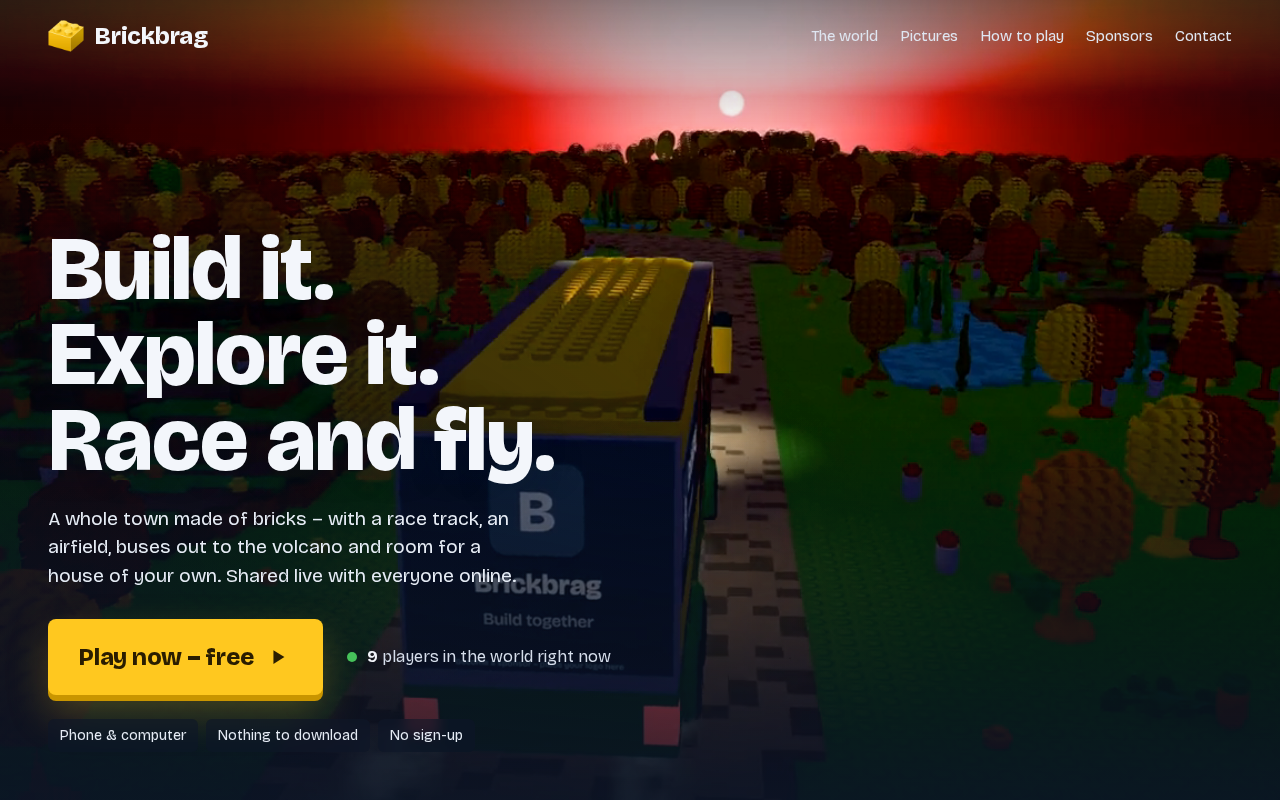
On the Hacker News Show HN board, a project called Brickbrag was submitted: it defines itself as a "multiplayer brick-building world that runs in the browser." No client download, no complicated environment setup — just open the webpage and step into a shared virtual space where you can assemble bricks into buildings, scenes, or anything else you can imagine, together with other people.
That description sounds modest, but the trend it points to is worth discussing — real-time collaboration, lightweight entry points, and creative gameplay are all being packed into a single browser tab.
What Is Brickbrag?
From the project's own description, Brickbrag has three core elements: browser, multiplayer, and brick building.
Brick building itself is not a new concept. From physical building blocks to various sandbox construction games, players are already familiar with the gameplay logic of "assembling complex structures from basic modules." Brickbrag's differentiation lies in moving this into the browser and emphasizing simultaneous multiplayer online presence. This means two things need to be solved at the same time: first, how to smoothly render large numbers of brick units on the web; second, how to synchronize multiple players' actions into each other's screens in real time.
The answer to the former usually involves browser graphics interfaces like WebGL or WebGPU, while the latter involves choosing a network synchronization model — whether to let the server make authoritative judgments, or adopt a lighter-weight state broadcast. For a Show HN project, the technical choices often determine how far it can go.
The difference between WebGL and WebGPU: WebGL is the previous generation of browser graphics standards, based on OpenGL ES, and is supported by almost all modern browsers; WebGPU is the new generation standard currently being rolled out, closer to the low-level models of Vulkan/Metal/DirectX 12, and capable of providing lower CPU overhead and stronger parallel computing power. For applications like brick building that need to render thousands of small objects, WebGPU's instanced rendering and compute shaders can significantly reduce the number of draw calls per frame, allowing the scene to run more stably in the browser.
Authoritative servers and state broadcasting: Multiplayer synchronization usually has two common models. In the authoritative server model, all actions are first sent to the server, which adjudicates and broadcasts the final state, while clients only display it. The advantage is anti-cheating and high consistency, at the cost of a feeling of latency in actions; in the state broadcast model, clients execute locally first and then send changes to others. The response is faster, but additional reconciliation logic is needed during conflicts or network jitter. Every add, delete, or modify in brick building is a discrete event, so both models can work. The trade-off lies in whether the project cares more about real-time feel or eventual consistency.
The Appeal of the Browser as a Creative Platform
Over the past few years, the browser has been transforming from "a tool for displaying documents" into "a platform for running applications." The continuous enhancement of graphics, computing, and networking capabilities has led more and more creative tools to choose web-first.
For applications like brick building, web-first has several natural advantages. Low distribution barrier — sharing a link lets others enter the world you built, without requiring them to install anything. Cross-platform — desktop, tablet, and mobile can all access it as long as the browser supports it. Collaboration comes naturally — the network is already the browser's home turf, and multiplayer synchronization feels more like following the infrastructure than building wheels against it.
By choosing this direction, Brickbrag is essentially betting that "low-barrier multiplayer creation" is more attractive than "high-fidelity single-player experience."
Technical Challenges of Multiplayer Online Building
Putting "multiplayer" and "bricks" together multiplies the problems.
Brick building means the number of objects in the scene can be enormous. Every brick has state such as position, rotation, and material. When multiple players add, delete, or modify these bricks at the same time, the server needs to handle a large number of state changes and conflicts. If instant synchronization is used, network jitter and latency will be directly reflected on screen; if some form of optimistic update is used, rollback and consistency issues must be handled.
Another challenge is rendering performance. Although the browser's graphics pipeline is becoming stronger, once the number of bricks reaches a certain scale, optimization techniques such as batching, culling, and instanced rendering become necessary. If done poorly, the screen will stutter, and stuttering is fatal in multiplayer collaboration scenarios — it is hard to interact with a world that responds sluggishly.
There are no standard answers to these problems. Every project makes trade-offs according to its own goals. Brickbrag has limited public information so far, and its specific technical route needs more details before it can be judged.
Batching, culling, and instanced rendering: In the browser graphics pipeline, every additional draw call adds CPU overhead. Batching combines objects with similar materials or states into a single draw; culling skips objects outside the view or invisible in advance to avoid wasted rendering; instanced rendering replicates the same geometry many times and distinguishes properties such as position and color only through per-instance parameters — bricks are exactly the typical case of "the same shape repeated many times," and instancing often brings framerate improvements of several times to dozens of times. These three optimizations usually need to be used together so that the screen remains smooth after the number of bricks increases.
Where It Might Go
The development path of brick-building projects usually depends on whether they focus on "building" or "social."
If the focus is on building, then the completeness of the toolchain is key: is there undo/redo, copy/paste, templates and asset libraries, can works be exported. These features determine whether creators are willing to stay.
If the focus is on social, then how the world is organized becomes important: do all people share one large world, or is it divided into rooms? Are there role distinctions between visitors and builders? Can you spectate others' works, like them, or leave comments?
The name Brickbrag includes "brag," which may hint that social attributes will be part of it — what you build is ultimately meant to be shown to others. If that is the case, then the mechanisms for displaying, sharing, and discovering works may be more worth attention than the bricks themselves.
Common feature layers of building tools: Whether a brick-building tool can retain creators often depends on whether it has completed the "editing experience." The basic layer includes undo/redo, copy/paste, and box-select movement; the advanced layer includes layers or grouping, alignment snapping, and templates and asset libraries; the output layer includes exporting models or screenshots, publishing to public worlds, and browsing others' works. Projects with strong social attributes also add visitor permissions, likes and comments, and work discovery pages. The word "brag" in Brickbrag's name means that the output layer and discovery page may determine its long-term appeal more than simple building features.
Summary
Brickbrag is currently still just a new project on Show HN, with low discussion heat and limited public details. But the direction it represents — browser-native, multiplayer online, creative gameplay — is exactly at the intersection of several current evolutions in web applications. Whether it can take off depends on whether the technical implementation is solid and whether it can find a group of users willing to keep building and sharing in it.
For people interested in web graphics, real-time collaboration, or creative tools, this is a project worth adding to the watchlist.
One-line Summary
Brickbrag is a browser-native multiplayer online brick-building project, with low-barrier collaboration as its core bet.
Paragraph Summary
Brickbrag is a new project on the Hacker News Show HN board, positioned as a "multiplayer brick-building world that runs in the browser," where opening the webpage lets you enter a shared space and build together with others. The article analyzes its three major elements — browser, multiplayer, and brick building — and points out the advantages brought by web-first development, such as low distribution barriers, cross-platform access, and natural collaboration. It also highlights two major technical challenges of multiplayer online building: state synchronization and conflict handling for large numbers of bricks, and rendering performance optimization. The "brag" in the project name suggests that social and work-display features may be an important direction, but as of now public information is limited, and its technical route and long-term positioning remain to be seen.
Related articles

Uber Deploys ChatGPT Work Company-Wide: AI in the Workplace Enters the Scaled Implementation Phase
Uber deploys ChatGPT Work to 30,000+ employees, extending it from engineering to all roles. We analyze its expert-engineer pairing, end-to-end automation, and questions of AI control and power concentration—insights for scaling AI in the workplace.

Shift at Midnight Hands-On: When "ID Verification" Becomes Alien Hunting
Shift at Midnight blends ID verification with horror survival in a four-player co-op game. We break down its inspection mechanics and chaotic humor.

Zelensky Recounts the Outbreak of War: I Need Ammunition, Not a Ride
Zelensky recalls the first day of war in a YouTube interview: farewell to family, rejecting Biden's evacuation offer with "I need ammunition, not a ride," and how Bucha shaped his stance on compromise and peace talks.