Bridging TODO and Calendar: A Complete Guide to CalDAV Task Synchronization

A complete guide to syncing plain-text .TODO files with calendar apps via CalDAV protocol.
This guide explores how developers can bridge the gap between VSCode .TODO files and calendar applications using CalDAV protocol. It analyzes three viable approaches — iCalendar format conversion, native VTODO tools like Nextcloud Tasks, and self-hosted Radicale sync bridges — while examining the deeper challenge of tool fragmentation in developer workflows.
A Real Developer's Frustration
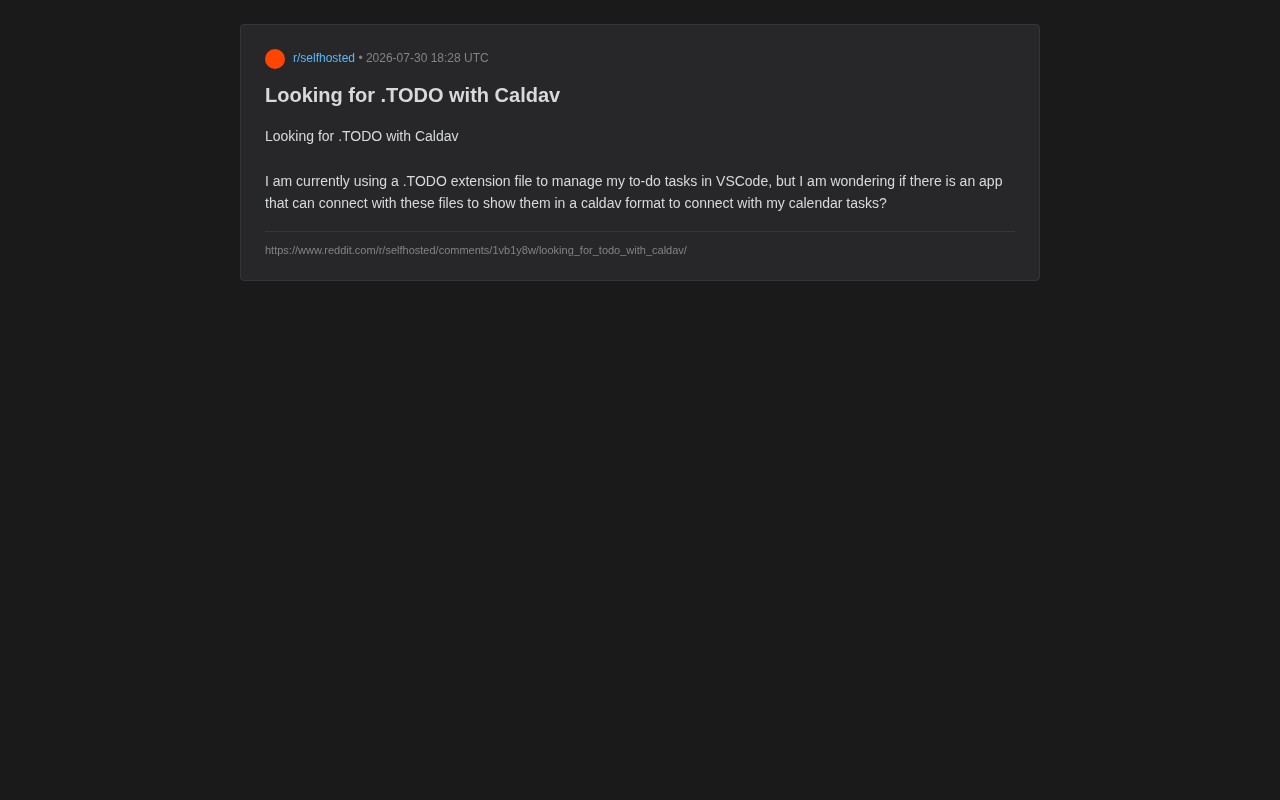
In day-to-day development work, task management is an unavoidable topic. Recently, a developer raised a highly representative question on Reddit: they habitually use .TODO extension files in VSCode to manage their to-do items, but wanted to find an application that could connect these files to a calendar via CalDAV format, achieving unified management of tasks and schedules.
This seemingly simple request actually touches on a long-standing pain point in the modern productivity tool ecosystem — the data silo problem between different tools. A developer's task information is scattered across code editors, calendar apps, project management platforms, and other systems, lacking a unified view.
Understanding the Technical Logic Behind the Need
What Are .TODO Files
.TODO is a lightweight plain-text task management format commonly found in extension plugins for editors like VSCode. Its advantage lies in tight integration with code repositories — developers can record to-do items directly within a project, with task information version-controlled alongside code, without needing to switch to external applications.
This "manage where you work" approach is extremely developer-friendly, but it also brings limitations: these tasks are "trapped" inside the editor, unable to interact with team calendars or time planning tools.
It's worth noting that the concept of integrating task management into version control systems has a deeper tradition. Early distributed bug tracking systems like Bugs Everywhere (2005) and git-bug attempted to store issues directly in Git repositories. The todo.txt format (created by Gina Trapani in 2006) established a widely recognized plain-text task management syntax, including priority markers (A-Z), project tags (+project), and context tags (@context). Together, these practices form part of the "Plaintext Productivity" movement, whose core belief is that data should be stored in human-readable formats, not locked into any specific software. .TODO files are a contemporary continuation of this philosophy.
The Role of CalDAV Protocol in Task Synchronization
CalDAV is an open standard protocol based on WebDAV, used for synchronizing calendar and task data between clients and servers. It's widely used in mainstream tools like Apple Calendar, Thunderbird, and Nextcloud. CalDAV supports not only events (VEVENT) but also to-do items (VTODO) components.
From a technical lineage perspective, the CalDAV protocol builds upon WebDAV (Web-based Distributed Authoring and Versioning), which itself is an extension of the HTTP protocol. WebDAV was originally standardized by the IETF in 1999 through RFC 2518, designed to allow users to remotely manage files via web protocols. CalDAV (RFC 4791, published in 2007) adds calendar-specific semantics on top of this, using the iCalendar (RFC 5545) data format to represent events and tasks. This layered protocol design embodies the evolutionary philosophy of internet standards — extending new functionality on existing infrastructure rather than reinventing the wheel.
In the iCalendar specification, VTODO is a core component type alongside VEVENT (events) and VJOURNAL (journals). A typical VTODO entry contains fields such as SUMMARY (title), DESCRIPTION (description), DTSTART (start time), DUE (due date), PRIORITY (priority, an integer from 1-9), STATUS (status, such as NEEDS-ACTION, IN-PROCESS, COMPLETED), and PERCENT-COMPLETE (completion percentage). This structured representation allows different clients to consistently interpret and manipulate task data, but it also means that converting from free-form plain text to VTODO requires explicit field mapping rules.
This means that, theoretically, tasks in .TODO files can be perfectly mapped to a CalDAV server via the VTODO format, enabling display and management in any CalDAV-supporting calendar client. This developer's idea is entirely technically sound.
Analysis of Real-World CalDAV Task Sync Solutions
The Absence of Direct Integration Tools
Unfortunately, there is currently no mature application on the market that can directly convert VSCode's .TODO files to CalDAV format in real time. The reasons are:
- The
.TODOfile format itself is not a standardized protocol, and syntax varies between plugins; - Semantic mapping from plain-text tasks to VTODO components requires custom parsing logic;
- Bidirectional synchronization (editing in the calendar and writing back to the file) introduces complex conflict handling issues.
The complexity of bidirectional synchronization deserves further elaboration. Bidirectional Sync is one of the most challenging problems in distributed systems. When a user modifies the same task simultaneously in a .TODO file and a calendar client, the system needs to handle conflict detection, conflict resolution, and state merging. The CalDAV protocol implements optimistic concurrency control through ETags (entity tags) and If-Match conditional requests, but this only solves the server-side problem. On the plain-text file side, there's no similar version marking mechanism, meaning change detection can only rely on file modification timestamps or content hash comparisons, which in multi-device sync scenarios can easily lead to data loss or duplication. This is the fundamental reason why most similar tools ultimately can only provide one-way synchronization.
Three Viable Alternative Paths
For developers with this type of need, the following approaches are worth considering:
Option 1: Conversion via iCalendar Intermediate Format
You can write a lightweight script to parse .TODO files and generate standard .ics (iCalendar) files, where each task corresponds to a VTODO entry. Then place the .ics files in the corresponding directory of a CalDAV-supporting server (such as Nextcloud or Radicale), and they become viewable in calendar clients.
The key to this approach is establishing accurate field mappings. For example, priority markers in .TODO files need to be converted to VTODO's PRIORITY values (1 being highest, 9 being lowest), task completion status markers need to map to the corresponding STATUS property values, and date information in task descriptions needs to be parsed into DTSTART or DUE properties conforming to ISO 8601 format.
Option 2: Use Task Tools with Native VTODO Support
Some applications with native CalDAV task sync support, such as Tasks.org (Android), GNOME To Do, and Nextcloud Tasks, can directly manage VTODO entries. Developers can abandon .TODO files and use these tools as a unified entry point instead.
Option 3: Self-host a Radicale Sync Bridge
Using a lightweight CalDAV server like Radicale, combined with scheduled tasks (such as cron) that periodically scan .TODO files and convert them for writing, you can achieve near-real-time one-way synchronization. This requires some hands-on skills but offers the highest flexibility.
Radicale is a lightweight CalDAV/CardDAV server written in Python, designed with a minimalist philosophy. Unlike full-featured collaboration platforms like Nextcloud, Radicale's core code is only a few thousand lines, doesn't depend on a database (using filesystem storage by default), and is extremely easy to install and configure. It stores each calendar collection as a directory and each event or task as an independent .ics file. This transparent storage structure allows external scripts to directly manipulate files to create or modify calendar entries, making it ideal as an intermediate node in automated workflows. For the scenario discussed in this article, a developer only needs to write a script that parses .TODO files and generates corresponding .ics files, writing the output to Radicale's collection directory to automatically complete the synchronization.
Deeper Reflections: The Integration Trend in Developer Toolchains
The Fragmentation Dilemma of Developer Productivity Tools
This developer's confusion is not an isolated case but reflects the fragmented state of the entire developer tool ecosystem. Code lives in Git repositories, tasks in editor plugins, schedules in calendar apps, and communication in instant messaging software — each tool excels at its specialty, but there's a lack of smooth data flow between them.
Open protocols (such as CalDAV, CardDAV, iCalendar) exist precisely to break down these silos. However, the existence of a protocol doesn't equal an out-of-the-box product experience — there's often a need for developers to "build bridges" themselves. This phenomenon is pervasive throughout the open-source ecosystem — standards provide the possibility of interoperability, but the "last mile" products that transform possibility into a smooth experience are often the scarcest.
The Trade-off Between Standardization and Flexibility
The popularity of .TODO files demonstrates developers' strong preference for "local, lightweight, version-controllable" task management. CalDAV, on the other hand, represents an alternative value orientation of "standardized, syncable, cross-platform." The difficulty in merging the two is essentially the eternal contradiction between flexibility and standardization.
The truly ideal solution might be a middleware tool that seamlessly maps local plain-text tasks to standard protocols — one that preserves developers' familiar workflows while opening connections to external calendars. Such a tool remains a market gap and represents a potential product opportunity. Similar design approaches have already appeared in other domains: for example, Obsidian achieves knowledge management through local Markdown files while connecting to various external services through its plugin ecosystem; and Syncthing implements file synchronization without requiring a central server. A "protocol adaptation layer" for developer task management could readily draw from these products' design paradigms.
Conclusion
Starting from a developer's simple question, we've seen the deep challenges within the modern productivity tool ecosystem. While there's no ready-made "silver bullet" solution at present, this need is entirely achievable through iCalendar intermediate format conversion or self-hosted CalDAV bridging.
For efficiency-minded developers, understanding the capabilities of open protocols like CalDAV is often more important than finding a perfect application. Because in an era of tool fragmentation, mastering the underlying protocols means taking control of integrating your own workflow.
Related articles
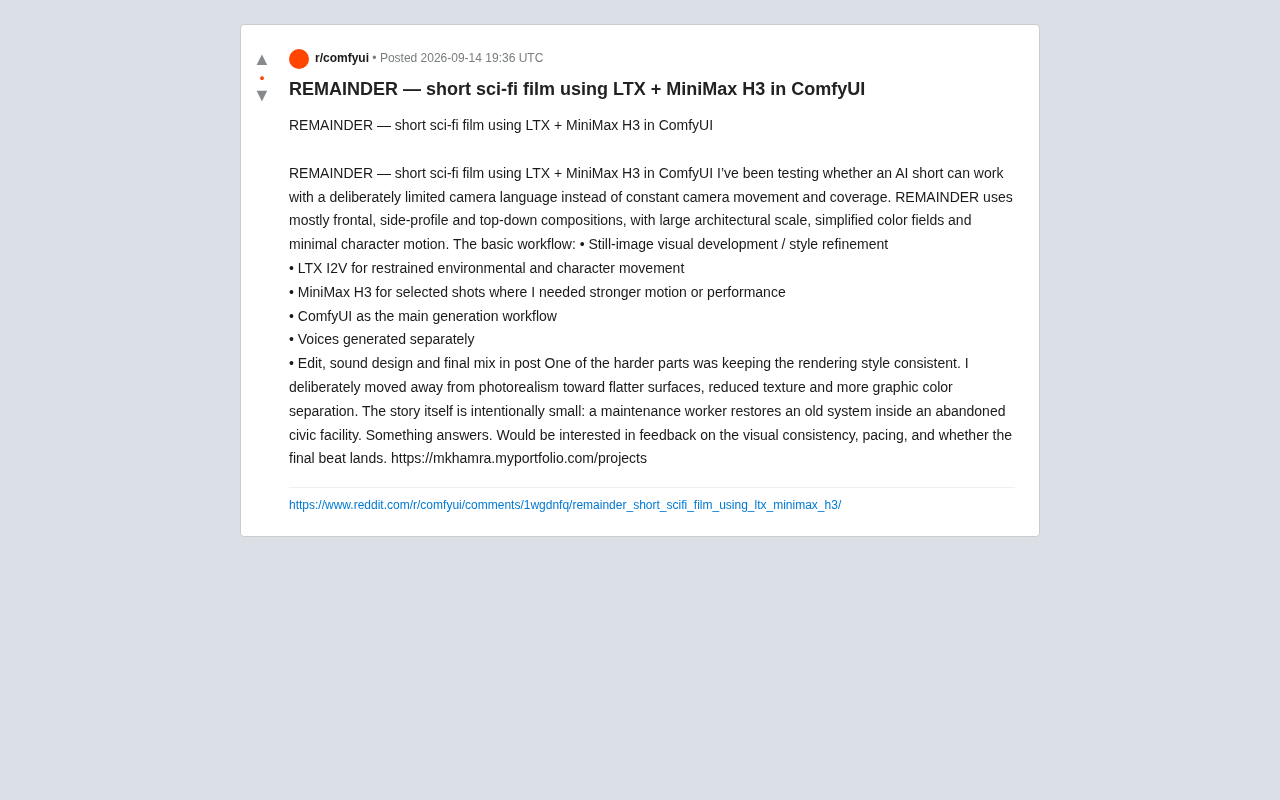
Building an AI Sci-Fi Short with LTX + MiniMax H3: Restrained Cinematography in ComfyUI
Sci-fi short REMAINDER uses LTX, MiniMax H3, and ComfyUI with restrained cinematography and flat aesthetics to solve visual consistency in AI filmmaking.
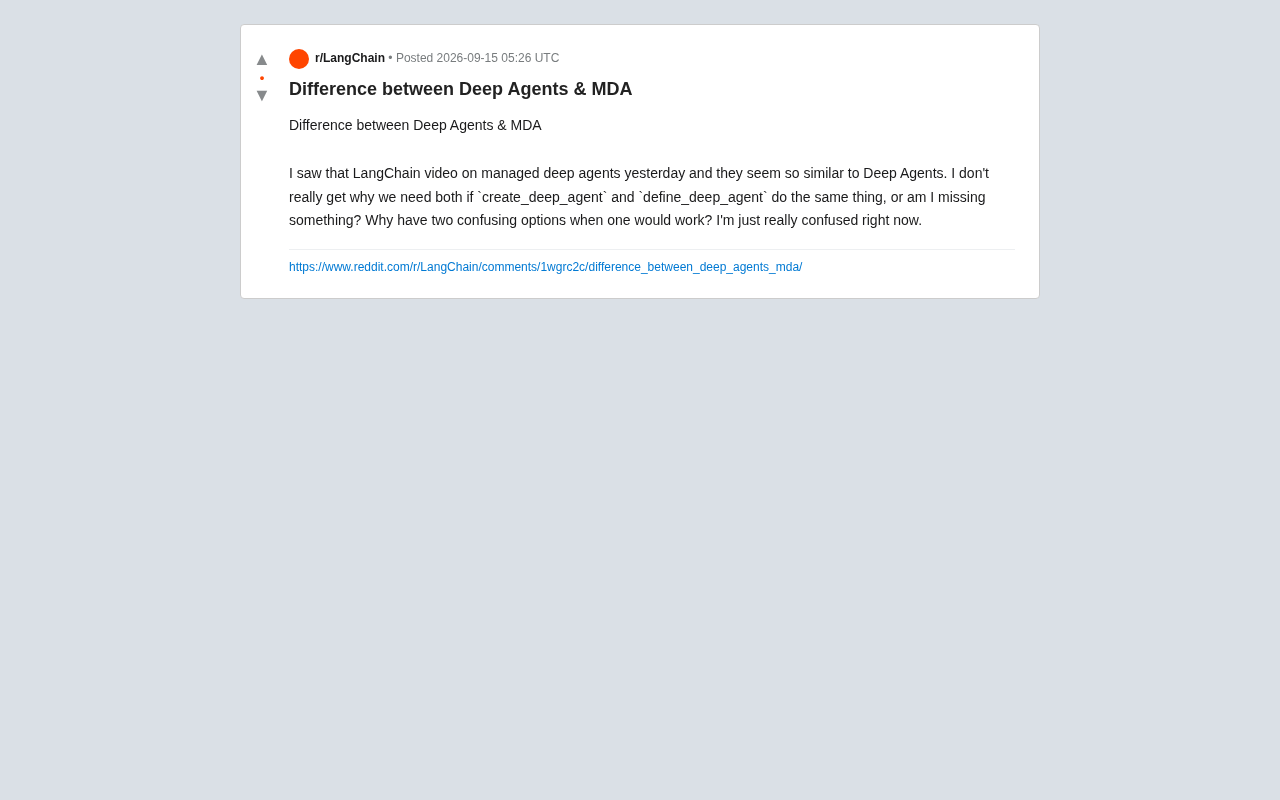
LangChain Deep Agents vs. MDA: Clearing Up the Confusion for Developers
What's the difference between LangChain's Deep Agents and MDA (Managed Deep Agents)? We break down create_deep_agent vs. define_deep_agent and help developers choose.
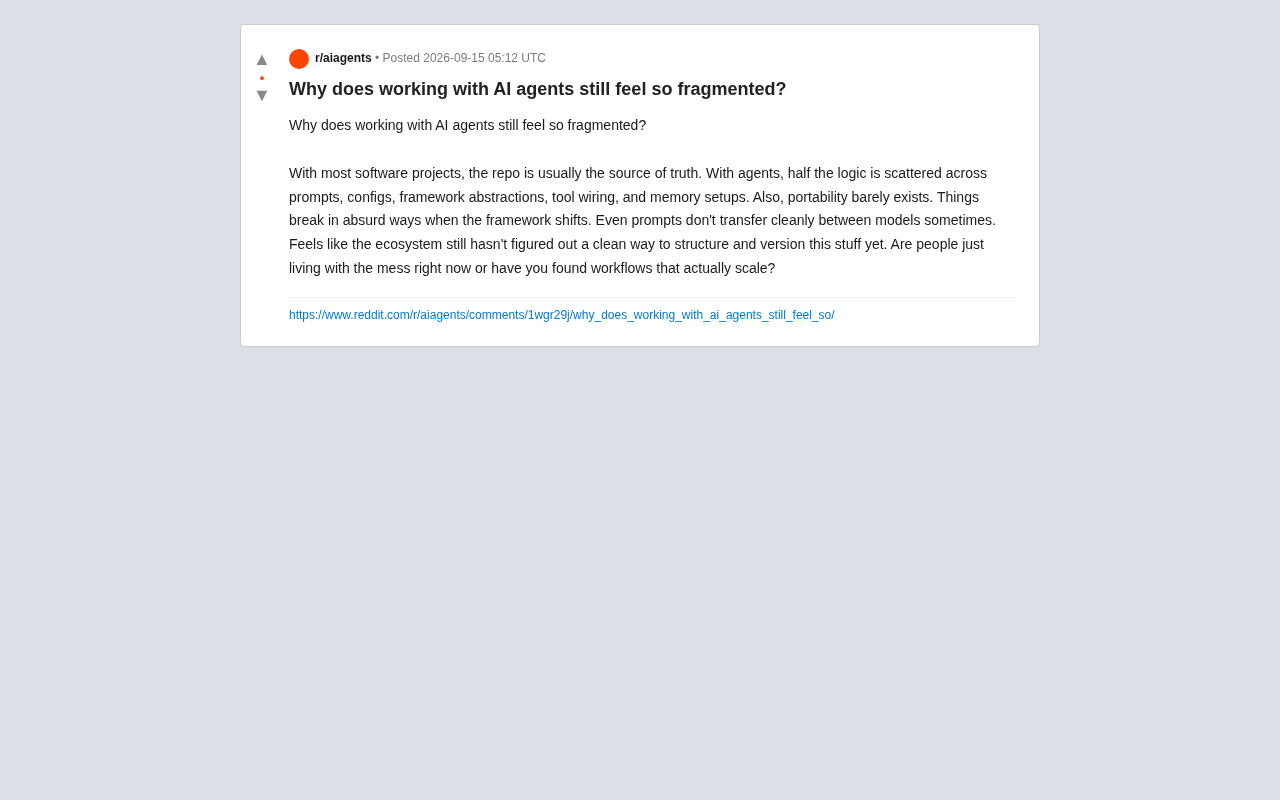
Why Is AI Agent Development So Fragmented? The Real Causes and How to Work Around Them
Why does AI Agent development feel so fragmented? Logic scattered across prompts, configs, and frameworks makes portability nearly impossible. Here's why — and how to cope.