Building a 500K Domain Search Engine for $10: Lessons from an Indie Developer's Weekend Project

How one developer built a 500K domain search engine in a weekend for just $10.
An indie developer demonstrated that building a 500K domain search engine is possible in a single weekend for $10, leveraging serverless computing, open-source search tools, and publicly available domain datasets. The project highlights the growing opportunity in vertical search engines that serve niche communities, and exemplifies the "ship fast, iterate later" philosophy enabled by modern infrastructure and AI-assisted programming.
One Weekend, $10, 500K Domains
Recently, an indie developer shared a project on Hacker News: in just one weekend and for approximately $10, they built a search engine covering 500,000 domains, specifically serving "Makers" (the indie developer/creator community). While the project didn't go viral on Hacker News (23 upvotes, 13 comments), the technology trends and entrepreneurial methodology it reflects are worth exploring in depth.
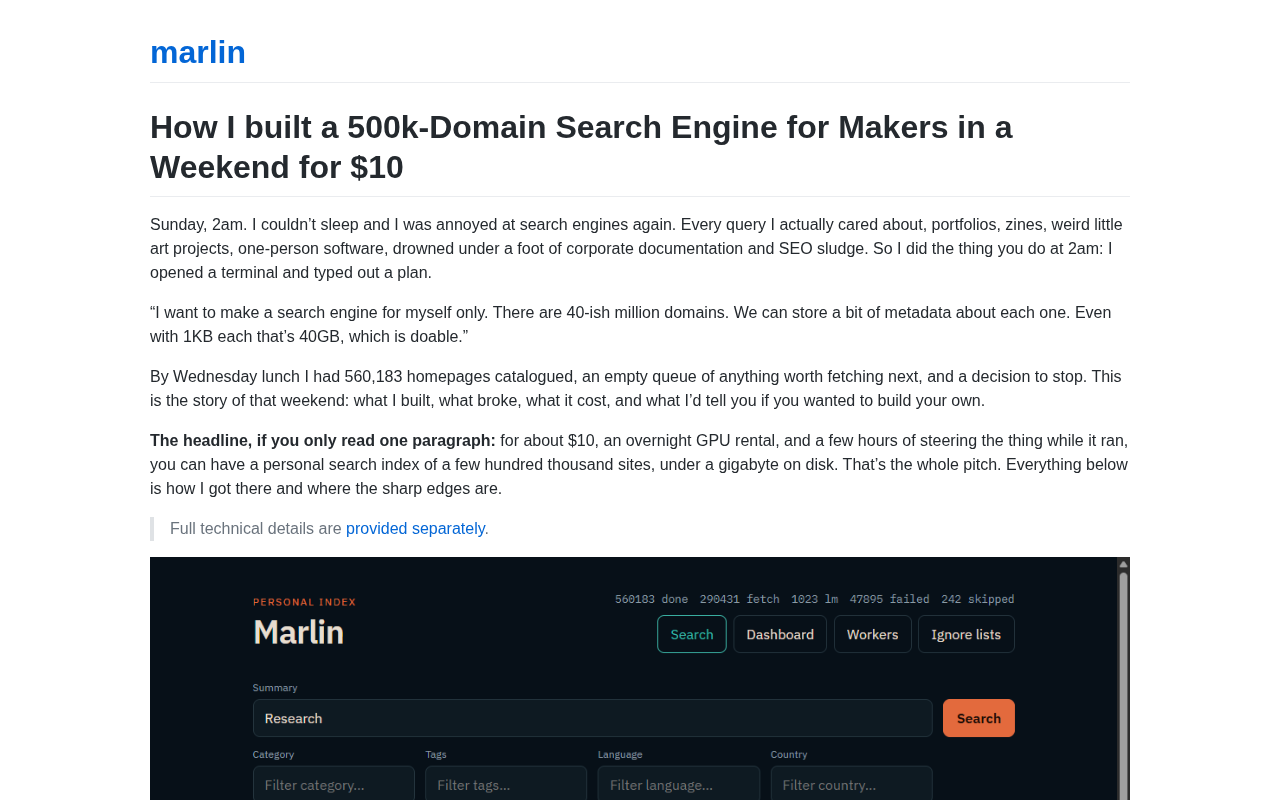
In the past, building a search engine at scale was considered "heavy lifting" requiring large engineering teams and expensive infrastructure investments. Now, a single person can crawl, index, and search 500,000 domains in their spare time for the price of a cup of coffee — a testament to the maturity of today's technology ecosystem.
Why a "$10-Level" Search Engine Is Possible Now
Infrastructure at Rock-Bottom Prices
The core enabler of such low costs is the continued decline in cloud computing and storage prices, combined with the widespread adoption of Serverless architecture. Serverless is a cloud computing execution model where developers don't need to manage server configuration, scaling, or maintenance. Instead, code is deployed as functions to cloud platforms (such as AWS Lambda, Cloudflare Workers, Vercel Functions). The system only spins up compute instances when requests arrive, automatically releases resources after execution, and bills based on actual execution time and invocation count. For tasks like web crawling — "batch execute then stop" — Serverless can compress costs to extremely low levels. The compute cost of 500,000 lightweight HTTP requests on AWS Lambda might be under $2. Developers pay only for what they use, consuming compute resources only during the crawling and indexing phases, avoiding the cost waste of traditional servers running 24/7.
For 500,000 domains, if you're only crawling homepage or core page metadata (rather than deep full-site crawls), the total data volume is quite manageable. Combined with the low cost of object storage and efficient inverted index data structures, the $10 bill makes perfect sense. An Inverted Index is the core data structure of search engines — unlike traditional indexes that map "from documents to words," it establishes a "from words to documents" mapping. For example, the term "indie development" maps to a list of all document IDs containing that term. This structure makes keyword retrieval approach O(1) time complexity rather than scanning all documents. For metadata indexing of 500,000 domains, the entire inverted index file might only be a few hundred MB, easily loadable into memory or queryable via SSD.
Combinatorial Innovation with Ready-Made Tool Chains
The success of projects like this typically doesn't come from building everything from scratch, but from cleverly combining existing tools. Multiple publicly available domain datasets exist on the internet, providing starting data sources for such projects. Examples include the Tranco List (a deduplicated domain list generated from multiple ranking sources), Common Crawl (a multi-billion page crawl dataset maintained by a nonprofit), and Zone files published by various TLD registries. Additionally, the Indie Hackers product directory, Product Hunt's historical launch data, and GitHub Pages custom domains can all serve as seed sources for filtering "Maker domains." The existence of these datasets means developers don't need to discover domains from scratch — they can perform targeted crawling and filtering based on existing lists.
For the search engine itself, open-source lightweight full-text search engines have dramatically lowered the technical barrier. Meilisearch is an open-source search engine written in Rust, known for sub-millisecond responses and zero configuration, suitable for small to medium datasets. Typesense similarly emphasizes ease of use, written in C++, marketed as "search that doesn't require a PhD to use well." SQLite FTS (Full-Text Search) is a full-text search extension for the embedded database SQLite — no additional service deployment needed, with a single file capable of hosting complete search functionality. For a weekend project, SQLite FTS might be the most economical choice — zero ops cost, deployable on any VPS.
The real value isn't in underlying technical breakthroughs, but in precise product positioning — targeting the vertical Maker community, filtering out noise from large commercial websites, and focusing on indie developers' projects, tools, and creations. This kind of "small but beautiful" vertical search actually delivers more practical value than general-purpose search engines.
Differentiation Opportunities for Vertical Search Engines
Blind Spots in General Search
In an era dominated by general search engines like Google, search needs in vertical domains are often overlooked. When indie developers want to discover similar indie projects, explore niche tools, or find inspiration, general search results are often drowned out by over-SEO'd commercial content.
Search Engine Optimization (SEO) is fundamentally the technical and content strategies websites employ to achieve higher rankings in search engines. However, once SEO became a massive industry, countless commercial sites manipulated rankings through keyword stuffing, backlink farms, and AI-generated low-quality content, causing sustained degradation of search result quality. Since 2024, "Google search quality deterioration" has become a widespread consensus in the tech community. Investigations by independent media like HouseFresh show that large media conglomerates' affiliate content dominates search results, squeezing out visibility for independent content creators. This is the fundamental reason vertical search engines have an opportunity.
A search engine focused on the indie developer ecosystem, through a carefully curated domain pool (e.g., sites from Indie Hackers, Product Hunt, personal blogs), can provide a "cleaner" and more targeted search experience. This is the persistent market gap where vertical search thrives.
Data Source Quality as a Moat
The most interesting aspect of such projects is this: the technical implementation can be replicated, but the quality and sourcing of the domain pool is the true differentiation barrier. How to define "Maker domains," how to continuously update and maintain the list, how to filter spam sites — these seemingly trivial operational tasks are precisely what determines the ultimate value of search results.
The Indie Developer's "Weekend Project" Philosophy
Fast Validation Over Perfectionism
The most valuable lesson from this project is the development philosophy it represents: validate an idea with minimal cost and shortest time. This concept originates from the MVP (Minimum Viable Product) concept in Lean Startup methodology. Eric Ries proposed this framework in 2011: rather than investing massive resources to develop a complete product based on assumptions, build a minimal version with core functionality first, launch it to gather real user feedback, then decide based on data whether to persevere or pivot. In the indie developer community, this philosophy has been further radicalized into "Ship fast, iterate later."
Rather than spending months polishing a "perfect" product, it's better to quickly build a working prototype over a weekend and release it to the community for real feedback. The Hacker News discussion (13 comments) is itself part of this feedback loop. Early users' suggestions, challenges, and usage experiences help developers quickly determine whether a direction is worth continued investment.
AI-Assisted Programming Further Lowers the Creation Barrier
It's worth noting that today's AI programming assistants further compress the development cycle for projects like this. Code generation, crawler script writing, data cleaning logic — all can be dramatically accelerated with AI tools. Using tools like GitHub Copilot, Cursor, and Claude as examples, developers can describe requirements in natural language, AI generates most boilerplate code and business logic, and developers only need to review and adjust. For common crawler project tasks like HTML parsing, data structure design, and API endpoint writing, AI tools can reduce hours of coding to minutes. This also explains why a "one weekend" time window is becoming increasingly realistic — the evolution of tool chains is continuously lowering the barrier to creation.
Limitations and Reflections
Of course, projects like this have obvious limitations. 500,000 domains is a drop in the ocean compared to the trillion-page scale of general search engines; without a continuous crawl-and-update mechanism, the index will quickly become stale; and the monetization path is far from clear. It's more of a proof of concept and portfolio piece than a sustainable business product.
But from another perspective, this is precisely what makes the modern technology ecosystem so fascinating: the cost of creation has never been lower. One person, one weekend, $10 — that's all it takes to turn an idea into a running product. Whether or not it ultimately becomes a business, this low-barrier experimentation capability is itself fertile ground for driving innovation.
Conclusion
The value of this "$10 search engine" project lies not in its technical complexity, but in the trend it reveals: as cloud infrastructure, open-source tools, and AI-assisted programming mature, indie developers' ability to build products that once required teams is growing exponentially. For every Maker with an idea, rather than watching from the sidelines, just start building — after all, your next weekend project might only cost a cup of coffee.
Related articles

Free Unlimited Claude Code Solution: Agnes AI + CC Switch Setup Guide
No paid subscription needed — pair the free AI platform Agnes AI with the open-source tool CC Switch to provide a backend for Claude Code, enabling unlimited free calls to text, image, and video models. This guide covers the full setup, test results, and usage boundaries.

A Complete Zero-Cost Guide to Getting Started with Claude Code for Beginners in China
A beginner's guide to Claude Code for users in China: two installation methods (command line and IDE plugin), full configuration steps for replacing the official API with the free domestic LongCat model, and a hands-on demo of building a small tool with natural language, plus tips.

When the NSA Gets Involved: The AI Supply Chain Crisis Behind Open-Source CVEs and API Key Hijacking
Multiple open-source projects disclosed severe CVEs in one day, PHP flaws alarmed the FBI, and Railway and OpenCode were breached with API keys stolen. This article breaks down the vulnerability window, AI-accelerated exploitation, and the AI supply chain crisis behind the API key black market, with a developer defense checklist.