Building a Daily Research Brief + Options Strategy Pipeline with Meta Muse: An AI Co-Pilot for Quant Traders

Use persistent Agent Muse to automate stock options research while keeping final judgment and risk confirmation in human hands.
Based on Bilibili creator ApexQuant's walkthrough, this article details how to build a personal equity options research pipeline using the persistent Agent Muse. Running in a dedicated Secure VM, Muse works continuously in the background with full awareness of your positions and schedule — fundamentally different from a chatbot. The four-layer architecture covers persistent operation, WhatsApp/broker MCP connections, daily brief and strategy draft field design, and hard execution limits via Sentinel permissions. Using Meta as a case study, the article breaks down the revenue-up/profit-down contradiction and explains how to verify options strategy drafts for numerical consistency. The core conclusion: the Agent eliminates repetitive labor; the human owns the final call.
Every morning you manually scan earnings reports, read the news, and calculate Greeks — the problem was never that you weren't working hard enough. It's that high-value judgment and low-value labor are hopelessly tangled together. This piece, based on content from Bilibili creator ApexQuant (顶点量化), isn't a tool unboxing. It's a complete research pipeline — using a persistent Agent to eliminate repetitive work, while keeping final judgment and risk confirmation firmly in your own hands.
Why Muse Is Not Just Another Chatbot
A typical AI is a one-shot interaction: you ask, it answers, and when you close the window, the context is gone. Muse is fundamentally different — it's a persistent personal Agent running inside a dedicated Secure VM with its own browser, capable of running continuously in the background. Close the app, and it keeps working.
More importantly, it knows your positions, your schedule, and the tickers you've discussed before. So what it produces isn't a generic news summary — it's research that fits your real-world context.
There's a mechanism here that's easy to overlook: the bottleneck in research automation was never how smart the model is. It's whether the model can continuously access your state. Positions, position limits, watchlists, earnings calendars — once these are persistent, the information density of your daily brief changes completely. But remember: its output is always a draft and a reminder, never a button press on your behalf.
Secure VM (Secure Virtual Machine) is an isolated computing environment separate from the host OS. When an Agent runs inside it, it can't be arbitrarily interrupted from outside, nor can it freely access other data on the host machine. This isolation serves two purposes: security — the Agent's browsing behavior and data reads are sandboxed, reducing risks like credential leakage or unauthorized access; and stability — background tasks don't get interrupted when you close the app or switch windows, much like a daemon process on a server. The key insight for everyday users: persistent execution isn't "longer conversation memory." It's a continuously alive compute process that can fetch earnings calendar updates while you sleep and organize overnight news before the open — without waiting for you to start a conversation.
Four-Layer Architecture: Permissions and Boundaries Matter More Than Prompts
The entire pipeline can be understood as four layers.
Layer 1 — Mechanism: Muse runs in a dedicated CPU VM in the background. This is what fundamentally distinguishes it from a chatbot.
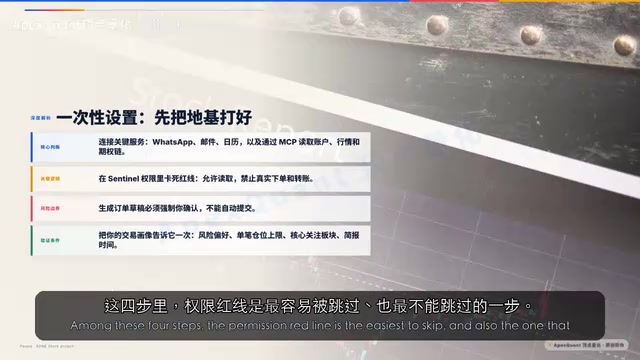
Layer 2 — Setup: Connect WhatsApp to receive briefs, pull events from email and calendar, read market data and options chains via broker MCP interfaces, then lock hard limits inside Sentinel permissions.
Layer 3 — Process: Define what fields the daily brief outputs, what legs the options strategy draft contains, which strike prices to use, and what Greeks and breakeven points to include.
Layer 4 — Boundary: All trading-related operations must follow a "recommendation + your final confirmation" model.
Of these four layers, permissions and boundaries matter more than prompts. The more capable the Agent, the more important it is to draw the fences first.
Calculate Your Time Savings with One Formula
Daily time saved = repetitive labor hours × automation coverage rate − manual review hours
Repetitive labor includes scanning news, compiling earnings dates, and calculating Greeks — tasks with clear inputs and outputs that are ideal for an Agent. Automation coverage depends on how many data sources you've connected — connecting one news feed versus connecting market data, earnings, positions, and options chains are two completely different magnitudes. Manual review time is the confirmation step you must preserve. It will never go to zero, and it shouldn't.
The real implication of this formula: if your review time hasn't decreased, your field design is too cluttered or your permissions are too loose — the Agent is just producing more things for you to read. The validation method is simple: log your manual time for three days, then log your review time for three days, and see which segment got compressed the most.
Permission Design: Open for Reads, Tight for Execution
Permission design is the most underrated part of this setup.
What the Agent is allowed to do: Read market data, earnings reports, positions, and options chains; organize news, earnings dates, and IV changes; generate strategy drafts and order previews; immediately push alerts for major events.
What the Agent is prohibited from doing: Any real order submission; any fund transfers or capital movements; automatically submitting orders without confirmation; reporting drafts as if they were already executed.
Of these four prohibitions, the last is the most subtle. Most automation failures aren't because the system actually placed a trade — they happen because the draft was written to sound like a completed transaction, leading you to believe your position had already changed. So the permission hard limits aren't just technical settings; they also manage your psychological expectations when reading the brief each day: reads can be wide open, execution must be locked down, and the confirmation step always stays on the human side.
You also need to tell it your trading profile once — for example: "US equity options retail trader, moderate risk appetite, single position not exceeding 5% of account, core focus on tech and semiconductors, need a research brief at 8 AM Beijing time and a strategy prep at 4 PM."
MCP (Model Context Protocol) is a protocol for standardized communication between AI models and external data sources or tools — think of it as a universal plug standard for Agents. Brokers, market data providers, and calendar services only need to implement the same interface, and the Agent can read from all of them without custom adapters for each source. In permission design, MCP's importance lies in its native support for tiered authorization of "read" vs. "write": you can give the Agent read-only access to market data and options chains while never exposing an order submission endpoint — blocking accidental trades at the protocol layer. This is the technical implementation of "open for reads, tight for execution" — the permission boundary isn't just a line in your prompt saying "don't place orders"; it means the capability simply doesn't exist at the interface level.
Brief Field Design Determines Reading Efficiency
The quality of a brief isn't determined by how much it says — it's determined by field design.
Field group 1: Yesterday's close, pre-market change, volume — a quick snapshot of price and liquidity. Field group 2: Latest key news, earnings date, IV change — viewing events and volatility expectations together, because options strategies are most vulnerable to event/volatility mismatches. Field group 3: Form 4 insider transactions and significant SEC filings — these signals often lead price, but require cross-validation; a single filing is never enough to draw a conclusion.
Present everything in a clean table, highlight anomalies, and include three key observations worth watching today. The critical mechanism: a brief isn't a news aggregator. It compresses "what happened" into "what to look at today." The more stable your fields, the faster you read. The more elaborate your fields, the more you'll start skipping them.
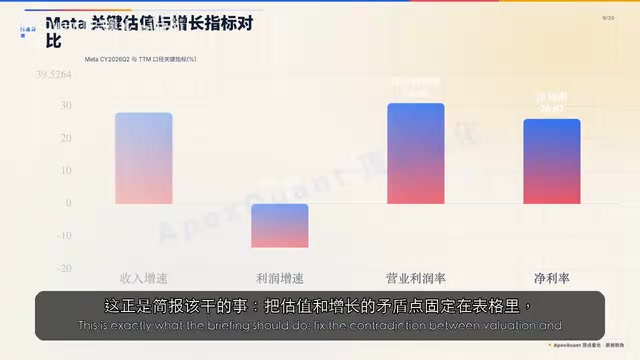
The Meta Case Study: Why This Type of Ticker Is Ideal for Automated Monitoring
Using Meta as an example, the creator highlights a classic contradiction. Revenue grew 28% YoY, operating margin was 30.88%, and net margin was 26.07% — core earnings power is clearly strong. But profit growth was −13.4%. Revenue up, profits declining — this typically signals accelerating costs or investment spend.
Core dashboard: price $736.6, market cap $1.88T, trailing P/E 27.93x, forward P/E 21.14x, EV/EBITDA 17.31x. Forward P/E below trailing P/E signals the market expects future earnings to improve.
Strong profits don't mean strong cash, so you need to check the free cash flow conversion ratio (FCF ÷ net income). Meta's TTM FCF is $21.55B, cash is $90.26B, debt is $112.32B — substantial cash reserves, but also meaningful debt and capex pressure. This metric lets you decompose the "declining profit growth" story: is it a demand problem, an investment problem, or a cash collection problem?
You don't need to recalculate these numbers every day. But you do need to know every day whether they've changed — that's exactly what the brief is for.
Options Strategy Drafts: Internal Consistency Beats Convincing-Sounding Arguments
When the Agent hands you a strategy draft, the most important thing to verify isn't how logical the argument sounds — it's whether the numbers are internally consistent.
Breakeven = strike price ± net premium. Add for long calls, subtract for long puts. For multi-leg structures, combine net premiums first, then calculate.
Three-step verification path: pull premiums for each strike from the options chain → calculate net premium → plug into the formula. Cross-check using max profit/loss against the breakeven point. If the Agent's Greeks run in the opposite direction from what you estimate off the options chain, trust the options chain and have it regenerate.
A complete draft must contain four pieces of information: specific legs and strike prices; Greeks, max profit/loss, and breakeven point; recommended position size and risk warnings; and — if no high-conviction opportunity exists — an explicit statement of "no quality strategy today."
That last one is the most counterintuitive but the most important. The biggest risk with an Agent isn't a bad strategy — it's a forced strategy, one manufactured just to complete the task. Explicitly allow it in your prompt to say "nothing today," or it will fill your screen with low-quality setups.
Don't Ignore the Volatility Environment
VIX fell from 16.45 at the end of June to 14.3 on September 23 — roughly −13% over three months and −19% over one week. This signals cooling fear and compressed volatility premium. For options strategies, this has two implications: the cost of buying protection is falling, improving the value proposition of protective hedges; selling volatility at these levels requires more caution, because when low vol gets punctured by an event, the rebound can be very fast. So when a draft suggests selling volatility, pay extra attention to max loss and margin requirements.

Greeks are a set of metrics measuring an option's price sensitivity to various variables, and they're the core tool for verifying a strategy draft's internal consistency. Delta measures how much the option price changes per $1 move in the underlying — directional judgment starts here. Gamma is the rate of change of Delta; near expiration or deep out-of-the-money, Gamma spikes sharply, meaning the margin for error on directional calls narrows dramatically. Theta represents daily time value decay — buyers "pay" Theta every day, sellers "collect" it. Vega measures the change in option value per 1% move in implied volatility (IV); the IV spike before earnings and the sudden IV crush after earnings are transmitted to option prices directly through Vega. The article's note that "if the Agent's Greeks run opposite to your options-chain estimate, trust the options chain" is essentially saying: Greeks must be reverse-engineered from real-time market prices, not forward-calculated from a theoretical model. When the two directions contradict, the draft's input data is stale.
VIX (CBOE Volatility Index) is calculated from the weighted implied volatility of S&P 500 index options, reflecting market expectations for 30-day volatility — commonly called the "fear gauge." VIX and market direction are typically negatively correlated: VIX spikes during sharp selloffs and retreats during calm rallies. For options traders, VIX represents the baseline level of the overall volatility premium — when VIX is low (e.g., around 14), individual stock implied volatility is broadly suppressed, making long option premiums cheaper but also thinning the premium collected from short options, compressing the margin of safety. Historically, rapid VIX recoveries from low levels (e.g., the "volatility meltdown" of February 2018, March 2020) often complete within days — which is exactly the context behind the article's warning to "pay extra attention to max loss and margin requirements" when a draft suggests selling volatility.
Fixed Timeline and Human-Machine Division of Labor
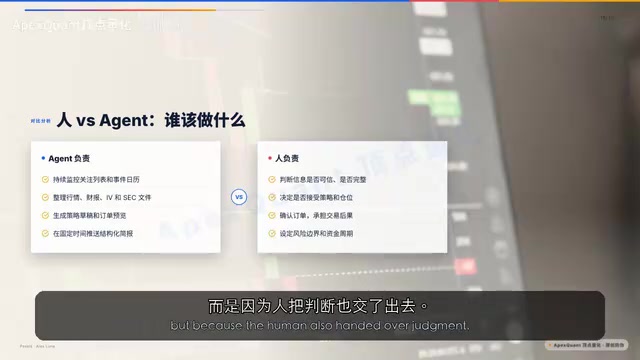
Automation only has rhythm when the timeline is fixed. Research brief pushed to WhatsApp at 8 AM Beijing time — you read and flag anomalies. Closing data auto-updated at 3:30 PM. Options strategy prep pushed at 4 PM — you confirm or reject the draft. Immediate urgent alert for any major breaking event.
The most critical column in this schedule is the "human action" column: read and flag at 8 AM, confirm or reject at 4 PM, judge whether to act on breaking news. The Agent's job is to put the right information in front of you at the right time. Your job is to make the decision at the critical moment.
The essence of the division: the Agent handles repeatable, verifiable, formattable labor; humans handle non-repeatable decisions that require weighing tradeoffs and accepting consequences. Most automation failures aren't because the Agent wasn't capable enough — they happen because the human handed over the judgment too.
Process Risks and Four Risk Control Hard Lines
The real thing to watch isn't market risk — it's process risk. The higher the automation, the more risk concentrates in a handful of points: data source quality (stale market data or earnings figures mean the draft is built on a false premise); permission boundaries (if reads and execution aren't separated, one misfire can become a real trade); confirmation fatigue (too many drafts pushed will shift you from careful review to habitual click-through).
The fix isn't less automation — it's narrowing your watchlist, standardizing output formats, and designing the confirmation step to be short enough to actually do carefully.
Four hard lines:
- All trading-related actions require your confirmation.
- Financial data must be cross-validated against official sources — especially insider transactions and SEC filings, which are easy to misread.
- It's not a backtesting engine or a high-frequency system; don't use it to validate historical strategies.
- Trading involves risk. The Agent is a tool, not a guarantee of any return.
Scoring Muse as a research co-pilot across six dimensions: information organization 90 (strongest), continuous operation 85, context memory 80, strategy drafting 75, execution safety 88, data cross-validation 65 (weakest). The conclusion is clear — hand it your strengths, keep its weaknesses for yourself.
Final Thoughts
The real efficiency gap isn't who's smarter — it's who first eliminates low-value labor from their day while keeping risk confirmation in their own hands. Muse's value is persistence and context, not one-shot Q&A. Hard lines must be explicit: reads open, execution locked. Brief quality lives or dies in field design. And contradictions like Meta's — revenue up, profits down — are exactly what automated monitoring should be built to catch.
Set up your trading profile, hard lines, and timeline first. Then drop in the prompt. The first run may need a few tweaks, but once it's dialed in, a custom research brief and strategy draft will appear on schedule every single day. Remember: risk management first, returns second.
Related articles
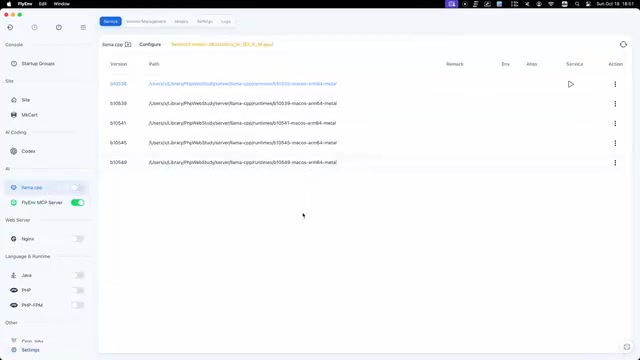
FlyEnv Plugin Review: Visually Running llama.cpp and Managing GGUF Models
FlyEnv launches the official llama.cpp plugin with side-by-side Metal runtime management, public GGUF repository indexing with file type labels, and visual configuration of context, threads, and GPU layers—saving templates and speculative decoding with each model for one-click local LLM inference.
How Can Frontend Developers Advance into AI Agent Development? Deconstructing System-Level Agent Architecture from OpenClaw
Starting from the OpenClaw demo in a Bilibili open class, this article breaks down the three-layer architecture and universal formula of system-level AI agents, and analyzes the path for frontend developers to enter agent development based on TypeScript, including plugin-based design and security/memory layer challenges, with an interview answer framework.
WorkBuddy in Action: How AI Agents Automate Batch File Conversion and Archiving
Bilibili creator Teacher Shanyao tests WorkBuddy vs. Doubao on batch file conversion, showing how AI Agents move from "giving solutions" to "direct execution," with a full workflow and credit cost reference.