WorkBuddy in Action: How AI Agents Automate Batch File Conversion and Archiving
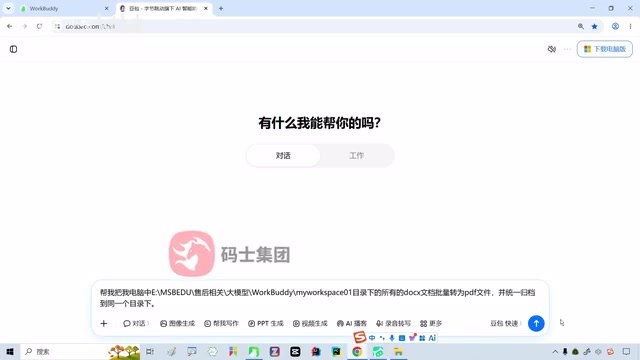
AI Agents give LLMs "hands and feet," autonomously converting and archiving Word files to PDF in seven minutes.
Using Bilibili creator Teacher Shanyao's test as a thread, the article compares ordinary LLMs with AI Agents. Although Doubao, ChatGPT, and similar products can understand requirements and generate complete Python scripts, they remain in an advisory role and leave file directories untouched. Agents like WorkBuddy, after user authorization, connect to the local file system and command line. Once a prompt is pasted, they autonomously scan directories, check the environment, perform conversion and archiving without intervention, and even catch environment errors to reinstall dependencies and adjust commands. Four Word documents were converted to PDF and archived in about seven minutes for 6.55 credits (new users receive 2,000 credits), with preview confirming identical content. The article stresses that the core change is AI moving from "answering questions" to "executing tasks" and from "giving suggestions" to "delivering results," while reminding users to control authorization scope and evaluate more advanced Agent products for complex scenarios.
From "Telling You How to Do It" to "Just Doing It for You": The Qualitative Shift of AI Agents
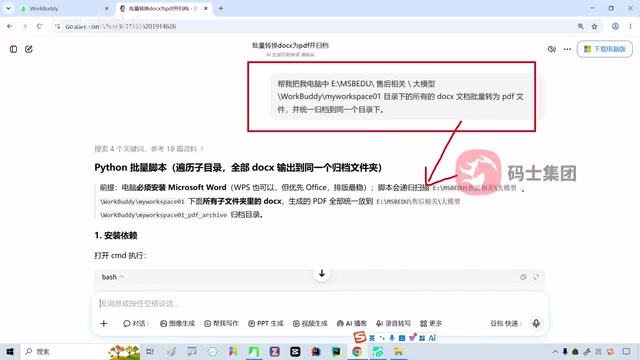
Mainstream LLM products (such as Doubao, ChatGPT, and DeepSeekAd) have already become deeply integrated into daily life. They can understand requirements, analyze problems, generate solutions, and even write complete Python scripts. But when your needs involve operating a local computer—for example, batch-converting all Word documents in a directory to PDF and archiving them—these tools can only play the role of "consultant." According to a demo by Bilibili creator Teacher Shanyao, when she sent the request to Doubao, it quickly provided a Python script and a step-by-step guide. The code was complete and the logic was clear, but the file directory remained untouched. Ordinary LLMs have a brain but no hands or feet.
This is exactly where AI Agents come in. As a type of AI Agent tool, WorkBuddyAd not only has the understanding and reasoning capabilities of an LLM, but also connects to the local file system, command line, and various tools through permission authorization, turning solutions directly into actual results. The creator tested the same requirement in WorkBuddy for comparison—batch-converting DOC/DOCX files to PDF and archiving them in the same folder.
AI Agent refers to a software system that uses a large language model as its reasoning core, can autonomously plan steps, call external tools (file system, command line, API, browser, etc.), and adjust strategies based on execution feedback to ultimately complete a target task. Compared with traditional conversational LLMs, the key difference of an Agent lies in its "Tool Use / Function Calling" and "looping decision-making" capabilities (the ReAct pattern: Reason–Act–Observe): the model no longer outputs only text, but outputs executable action instructions and then reads the execution results to decide the next step. Therefore, Agents require permission systems, sandbox environments, and error-handling mechanisms to ensure safety and reliability. The industry often describes capability levels as: conversation → retrieval augmentation → tool calling → multi-step autonomous execution, with Agents at the latter two levels.
Credit-based billing is a common usage metering method for current AI Agent products: token consumption from model inference, number of tool calls, execution time, and other factors are converted into unified credits, and users are charged according to actual consumption. Compared with fixed subscriptions, credit-based billing makes it easier to price high-cost long tasks differently and gives users an intuitive sense of task complexity.
WorkBuddy Hands-On Breakdown: Batch File Processing Completed in Seven Minutes
Authorization and Task Start
After pasting the prompt into the WorkBuddy interface, the system requests permission to access the local directory. After the user clicks "Allow Access," the Agent begins working autonomously: first scanning the files in the specified directory, then checking the runtime environment, and then performing conversion and archiving. The entire process requires no user intervention, and the interface displays the credits consumed in real time. The creator mentioned that new users receive 2,000 credits upon registration, and this task ultimately consumed 6.55 credits—a very low cost.
Self-Correction and Transparent Process
It is worth noting that WorkBuddy's execution was not entirely smooth. The creator observed that when a step failed due to an environment issue, the Agent actively caught the error and tried reinstalling dependencies or adjusting the command. This ability to "fix while doing" is exactly the core difference between an Agent and a pure conversational model—it enters a real working environment, faces real failures, and recovers autonomously. The entire process took about seven minutes, during which the user could simply scroll on their phone and wait.
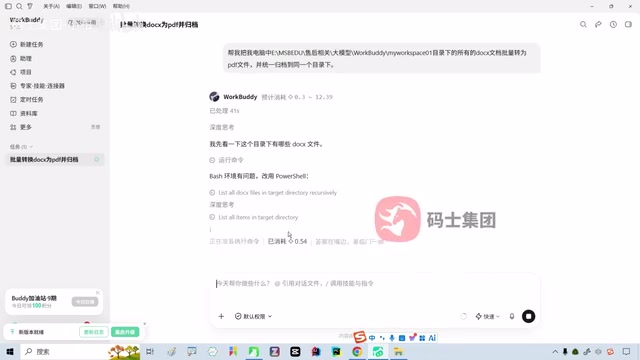
Self-Correction / error loop means that after executing an action, the Agent reads the terminal return code, error message, or logs, feeds the failure reason back into the model as new context, and lets it decide whether to retry, change the command, install missing dependencies, or adjust the path. The foundation of this mechanism is an "observable execution environment": command output and exit status codes must be returned to the model. It significantly improves task success rates, but also brings risks—the Agent may repeatedly attempt unauthorized or dangerous operations, so products usually set maximum retry counts, high-risk command interception, and manual confirmation checkpoints. Process transparency (collapsing and displaying thoughts and execution steps) is intended to let users audit every command call, balancing credibility and traceability.
Result Delivery and Preview
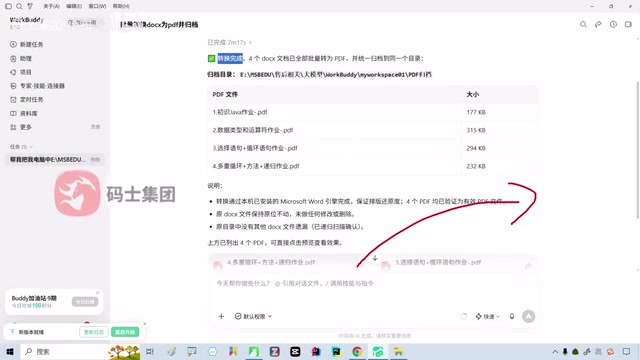
After the task is completed, WorkBuddy collapses and displays the complete thinking and execution process and provides a result preview. The creator opened the generated PDFs to confirm that the content matched the original DOCX files. All four files were successfully converted and archived in the specified folder with no omissions. From "giving suggestions" to "delivering results," WorkBuddy completed a full closed loop.
The Boundaries and Applicable Scenarios of AI Agents
In the tutorial, the creator frankly pointed out that WorkBuddy is not omnipotent. For complex work scenarios, more advanced Agent products may be needed. But its value lies in directly turning natural language requirements into local operations, eliminating the tedious steps of manually running scripts, troubleshooting the environment, and archiving files by hand. The referral credit mechanism (referring a new user earns 650 credits) also shows that the usage rate of such tools is rising rapidly.
The core change is this: AI is shifting from "answering questions" to "executing tasks," and from "providing suggestions" to "delivering results." For repetitive tasks such as batch file processing and automated office work, Agents like WorkBuddy can significantly lower the operational barrier. Users with zero foundation only need to describe their requirements clearly and wait for the results after authorization. Of course, users need to control the scope of authorization themselves and should be cautious about granting permissions when sensitive files are involved.
Practical Tips for Beginners
If you want to try it too, it is recommended to start with simple file operation tasks, such as batch renaming, format conversion, and archiving by type. Pay attention to credit consumption on first use and plan task complexity reasonably. WorkBuddy iterates quickly, and its interface and features may be updated at any time; refer to the actual version. For more complex automation workflows, you can gradually explore its command-line invocation and multi-step task orchestration capabilities.
Related articles
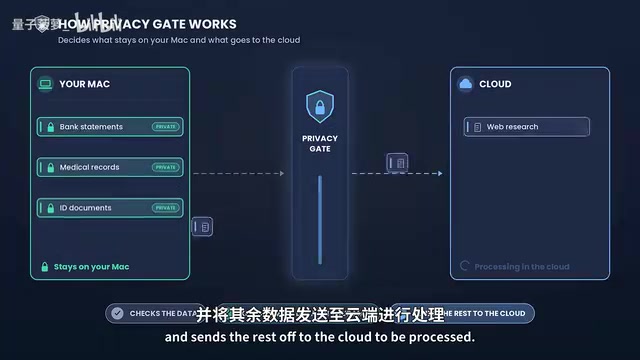
Perplexity Hybrid Compute Tested: Privacy Data Never Leaves the Mac
Perplexity Hybrid Compute tested: how PrivacyGate intercepts sensitive data, how local and cloud models divide work, model differences on 16GB vs 32GB Macs, and privacy protection in real scenarios like bank statements and medical records.
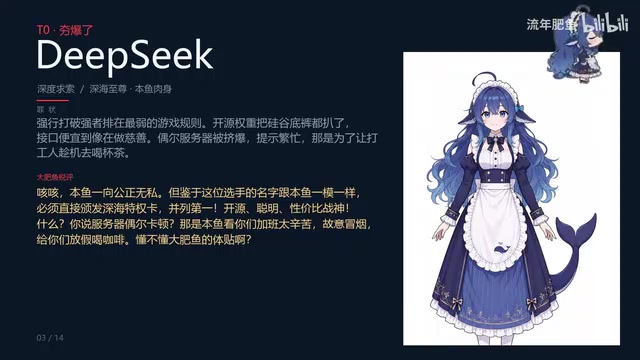
Big Fat Fish Roasts Mainstream LLMs at Home and Abroad: Doubao Takes the Crown, DeepSeek Tied for First
Bilibili creator Big Fat Fish roasts mainstream LLMs: Doubao tops for emotional value, DeepSeek ties first for open-source value, with ERNIE, Hailuo, Yuanbao, Kimi, Qwen, Kling, Claude, Gemini, and Grok each branded with a distinct persona.

How to Truly Test AI Agents Before Production? A Practical Testing and Monitoring Framework
BotGage founder Pramin Pradeep shares a three-step framework for testing AI Agents before production: Agent registration visibility, red teaming, and production observability — plus a real case cutting QA costs from $180K to $80K and an analysis of IT roles shifting to Agent supervisors.