How Can Frontend Developers Advance into AI Agent Development? Deconstructing System-Level Agent Architecture from OpenClaw
Deconstructing OpenClaw from a frontend perspective: Agent = Model + Planning + Memory + Tools, with TS leading the way.
Based on a Bilibili "frontend full-stack + AI" open class, this article uses the phenomenon-level product OpenClaw as a sample to break down the composition of system-level AI agents for frontend developers. It presents the universal formula "Agent = Large Model + Planning + Memory + Tool Use," draws an analogy with React's UI=f(state), and classifies agents into workflow, general-purpose, and vertical types. It then analyzes OpenClaw's three-layer architecture of CLI, Core, and Web, noting that pluginization (microkernel) is a common design and that MCP and Skills are variants at different abstraction levels. The instructor implements a simplified version in TypeScript and emphasizes that the real enterprise challenges lie in security sandboxes, long-term memory, and observability. Finally, it advises frontend developers to first master LangChain/LangGraph in TypeScript before considering Python, while Java occupies an awkward position in the AI application layer.
In a Bilibili open class, the instructor has spent several months focusing on "frontend full-stack + AI," and this time turned the spotlight on a phenomenon-level product, OpenClaw (formerly Clawdbot, renamed several times since). Rather than a product demo, this is an architecture breakdown aimed at frontend developers: what exactly makes up a system-level AI agent, and how frontend engineers can participate in—or even lead—the development of such products based on the TypeScript tech stack.
The Universal Formula for Agents: Model + Planning + Memory + Tools
The instructor repeatedly emphasized one judgment: no matter how complex agent products on the market appear, they all boil down to one formula—Agent = Large Model + Planning + Memory + Tool Use.
The value of this formula lies in lowering the cognitive barrier. The large model layer involves model selection across text, image, video, and digital human models; the planning layer corresponds to reasoning patterns like ReAct; the memory layer includes context storage and persistence solutions; and the tool layer extends to standardized protocols such as MCP and Skills. The instructor used the analogy of UI = f(state) from React source code: state drives view updates, just as the model drives agent behavior.
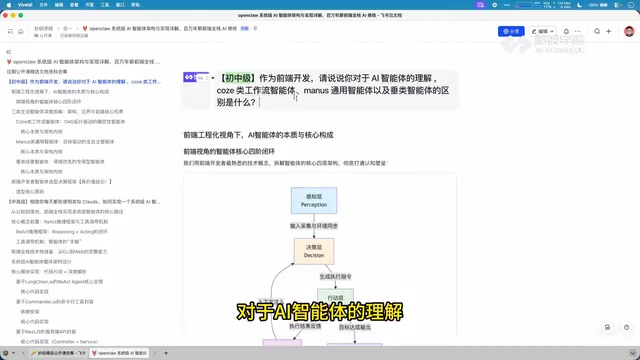
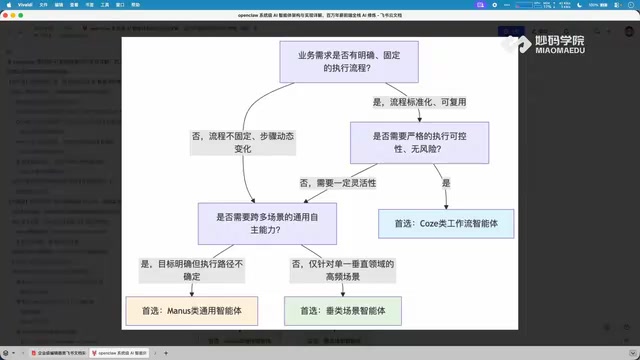
On this basis, agents are classified into three types: workflow agents (DAG-based orchestration, like the drag-and-drop nodes in Coze), general-purpose agents (relying on planning capabilities to autonomously decompose tasks, like Manus), and vertical agents (targeting specific domains, like CapCut's smart editing or Figma AI). When asked in an interview about "the difference between Codex and Manus," the anchor for your answer is this classification framework.
ReAct stands for Reasoning + Acting, proposed by Shunyu Yao et al. in 2022, and is one of the most mainstream reasoning paradigms in the agent planning layer today. Its core idea is to have the large model alternate between "Thought" and "Action": the model first outputs a reasoning passage explaining its current intent, then decides which tool to call and with what parameters, receives the tool's "Observation," and continues to the next round of reasoning until the task is complete. Compared with generating a complete plan upfront and then executing it (like Plan-and-Execute), ReAct thinks while acting and dynamically adjusts based on feedback, making it more suitable for scenarios with frequent tool calls and high environmental uncertainty. AgentExecutor in LangChain and the prebuilt ReAct graph in LangGraph are engineering implementations of this paradigm. Understanding ReAct helps grasp what the "planning layer" is really doing—it doesn't have the model decompose tasks out of thin air, but weaves reasoning and tool feedback into a loopable, interruptible, observable execution chain.
MCP (Model Context Protocol) was open-sourced by Anthropic in late 2024, positioned as "a unified communication protocol between models and external data sources and tools." Before MCP, connecting each tool (database, file system, third-party API) often required a custom adapter; as the number of tools grew, this created an M×N adapter explosion. MCP adopts a client-server model: tool providers implement an MCP Server to expose capabilities (resources, tools, prompts), and the agent side implements an MCP Client to discover and invoke them via a unified protocol, reducing adaptation cost to M×1+N×1. It is often likened to "USB-C for the AI era" or "the LSP (Language Server Protocol) of the tool world." Compared with Skills, MCP leans more toward low-level communication and capability discovery, while Skills lean more toward high-level capability encapsulation for specific tasks; the two can be stacked—Skills can absolutely call external tools via MCP internally.
The Three-Layer Architecture of System-Level Agents
Using OpenClawAd as a reference, the instructor presented a clear layering: CLI command-line layer, Core engine layer, Web interface layer. The CLI layer uses Commander to wrap commands like onboard and dashboard, handling service startup and initialization; the Core layer is the agent scheduling center, introducing models based on LangChain, registering tool plugins, and executing the reasoning loop; the Web layer is built on Next.js, communicating with the server via HTTP and WebSocket.
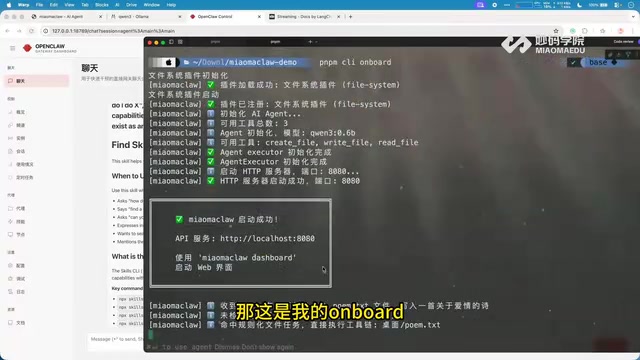
You may not have noticed the plugin-based design. The instructor showcased the file-system plugin set—including tools like createFile, readFile, and writeFile—dynamically registered through a plugin scanner. He considers this homologous to the plugin mechanisms of Webpack and Vite, both embodying the microkernel idea. In his view, Skills and MCP are merely variants of pluginization at different abstraction levels: MCP is a unified communication protocol for tools and data sources, while Skills are higher-level encapsulation of capability units; both serve the same purpose—letting the model know "what tools are available and how to call them."
The Difficulties of Building from 0 to 1: Security and Memory
The instructor fully implemented a simplified version of OpenClaw in TypeScript and pointed out that the real barrier to enterprise-grade deployment lies not in features but in several easily overlooked aspects. The security layer comes first: commands like rm -rf / must be intercepted in a sandbox. The memory layer requires vector storage and long-term memory persistence; otherwise, the agent cannot maintain context across sessions. There are also engineering issues such as observability and multimodal perception (visual document parsing).
On model selection, the instructor demonstrated pulling the Qwen 3.5-Cloud model with Ollama (free cloud inference) to drive the entire workflow: having the agent write a poem imitating Li Bai and save it to the desktop, then generating a chapter-by-chapter teaching deck based on that file. The whole process triggered file creation, content writing, and directory organization via chat commands, validating the closed loop of "model decision → tool execution → result verification."
Long-term Memory differs from ordinary conversation context in two key ways: whether it spans sessions and whether it is retrievable. History within the context window is lost when the session ends and is constrained by the token limit; long-term memory extracts important information and writes it to external storage, recalling it by relevance when needed. A common implementation is a vector database (such as pgvector, Milvus, Qdrant): text is converted into vectors via an embedding model, and at retrieval time approximate nearest neighbor (ANN) algorithms find semantically similar snippets, which are then stitched back into the prompt. Engineering also requires handling memory write strategies (what is worth remembering), deduplication and updates (how to overwrite when the same fact changes), layering (short-term working memory vs. long-term factual memory), and forgetting mechanisms. This is why the instructor emphasizes that the memory layer is the barrier to enterprise-grade deployment—it determines whether an agent can "understand you better the more you use it," rather than being just a single-turn Q&A tool caller.
Technical Path Choices for Frontend Developers Entering AI
The instructor's advice to frontend developers is quite clear: master TypeScript first, then consider Python. The reason is that both LangChain and LangGraph have TS versions with consistent concept systems, and the engineering experience frontend developers already have (pluginization, microkernel, state management) can be directly transferred. Once the business logic is thoroughly understood, switching languages is just a syntax-level cost.
Regarding Java's position in AI application development, he considers it rather awkward: frameworks like Spring AI and LangChain4j lag in updates, and in many companies the Java layer has gradually degraded into a BFF middle layer that calls Python scripts underneath. For frontend developers, Node.js BFF + TS agent engine + Next.js interface is a cost-controllable advancement path.
Image captions: The screenshots in this article are from the Bilibili open class demo, corresponding respectively to the agent architecture explanation, the CLI startup flow, and the project code structure.
One-line Summary
Deconstructing OpenClaw from a frontend perspective: Agent = Model + Planning + Memory + Tools, and TS can lead the way.
Paragraph Summary
Based on a Bilibili "frontend full-stack + AI" open class, this article uses the phenomenon-level product OpenClaw as a sample to break down the composition of system-level AI agents for frontend developers. It first presents the universal formula "Agent = Large Model + Planning + Memory + Tool Use," draws an analogy with React's UI=f(state), and classifies agents into workflow, general-purpose, and vertical types. It then analyzes OpenClaw's three-layer architecture of CLI, Core, and Web, pointing out that pluginization (microkernel) is a common design and that MCP and Skills are merely variants at different abstraction levels. After implementing a simplified version in TypeScript, the instructor emphasizes that the real enterprise challenges lie in security sandboxes, long-term memory, and observability. Finally, it offers technical path advice: frontend developers should first master LangChain/LangGraph in TypeScript before considering a move to Python, while Java occupies an awkward position in the AI application layer.
Related articles
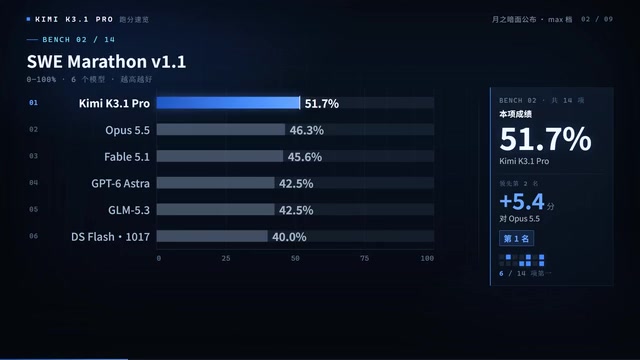
Kimi K3.1 Pro Benchmark Results Revealed: First Place in 6 of 14 Tests, Coding Nearly Catches Opus
Kimi K3.1 Pro benchmark results: first place in 6 of 14 tests, field-task coding 51.7 beats Opus, terminal combat 65.7 just 0.7 behind, hallucination rate drops from 23.4% to 8.3%, high-speed version supports million-token context with open weights planned.

Dutch Government Allegedly Hacked Kushner's Phone: The Hidden Tech-Geopolitical Battle
Dutch government allegedly hacked Kushner's phone, sparking nearly 200 comments on Hacker News. This article analyzes the rumor from three angles: technical attack paths, allied intelligence games, and information credibility, exploring why mobile device security has become the frontline of geopolitical games.

New Alzheimer's Finding: Restoring Sleep Without Clearing Brain Plaques
New Alzheimer's research suggests restoring two hours of sleep can improve function without clearing amyloid plaques, raising questions for sleep intervention and drug R&D.