Building a Native Desktop App for Coding Agents with Rust + GPUI: Technology Choices and Trend Analysis

A native desktop app for coding agents built with Rust and GPUI signals the trend toward high-performance AI dev tools.
A developer has built a native desktop application for coding agents using Rust and GPUI, the GPU-accelerated UI framework from the Zed editor. This project reflects a growing trend toward native performance in AI programming tools, leveraging Rust's memory safety and zero-cost abstractions alongside GPU-rendered interfaces to meet the demanding requirements of autonomous coding agents that need deep system access and efficient resource management.
A Technical Experiment Worth Watching
Recently, a developer posted their creation on Hacker News: a native desktop application purpose-built for coding agents, using Rust and GPUI as the technology stack. While this "Show HN" post hasn't generated extensive discussion yet, the technology choices and product direction behind it reflect a trend worth exploring in the current AI programming tools ecosystem—how to provide higher-performance, system-level runtime environments for increasingly prevalent coding agents.
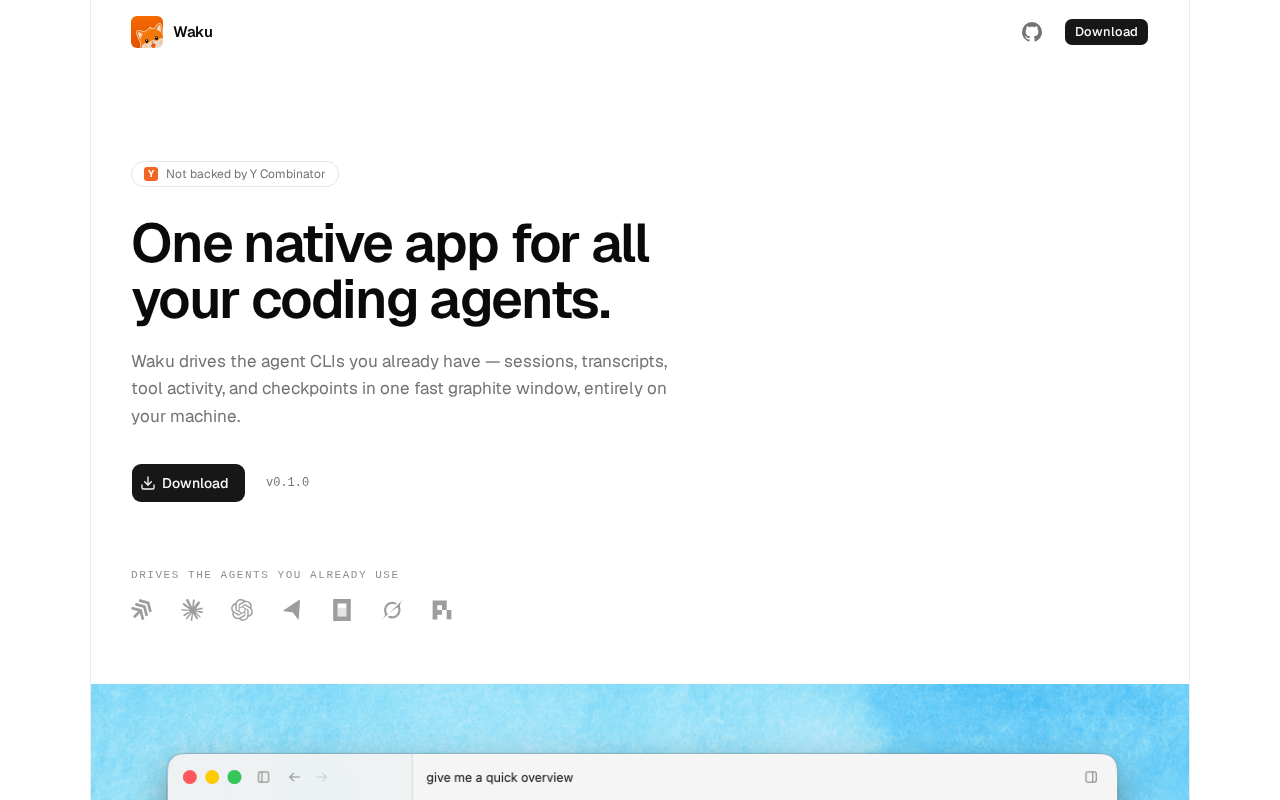
As AI-assisted programming evolves from simple code completion to autonomous "agents" capable of executing multi-step tasks, the clients hosting these capabilities are undergoing a fundamental architectural restructuring. The coding agents mentioned here represent the latest evolution in AI-assisted programming—unlike traditional code completion tools (such as early versions of GitHub Copilot that only provided line-level suggestions), coding agents possess the ability to autonomously plan and execute multi-step tasks. They can understand high-level requirement descriptions, automatically decompose them into subtasks, and independently complete code writing, file modifications, test execution, and even debugging. Representative products include Devin, Claude Code, OpenAI Codex, and others. The core shift in this paradigm is from "assisting humans in writing code" to "autonomously completing coding tasks," transforming the human developer's role from executor to reviewer and guide. This application was born precisely in this context.
Why Choose Rust and GPUI for Building Coding Agents
Rust: Dual Guarantees of Performance and Memory Safety
The developer's choice of Rust as the core language is no accident. Coding agents frequently need to read and write files, monitor code changes, and interact with local processes and external APIs during execution, which places high demands on memory safety and concurrency handling. Rust's ownership mechanism eliminates a vast number of memory errors and data races at compile time while maintaining near C/C++ runtime efficiency.
Specifically, Rust's Ownership mechanism is its core innovation distinguishing it from other systems programming languages. Each value can have only one owner at any given time, and the value is automatically freed when the owner goes out of scope. Combined with Borrowing and Lifetime rules, the compiler can statically verify memory safety at compile time, avoiding common C/C++ memory errors like dangling pointers and double frees, without introducing the runtime overhead and unpredictable pauses that come with garbage collectors in languages like Java and Go. This is particularly important for desktop applications that need to run for extended periods and perform frequent IO operations, as memory leaks gradually accumulate during long-running processes and lead to performance degradation.
For a desktop application that needs to run persistently in the background while continuously processing agent tasks, the stability and resource efficiency brought by this "zero-cost abstraction" is especially critical. Compared to similar tools built on Electron and other web technology stacks, native Rust applications typically achieve order-of-magnitude improvements in memory usage and startup speed. It's worth noting that Electron is a cross-platform desktop application framework developed by GitHub that bundles the Chromium browser engine with the Node.js runtime, allowing developers to build desktop applications using web technologies. Well-known applications like VS Code, Slack, and Discord are all built on Electron. Its advantage lies in high development efficiency and good cross-platform consistency, but the cost is that each application embeds a complete browser instance—a typical Electron application idles at 200-500MB of memory, while a native application with equivalent functionality might only need 20-50MB. For scenarios that need to run alongside coding agents that already consume large amounts of memory loading code context, this additional overhead becomes non-negligible.
GPUI: A GPU-Accelerated UI Framework from the Zed Editor
Even more noteworthy is the UI layer choice—GPUI. This is a GPU-accelerated user interface framework open-sourced by the team behind the well-known code editor Zed, written in Rust, achieving fluid interface responsiveness through direct GPU rendering calls.
From a technical architecture perspective, GPUI is a UI framework designed from scratch by the Zed team for building high-performance editors. Traditional desktop UI frameworks (such as Qt, GTK) primarily rely on the CPU for interface drawing, while GPUI maps the rendering pipeline directly to GPU shaders, leveraging the graphics card's massively parallel computing capabilities for text rendering, window composition, and animation effects. Its architecture adopts an Immediate Mode rendering philosophy, redescribing the entire UI tree each frame while the framework automatically handles differential updates. This design has clear advantages in scenarios like code editors that require rendering large amounts of text with low-latency response, maintaining fluidity at refresh rates above 120Hz.
GPUI's design philosophy is to offload UI rendering to the graphics card as much as possible, maintaining a smooth experience even in complex interfaces and high-frequency refresh scenarios. Choosing GPUI means this application pursues native-level performance from the rendering layer up, rather than settling for merely "functional." This also reflects the growing recognition of GPUI as an emerging Rust UI framework within the developer community.
What Native Applications Mean for Coding Agents
The mainstream AI programming tools on the market today, whether IDE plugins or standalone clients, are mostly built on cross-platform web technologies. This approach is quick to start with and flexible to iterate, but has inherent limitations when it comes to deep integration with local development environments and system resource control.
The core value of coding agents lies in "autonomous execution"—they need to read entire codebases, run tests, invoke compilers, and manage multiple concurrent tasks. These operations are highly coupled with the operating system, and a native application can:
- Access the file system and processes more directly, reducing latency and permission restrictions introduced by intermediate layers;
- Control resource scheduling more precisely, maintaining overall system responsiveness while agents execute long-running tasks;
- Provide system-native interaction experiences, such as native window management, keyboard shortcuts, and notification mechanisms.
From this perspective, building a native application with Rust + GPUI is a tailor-made technical response to the coding agent paradigm, rather than simply re-skinning existing tools.
Industry Trends Reflected in AI Programming Tools
While this project is still in its early stages, the direction it represents has forward-looking significance. Over the past year or two, we've seen an increasing number of development tools returning to native technology stacks: the Zed editor itself is the flagship of this trend, and various applications extending from the GPUI ecosystem continue to emerge.
The explosion of AI programming has further amplified the demand for performance. When agents need to process massive code contexts and respond to user commands in real time, the efficiency of the underlying framework directly determines the ceiling of user experience. The maturity of the Rust ecosystem—especially the existence of the Tokio async runtime—also empowers individual developers to independently build complex desktop applications that previously required entire teams.
Tokio is the most widely used async runtime framework in the Rust ecosystem, providing event-driven non-blocking IO, task schedulers, and rich async primitives. For coding agent applications, Tokio's value lies in its ability to efficiently handle hundreds of concurrent operations simultaneously—such as monitoring file change events, waiting for LLM API responses, and executing background compilation tasks—without creating a separate thread for each operation. Its work-stealing scheduling algorithm automatically balances load across CPU cores, ensuring optimal utilization of system resources. Tokio has become the de facto standard for Rust networking and systems programming, with its ecosystem encompassing HTTP clients (reqwest), WebSocket support (tungstenite), database connection pools, and a complete toolchain. Combined with tens of thousands of community libraries on crates.io, independent developers now have unprecedented productivity leverage.
A Sober Perspective: The Distance from Prototype to Product
It should be noted that this is still a "Show HN" stage project with limited community feedback. Advanced technology choices don't equate to product maturity. From a technical proof-of-concept prototype to a tool that developers actually adopt in their daily workflows, there's still a long road ahead—including stable integration with mainstream large model services (APIs provided by OpenAI, Anthropic, Google, etc.), engineering optimization of context management (how to efficiently organize project information within limited token windows), multi-platform support (GPUI's support for Windows and Linux is still being refined), and most critically, validation of real-world utility.
However, for developers following the evolution of AI programming tools, the significance of projects like this lies in demonstrating the boundaries of what's technically possible. When native performance, Rust's safety guarantees, and the autonomous capabilities of coding agents combine, future development tools may take on forms radically different from what we see today.
Conclusion
Building a native application for coding agents with Rust and GPUI is a technical practice aligned with current trends. It addresses the real need of AI agents for deep control over local resources while following the industry movement toward native tools pursuing ultimate performance. Although the project is still in its early stages, the thinking behind it deserves attention from every developer watching the future of AI programming.
Key Takeaways
Related articles

Uber Deploys ChatGPT Work Company-Wide: AI in the Workplace Enters the Scaled Implementation Phase
Uber deploys ChatGPT Work to 30,000+ employees, extending it from engineering to all roles. We analyze its expert-engineer pairing, end-to-end automation, and questions of AI control and power concentration—insights for scaling AI in the workplace.

Shift at Midnight Hands-On: When "ID Verification" Becomes Alien Hunting
Shift at Midnight blends ID verification with horror survival in a four-player co-op game. We break down its inspection mechanics and chaotic humor.

Zelensky Recounts the Outbreak of War: I Need Ammunition, Not a Ride
Zelensky recalls the first day of war in a YouTube interview: farewell to family, rejecting Biden's evacuation offer with "I need ammunition, not a ride," and how Bucha shaped his stance on compromise and peace talks.